
Sanitation Is a Team Sport: Building a Culture of Clean in Food Processing
.avif)
Table of contents

Share:


Sanitation Is a Team Sport: Building a Culture of Clean in Food Processing
Sanitation is the foundation of food safety, quality, and trust. In any food processing plant, dirty surfaces, improperly rinsed equipment, or residual contaminants can lead to microbial growth, cross-contamination, and even deadly foodborne illnesses. Such failures not only threaten consumer health but also result in recalls, reputational damage, and costly downtime.
The Canadian Food Inspection Agency (CFIA) reported 2,754 consumer food-safety complaints in the 2024-2025 reporting year, a significant increase from the 1,918 complaints logged just two years earlier. Although nearly 99.4% of food samples tested in recent CFIA microbial-pathogen surveys were "satisfactory," there were still unsatisfactory (0.1%) and investigative (0.5%) findings, all of which could have resulted in a foodborne illness.
In the CFIA's 2024-2025 departmental report, 85.8% of non-compliant inspected food establishments resolved their issues by a follow-up inspection. That means nearly one in seven establishments remained out of compliance; a reminder that even in a highly regulated environment, proper sanitation remains a persistent challenge.
At Weever, we've worked with Fortune 100 manufacturing companies for over a decade to deploy 5S programs that improve organization, standardization, and sustain behavior change. In lean manufacturing, 5S stands for Sort, Set in Order, Shine, Standardize, and Sustain. When applied to sanitation, 5S helps ensure that cleaning tools are properly stored (Set in Order), used only where appropriate to avoid cross-contamination (Shine), and that the processes are documented and repeated reliably (Standardize and Sustain). By embedding 5S discipline into sanitation routines, teams build the habits and visual cues needed to maintain a safe environment over time.
Best Practices for Sanitation in Food Processing
Based on our experience working alongside world-class manufacturers, here are some key strategies to maximize sanitation effectiveness and sustain it.
Harness the power of operator-led sanitation - Don't outsource sanitation solely to a specialist crew. When equipment operators take ownership of cleaning, you expand capacity and tap into valuable insights. Operators know precisely how the equipment works, where food residue can hide, and which steps could be optimized. Empowering operators to clean and sanitize their own lines increases scalability and fosters accountability. But to make this work, management must supply time, training, materials, sanitizers, and clean water. Software tools can guide cleaning protocols, verify compliance, and reinforce correct methods.
Document every step with SSOPs - Standard Sanitation Operating Procedures (SSOPs) are your blueprint for consistency. Every cleaning activity should be recorded in a detailed, accessible protocol that ensures operators follow the same steps, enabling success to be replicated. These documents should specify the correct chemical to use, its concentration, contact time, application method, and rinsing procedure. Using the wrong dilution or skipping a step can render sanitation ineffective, risking contamination or regulatory non-compliance. Detailed documentation also makes it easier to spot deviations, investigate root causes, and identify continuous improvement opportunities.
Make resources instantly accessible - Cleaning regimes can be technical: different compounds, pressure settings, and temperatures all matter. Even well-trained operators can forget details, especially in high-stress situations or when performing infrequent tasks. Rather than relying on bulky binders or paper manuals, deliver your instructions in real time via digital checklists, mobile dashboards, or on-screen prompts. Real-time access to precise instructions helps ensure every sanitation task is done correctly and without delay.
Train thoroughly and regularly - Proper onboarding of new operators is crucial, but so are ongoing refreshers for seasoned employees, coaching for all employees, and hands-on demonstrations. Training encourages employees to understand how to clean and why it matters, underscoring sanitation's role in preventing foodborne pathogens, protecting consumers, and preserving brand integrity. Equipping your workforce with both the knowledge and context helps drive compliance and engagement.
Establish a robust cleaning schedule with verification - A regular cleaning cadence is vital to your sanitation program. Develop a calendar that defines what needs cleaning, how often, who is responsible, and how to verify completion.
Critical tools such as metering pumps should be routinely calibrated based on your food safety team risk assessment or Hazard Analysis and Critical Control Point (HACCP), which identifies, evaluates, and controls potential biological, chemical, and physical hazards from production to consumption. Calibration frequency should be documented, and the rationale logged.
Beyond that, verify cleaning through environmental monitoring, swabs, or ATP testing, which can rapidly measure adenosine triphosphate, a molecule found in all living cells. By swabbing a surface and using a specialized kit, the presence of organic matter from microorganisms or other living things can be detected through a bioluminescent reaction, providing a quick check on the effectiveness of cleaning protocols. Regular monitoring ensures the cleaning program is effective.
Safely use the right chemicals - Not all sanitizers are created equal. Use food-plant-approved cleaning agents, and train your team on how to dilute, apply, handle, and store them safely. Misuse of chemicals can lead to residue, ineffective sanitation, and even safety risks. Safety protocols and chemical handling procedures (PPE use, first-aid measures) must be part of your SSOPs and training.
Use audits to improve and sustain results - Sanitation programs should be treated like any process improvement initiative: Run periodic internal audits to check whether procedures are being followed, identify gaps, and assess efficiency. Encourage operators and sanitation staff to report abnormalities and suggest improvements. Use the Plan-Do-Check-Act (PDCA) cycle to trial changes, measure ROI, and standardize improved practices. Update SOPs with your new, better approach to training and sanitization.
Motivate employees - Cleaning is hard, often thankless, but essential work. Use recognition, rewards, or incentive programs to spotlight employees' efforts. Broadcast sanitation KPIs on dashboards to show how sanitation contributes to overall operating efficiency, recall prevention, and product quality. Visibility helps people feel their work matters, fostering a culture of ownership and pride.
Continuous improvement - Although many think of production when discussing continuous improvement, it applies equally to sanitation efforts. Document process anomalies, suggestions, or near-misses. Use these insights to run PDCA improvement projects. Measure and benchmark against your sanitation baseline, then update SSOPs, retrain, and communicate wins. Sustainable improvement ensures your sanitation program evolves and scales with your operation.
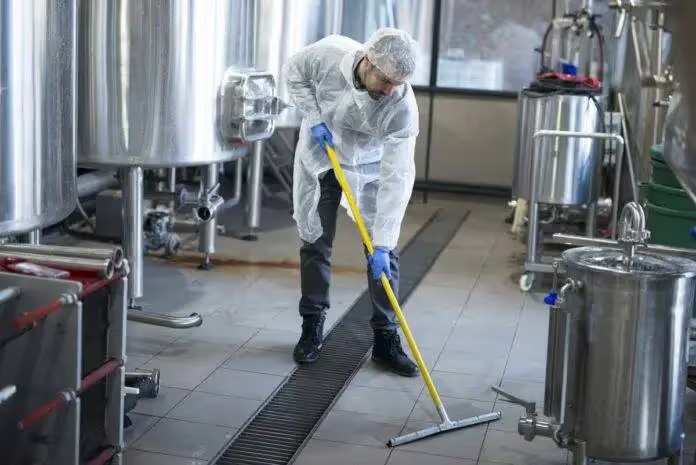
Use visual cues to prevent cross-contamination - Minimize the risk of cross-contamination with clear, visual controls. Have dedicated cleaning tools such as mops, scrubbers, buckets, and hoses exclusively for sanitation and color-code them. For instance, red could be for restrooms, blue for food-contact areas, and green for non-food zones. This simple 5S-aligned practice (Shine and Set in Order) makes it obvious which tools go where, reduces the risk of mixing, and reinforces discipline.
Sanitation As a Strategic Asset
Sanitation in food processing should be a strategic lever for food safety, operational efficiency, and continuous improvement. At Weever, our work with major manufacturers has shown that combining an operator-led sanitation model with 5S principles, digital tools, and a culture of continuous improvement yields not only safer products but also better productivity and team engagement.
By documenting procedures, providing effective training, offering real-time access to resources, and motivating your teams, you create a sanitation program that's resilient, scalable, and reliable. With internal audits, PDCA cycles, and visual controls, you don't just maintain standards, you raise them.
Building a sanitation program that is proactive, participatory, and built around continuous improvement is more critical than ever. When done right, sanitation protects people, reinforces trust, and safeguards your bottom line. Let Weever help you make it one of your competitive advantages.
.webp)

Spend Less Time on Admin. More Time Improving Operations.
See how Weever automates data entry, reporting, and action items so you can focus on improvement not admin.