
How to Reduce Equipment Downtime in Manufacturing
Table of contents

Share:


Your TPM program is up and running. Staff training is complete, CIL schedules are set, your team is logging defects, and you've even moved the line status to “AM Step 3.” So why does unplanned downtime continue to cost U.S. manufacturers an estimated $50 billion per year, with equipment failures alone causing 42% of those incidents? In most manufacturing plants we work with, reducing equipment downtime has nothing to do with the maintenance plan or the people executing it. It's a data problem, and it's hiding in plain sight.
Why unplanned downtime happens, even when your maintenance plan looks fine
Most equipment downtime-reduction strategies are based on a reasonable assumption: if the autonomous maintenance (AM) program is solid and the team follows it, equipment reliability will improve. But there's a gap most programs don't account for — the space between what the records show and what's actually happening on the floor. And that gap is bigger than most teams realize.
In our experience reviewing autonomous maintenance programs in CPG, food and beverage, and automotive manufacturing facilities, managers have usually implemented thorough equipment inspection processes, and the teams are doing everything they're supposed to.
The problem is that when your AM program runs on paper forms, physical boards, and spreadsheets, you can't trust what the records tell you. Completion rates look fine, but nobody can verify whether those checks were actually done at the machine or filled in later at the board. Defects are documented, but without automatic ownership or follow-up, many sit unresolved for weeks. The CI Manager knows the numbers don't tell the full story. They just don't have a better source.
That's what causes equipment issues to persist from shift to shift. It’s only when a machine breaks down that the problem becomes impossible to ignore. But research from McKinsey shows that manufacturers who implement digital tools across their operations can see 30–50% reductions in machine downtime. We're going to show you how.
7 practical ways manufacturers can reduce equipment downtime
Major manufacturers experience an average of 25 unplanned downtime incidents per month, resulting in roughly 27 hours of lost production time. In most cases, solving this challenge doesn't require rebuilding your AM program. But you do need to fix the data problem underneath it. Here are seven practical ways to make that happen:
1. Make CIL checks evidence-based, not just completion-based
Pencil-whipping doesn't happen because operators deliberately cut corners. It happens because the system makes it easy and offers no way for anyone to verify the work. In most plants that run AM on paper, the board where operators record CIL checks is separate from the equipment they're supposed to be inspecting.
This means an operator can flip a card on the board at the end of a shift without being near the machine, and a supervisor reviewing the record has no way to tell the difference. On the surface, completion rates look fine, but the data can't be trusted.
To make your CIL checks evidence-based, you need three things:
- A digital timestamp that confirms when the check happened and where
- Photo evidence that documents what the operator actually found on the equipment
- A guided digital checklist — launched from a QR code at the machine — that confirms the operator completed the check at the asset, not back at the board
When your CIL records include this level of detail, supervisors trust that tasks were completed correctly, and maintenance can proactively address issues that could lead to equipment failure before they escalate.
2. Bridge the equipment defect loop from discovery to closure
Finding an equipment defect is only half the job. The other half is making sure someone fixes it before it becomes a production problem. That's where most AM programs break down.
Let's say an operator notices a leak, a worn component, or another issue that's clearly not right. In most plants, the typical process is to attach an F-tag to the machine and record the issue in a paper log, on a board, or in a spreadsheet. But without the ability to automatically assign an owner, set a due date, or receive a notification when someone actually fixes it, the issue can easily get buried. Weeks can pass without the CI Manager knowing whether anyone acted on it at all.
What makes this situation worse is that even when the maintenance team knows about the defect, they often can't act on it. That's because a paper log or board entry rarely captures what they actually need. Without a photo, precise location, or context on when the problem began, maintenance has to either track down the original operator who identified it in the first place or make a judgment call with incomplete information. In many cases, the defect sits open because no one has enough detail to close it confidently, and without a clear owner, no one is accountable for resolving it.
This breakdown in follow-through causes another problem. When operators report defects and hear nothing back, they conclude that reporting is pointless. Participation drops, and the abnormality management process — the primary early-warning system for equipment failures — collapses from within.
To close the defect loop, you need a system that does three things automatically the moment an operator logs a defect:
- Assigns a clear owner with a due date
- Sends reminders that follow the issue across shift handoffs
- Notifies the right people when — and only when — someone confirms the fix
As we mentioned earlier, the system also needs to capture the right information at the point of submission, such as a photo, the specific asset and component impacted, and enough context for maintenance to act without having to track anyone down.
Pet food manufacturer, Royal Canin, did exactly this. After implementing the right tool, they cleared a backlog of more than 300 open AM abnormalities and reached a 95% corrective action closure rate across more than 6,000 monthly submissions.
3. Match your autonomous maintenance schedule to real production conditions
A CIL schedule that doesn't reflect what's actually happening on the floor creates more than just extra admin. It corrupts your completion data.
When a line goes down unexpectedly, the CIL schedule doesn't adjust. Tasks keep appearing for equipment that isn't running, and operators either skip them or rush through checks on idle machinery. Either way, your completion data stops reflecting reality, and the CI Manager ends up spending time in the next leadership meeting explaining why the numbers look worse than they are instead of actually driving improvement.
To keep your completion data accurate, you need production-aware scheduling — a system configured to do two things automatically:
- Suppress CIL tasks when a line goes down
- Resurface them when production resumes
When your schedule works this way, your completion data reflects real execution. A completion rate of 95% actually means 95%. And if a task shows as missed, it's because someone actually missed it on running equipment — not because a line was down and the schedule didn't adjust.
4. Give your operations team real-time visibility into equipment risk
In most AM programs running on paper, the only way to understand what's happening across your lines is to physically walk the floor. There's no dashboard showing what's overdue, no alert when a check is missed, and no automatic flag when a defect has been sitting open for days. The CI Manager finds out what happened last week by pulling data from spreadsheets and boards that operators filled in hours after the fact.
What makes this situation worse is that whatever information does exist tends to live in different places. Maintenance sees open work orders in the CMMS or SAP, operations sees the AM board, and quality has its own tracking system. By the time someone manually assembles the full picture, defects have aged, and the window to intervene has already closed.
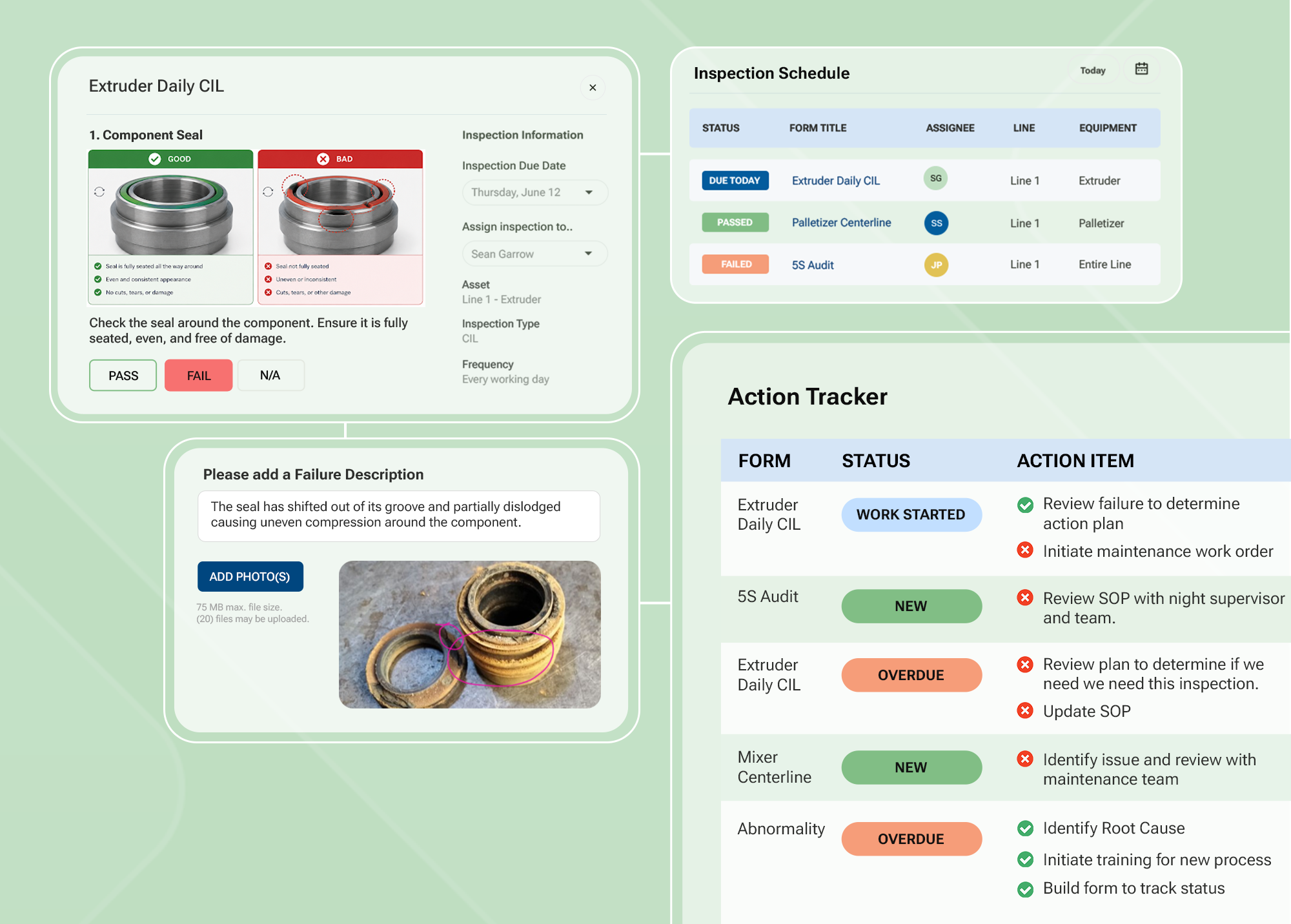
To give your team real-time visibility, you need a live dashboard that automatically surfaces CIL completion rates, open defects, overdue checks, and participation trends across every line and shift, without anyone having to build a report. Specifically, it should:
- Flag missed CIL checks the moment they occur
- Escalate defects that have been open too long to the right owner
- Surface recurring patterns on the same line or machine before they become breakdowns
When your team has a real-time view of AM performance across every line and shift, the transition from reactive to proactive maintenance happens naturally. And that shift is what actually reduces machine downtime over time.

5. Track the leading indicators that actually predict equipment failures
It’s common for plants to track metrics like MTBF, OEE, and downtime frequency. These are all important to measure. But by the time they start to deteriorate, the problems that caused them have usually been building for weeks. That's why relying on these numbers alone means you're always reacting to failures rather than preventing them through planned, preventive maintenance.
To get ahead of these problems, you need to shift your focus to leading indicators — metrics that show you whether your AM program is working before equipment fails. Specifically, you need to automatically track:
- CIL completion quality — not just whether checks were done, but whether they were done at the machine with evidence you can trust
- Defect closure rate and average time from issue to confirmed fix — which verifies whether your corrective action process is actually closing the loop
- Repeat issues on the same equipment — which tells you whether fixes are holding or the same problem keeps resurfacing
- Schedule attainment against running equipment — which shows whether your completion data reflects real execution or scheduling noise
When your team can predict equipment failures before they happen, you can protect production output, reduce maintenance costs, and minimize the unplanned downtime that can cost your manufacturing plant up to billions each year.
6. Bridge the gap between your enterprise systems and frontline operations
Most manufacturers already have enterprise systems in place, whether that's SAP, a CMMS, an OEE platform, or some combination of all three. And on the surface, it's reasonable to assume these tools are enough to manage your AM program. The problem is these tools were built for people who plan and manage maintenance, not for the operators who perform it:
- SAP and CMMS platforms manage formal maintenance jobs — work orders, scheduling, inventory, and planned maintenance tasks. But their complex interfaces weren't designed for operators who need to complete quick, routine checks dozens of times every shift on the floor.
- OEE platforms automatically track machine performance — measuring speed, availability, and output. But they don't provide a way to record whether an operator actually performed a lubrication check, inspected a component, or flagged a defect. They track machine output and performance, not the hands-on work operators do to keep equipment running.
That gap — the space between your enterprise systems and what operators are actually doing on the floor — is exactly where your AM data breaks down. Your team logs defects in one system and tracks them in another. Maintenance works from a different list than operations. And your CMMS plans maintenance based on records that don't accurately reflect the equipment's actual condition.
To get accurate, verified, real-time data flowing from the floor into your enterprise systems, you need a tool built specifically for operators — one that integrates directly with your existing tools. Specifically, it should:
- Work on shared devices on the manufacturing floor without complex logins
- Capture timestamped CIL completion data with photo evidence at the point of work
- Route defects directly into SAP work orders without duplicate entry or manual handoffs
The goal is to give your operators a tool that works on the floor and feeds the systems you already rely on, rather than ripping and replacing everything you’ve put in place.
7. Implement a digital AM tool built for the floor, not the boardroom
If you've been through a failed digital AM rollout before, you already know how it goes. Vendors show leadership impressive-looking dashboards and reports, and everyone signs off. Then the tool reaches the floor, and it doesn't work the way operators actually need to do their jobs.
Before long, the team finds their own workarounds — shadow systems, makeshift binders, spreadsheets — just to fill the gaps. They're not trying to resist change. They're just trying to make the tool work because it was chosen for the boardroom, not for how they operate. The culture is not sustained.
To ensure operators can actually use the digital system you put in place, it has to be faster and easier than the way they typically work. Specifically, this means they can do things like:
- Scan a QR code at the machine and pull up the right checklist instantly on any shared tablet or phone — no personal login, no app to install, no navigation required
- Follow embedded instructions and capture required photos at each step, so every operator completes the check correctly, regardless of experience level
- Flag a defect and automatically trigger a workflow that assigns an owner, sets a due date, and tracks it to completion
When a tool integrates with existing frontline operation processes and allows operators to perform their tasks more easily, they adopt it without being pushed. Similarly, when new operators can complete a CIL correctly on their first shift, they can provide immediate value because the guidance is built into the form rather than stored in someone's head.
Case in point: one global CPG manufacturer we worked with saw a 500%+ increase in genuine AM participation after implementing our software because operators were actually performing checks.
Getting Started
Implementation best practices that don’t disrupt how your team works
Once you've decided to reduce equipment downtime by digitizing your AM program, how you roll it out matters just as much as the tool itself. At Weever, we use our proven ADAPT framework to help frontline manufacturing teams get up and running without disrupting how their teams already operate. Here's how it works.
A- Assess how your AM program actually runs on the plant floor - Before configuring anything, take time to understand how work actually happens on the manufacturing floor. Don't just map out the process in a slide deck. Examine real behavior, where operators juggle tasks under time pressure, and supervisors spend half their day chasing updates. That understanding shapes everything that follows.
D - Digitize the manufacturing processes that already work, rather than redesigning them - The most common mistake plants make is trying to improve the program and digitize it at the same time. Instead, take your current CIL routines, check sequences, and asset hierarchy, and translate them directly into digital forms. This allows the process your operators already know to stay intact. The only thing that changes is how the data gets captured — accurately, in real time, at the machine.
A - Align the digital system to how your plant actually runs - No two plants run the same way, and your digital system needs to reflect that. Before you go live, identify where you will position tablets or phones, how operators will access shared devices across shifts, which checklist steps are relevant for each asset, and how defects will flow into your existing maintenance workflow. The goal is a system that feels natural from day one. Otherwise, operators will just find workarounds.
P - Prepare for plant-wide adoption by starting small - Start with one high-impact line or area — usually the one causing the most pain — and ensure operators are using the digital system you’ve put in place. When the tool makes their job easier, adoption takes care of itself. That early success builds the confidence and momentum to expand across other lines, shifts, and sites.
T- Tune and improve your AM program as you go - Once your team is using the new digital system consistently, shift your focus to continuous improvement. Real-time data can show you where execution is slipping, which lines are generating recurring concerns, and where defects are sitting too long. Because the data reflects what's actually happening on the floor — and isn’t reconstructed after the fact — the improvement cycle can easily transition from reactive repairs to proactive planned maintenance decisions.
How Weever fixes the data problem causing unplanned equipment downtime
Reducing equipment downtime starts with trusting your AM data. But when your program runs on disparate paper forms, physical boards, and spreadsheets, it's impossible to solve this problem.
That's why we built Weever — a connected worker platform designed specifically for how plants actually run. It gives you and your team the accurate, real-time AM program data you need, so equipment issues are caught before they cause unplanned downtime, significant production losses, and unnecessary costs.
Built for the manufacturing floor
Weever is built around how your team actually operates, rather than forcing them to change how they work. It runs on shared tablets and phones, across multilingual crews, without a personal login or an app to install. QR codes at each machine launch the right CIL checklist instantly, so operators get to the right procedure at the right time without any navigation. For plants with diverse workforces, multilingual forms and visual guidance mean every operator can participate fully regardless of language. And when Wi-Fi drops, Weever works offline and syncs automatically when connectivity returns.
AM execution that actually closes the loop
The two biggest data trust problems in AM are checks that can't be verified and defects that never get resolved. Weever addresses both. Digital CIL checklists mirror your existing maintenance procedures, adding timestamps, photo evidence, and conditional logic that shows operators only the steps relevant to the equipment they're working with. This makes it structurally harder to pencil-whip a check because the record has to be created at the asset, with evidence, at the time it happens. When a check fails, or an operator finds a defect, the system automatically creates an action item with a clear owner, a due date, and escalation rules that track the issue through shift handoffs until someone confirms the fix.
Real-time AM performance visibility that drives action
In most AM programs, the only way to know what's happening is to physically walk the floor or wait for someone to compile a report. Weever replaces that with live dashboards that show CIL completion rates, open defects, overdue checks, and performance trends across every line and shift, without anyone having to build a report.
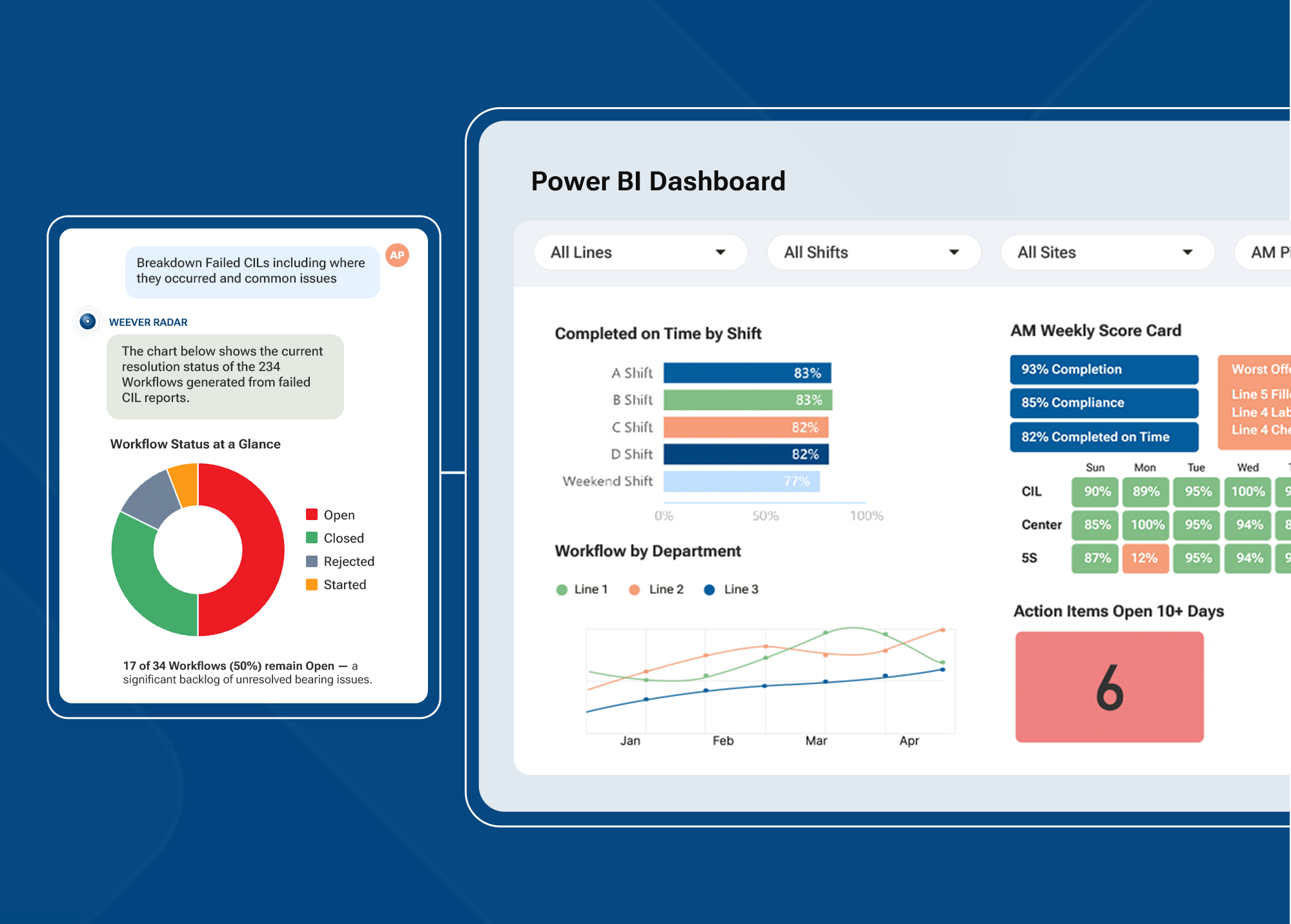
When a check is missed, the system flags it. When a defect has been open too long, it escalates automatically. The right people get notified immediately, rather than finding out at the next shift handoff or in a weekly meeting.
Because Weever is built to complement your existing systems rather than replace them, your CIL standards, processes, and workflows remain in place. For plants already running SAP or CMMS, Weever integrates via API so defects flow directly into work orders and execution data feeds into the dashboards your leadership team already uses, including Power BI: no duplicate entries, and no separate workflows.
This means your maintenance team can spend less time reacting and more time building equipment reliability.
Results that speak for themselves
Plants that implement Weever see results quickly:
- One global CPG manufacturer increased AM participation by 500%+ and completed more than 3,000 CIL and centreline reports in the first 8 months
- Mars Fort Smith achieved an 89% completion rate for abnormalities addressed and corrected
- A Maintenance Manager at a global CPG company recovered 30% of his working day — time previously spent on spreadsheets and manual data entry — and redirected it to improvement work
- Royal Canin cleared a backlog of more than 300 open abnormalities and reached a 95% corrective action closure rate across more than 6,000 monthly submissions
None of these plants rebuilt their AM program from scratch. They just used Weever to close the gap between their documented AM program and what was actually happening on the floor.
Reduce equipment downtime in your manufacturing plant with an AM program your team can actually trust
If you can't trust your AM data, you can't reduce equipment downtime. See how Weever provides the real-time, verified data you need so your team can catch equipment issues while there's still time to act.



Spend Less Time on Admin. More Time Improving Operations.
See how Weever automates data entry, reporting, and action items so you can focus on improvement not admin.