
Paper Logs vs Electronic Logs in Manufacturing: Should You Make the Switch?

Table of contents

Share:


If you're considering switching from paper logs to electronic logs in your manufacturing plant, we know this is a big decision.
After all, paper is familiar. You've already designed forms, binders, and other tools for capturing essential information, the team knows the routine, and programs run according to the processes you've put in place.
But you also know paper has a cost. It shows up in the hours you spend on admin instead of on the floor, the audit findings that keep coming back because corrective actions never actually close, and the days spent hunting for records scattered across binders, clipboards, and spreadsheets.
That's why we put together this article. We'll walk you through the real cost of paper logs, what the right electronic log system actually delivers, and what switching looks like, so you can make the right call for your plant.
How paper logs and electronic logs compare in manufacturing
The choice between paper logs and electronic logs might seem like a minor operational detail. But how you capture and manage information across your programs affects everything from daily floor visibility to audit readiness. Here's how the two approaches stack up across six areas that matter most to manufacturing operations leaders.
Paper Logs vs. Electronic Logs
Data capture at the point of work
When plants rely on paper-based systems, operators often record data away from the point of work — filling in forms, initialing boards, or completing packets at a central location or from memory at the end of a shift. No matter how the information is captured, it ends up scattered across formats, making it impossible to see the full picture or take the right action.
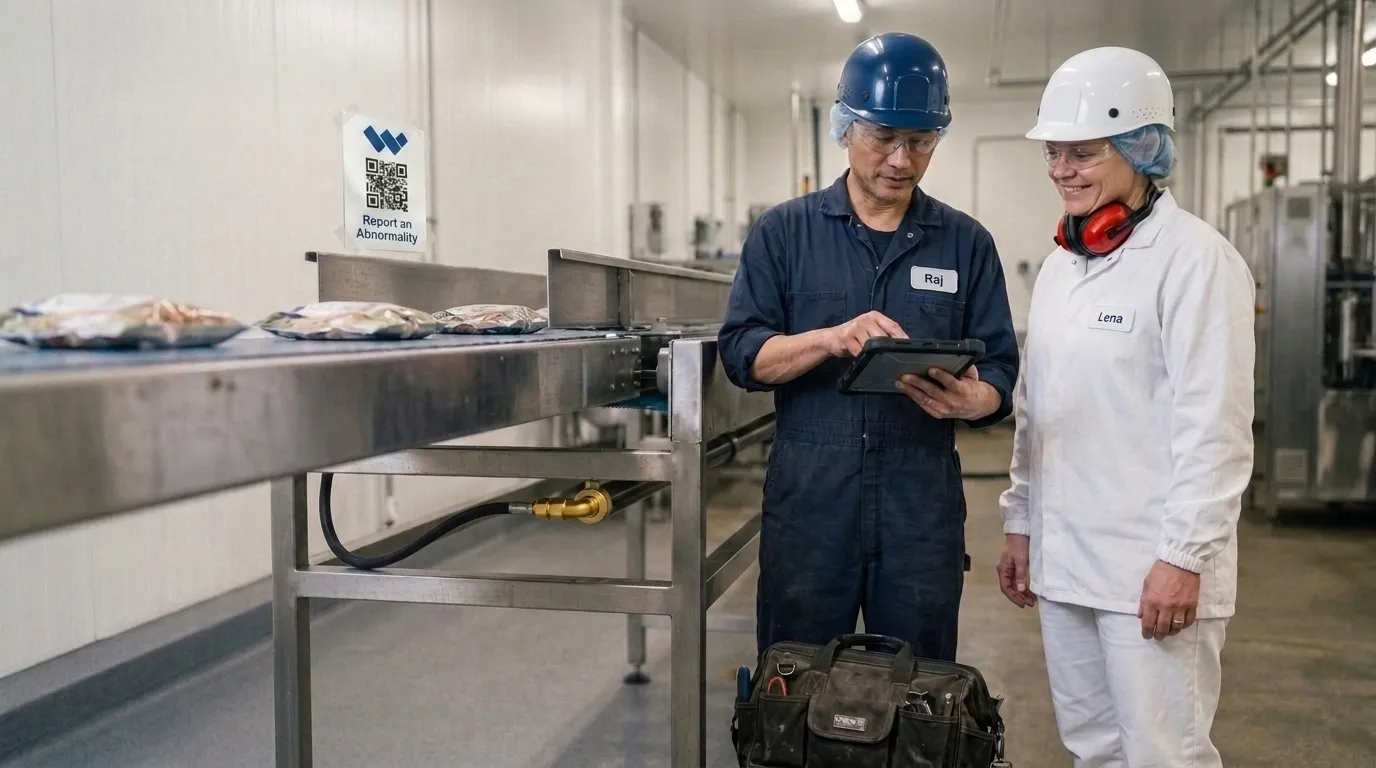
With the right electronic system, operators scan a QR code at the workstation to pull up the correct digital form on any shared device. The log is created at the point of work, and supervisors can see the information that was submitted the moment it happens, without waiting for binders to come back at the end of the shift.
Error log potential
Paper logs create two error points. The first occurs at the point of capture, where operators can skip fields, create difficult-to-read entries, or accidentally damage records in wet production environments. The second happens during transcription, when someone re-enters that handwritten data into a spreadsheet or report. That two-step process is where errors compound. And when errors accumulate across shifts and weeks, they surface as audit findings, signaling to regulators that your corrective actions aren't working.
In contrast, the right electronic system captures data once at the source, with required fields and validation rules that prevent submissions with missing or invalid entries. There is no transcription step required, so the data remains accurate from the moment it's recorded.
Information visibility across the plant and sites
With paper logs, information is buried across binders, packets, and whiteboards. Even when managers track down the data they need, it reflects what happened last shift or last week, not what's happening in real time. By the time anyone realizes there's a problem, it's often been occurring for days.
The right electronic system works differently. Completion data flows into live dashboards the moment teams record information, so plant managers and operations leaders can instantly see overdue tasks, trending deviations, or areas where programs are falling behind. That data can also feed directly into the reporting tools leadership already uses, so it doesn't create another system to check. The result is a single, real-time view of what's happening across every line, shift, and site without anyone having to compile a report.
Follow-up on flagged issues
When an operator flags an issue in a paper log, resolving it depends entirely on someone remembering to follow up. Someone might transfer it to a spreadsheet, mention it at the next handoff, or email a supervisor. But without a clear owner, due date, or reminder, it can sit unresolved for weeks — sometimes months — before anyone notices it hasn't been closed.
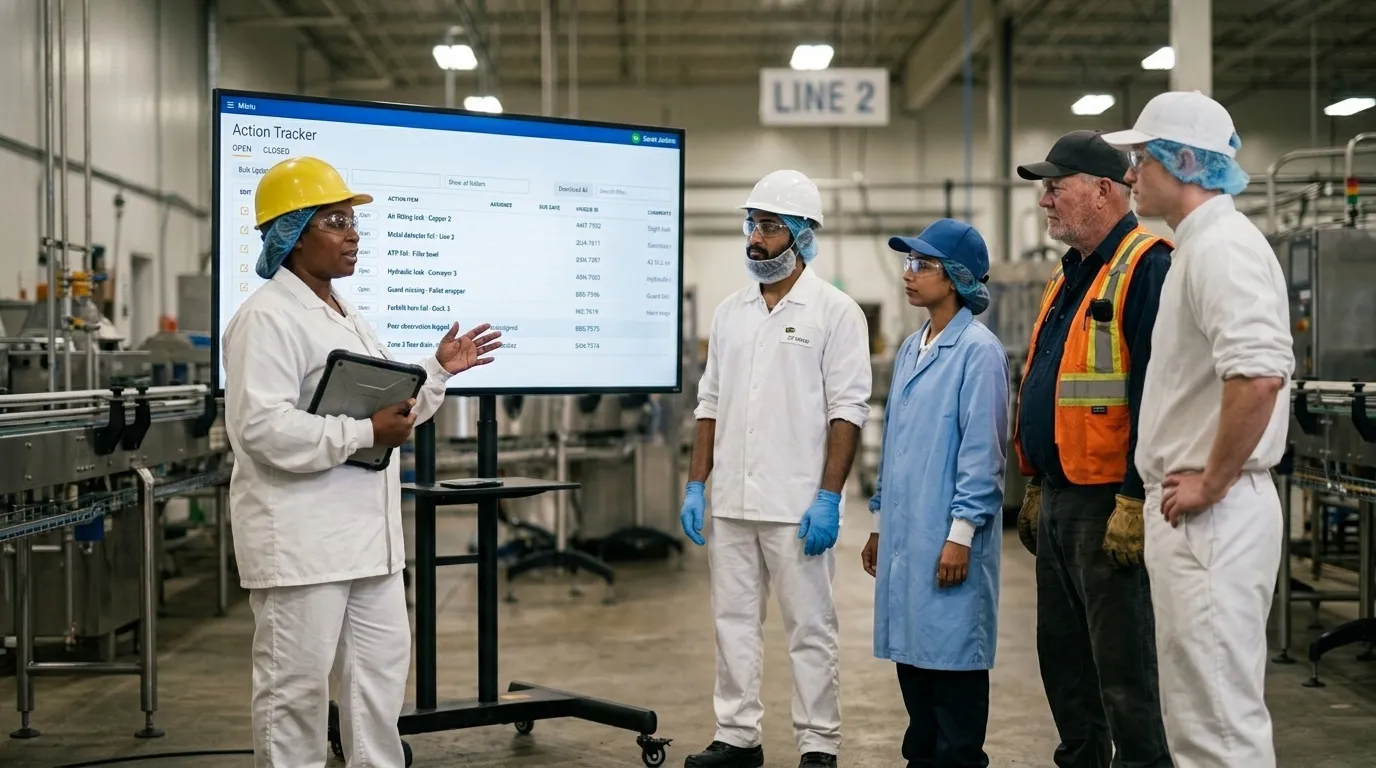
Compare that to the right electronic system, where corrective actions are automatically assigned a named owner, a due date, and follow-up reminders. Operations leaders can see which issues are open, who is responsible for resolving them, and how long they've been sitting without having to ask.
Scaling and standardization
When plants rely on paper logs, every new line, shift, or site that’s added requires printing more forms, maintaining more binders, and reconciling more spreadsheets. Every facility also tends to develop its own version of the same program, which means corporate leadership has no way to compare performance or govern programs consistently across the business.
However, the right electronic system lets you roll out a single standardized version of the program across every line, shift, and site without increasing administrative overhead. Corporate leadership can compare performance across facilities at any time, rather than waiting for each plant to manually compile reports.
Audit readiness
Before an audit, paper-based programs require days of manual assembly. The logs are often incomplete, illegible in places, or lacking the traceability an auditor needs. And because action items often don't close reliably on paper, the same findings come back cycle after cycle.
The right electronic system takes the scramble out of audit prep. Electronic logs automatically build audit trails as work happens, with every task timestamped and every corrective action tracked to closure within the same system. If an auditor asks about a specific issue on a specific date, the electronic logs provide that information down to the minute.
Why paper feels like the safe choice (and what that assumption misses)
Most manufacturing plants use paper logs because that's how it's always been done. Switching can feel like an unnecessary risk when programs are already running.
But staying on paper isn't as safe as it seems. On the surface, paper-based systems appear to run smoothly, but the reality on the floor often differs. As we've mentioned, paper-based systems have inherent challenges: operators record information away from the point of work, corrective actions often go unresolved, and records are incomplete.
In fact, the gap between paper logs and reality on the floor is often larger than it appears because individuals find workarounds for known issues. For example, supervisors might tape laminated sheets to equipment listing steps the MSS doesn't cover, pass instructions verbally at handoffs that never make it into any official record, or even keep handwritten notebooks to record details the official forms don't capture. These informal systems work until the supervisor who built them leaves, or until an auditor asks for documentation that exists only in someone's personal records or memory.
What paper-based manufacturing programs are actually costing your plant
Most manufacturing operations leaders we’ve worked with have never totaled the actual costs of their paper-based programs, so they’re often surprised to see the numbers. Here's where the expenses add up:
Manager and supervisor time lost to coordination
Sanitation managers who run Master Sanitation Scheduling (MSS) on paper spend an average of 933 hours a year (roughly 23 working weeks) on the administrative work generated by the program, such as printing packets, collecting binders, chasing signatures, reconciling spreadsheets, and following up on corrective actions [Weever Sanitation Gap Report, 2026]. CI Managers, safety leads, and supervisors across your other programs absorb the same kind of overhead. And this prevents them from spending time on what they were actually hired to do: coaching operators, making process improvements, and catching problems early enough to prevent equipment downtime, failed audits, and product holds.
Errors and incomplete records create compliance exposure
When records are handwritten and later re-entered into spreadsheets, errors become easier to introduce and harder to catch. In regulated environments, those gaps can create compliance exposure. The risk is especially clear in two-step, paper-based calibration processes, where manual re-entry has been estimated to produce errors in roughly 40% of records.
Those errors can have costly consequences. In food manufacturing, incomplete or inaccurate records can lead to audit findings, product holds, rework, investigation delays, and, in the worst cases, recalls. When teams can’t quickly prove what happened, small recordkeeping gaps can turn into costly operational problems. In the U.S., the average food recall has been estimated at $10 million in direct costs alone, while 23% of companies in a GMA recall-cost survey reported recall-related financial impacts above $30 million. And the costs can hurt long before they reach recall scale. One food and beverage manufacturer we worked with was absorbing more than $200,000 a year in product holds before moving off paper.
Audit prep takes days, and the same findings keep coming back
Between pulling binders, reconciling spreadsheets, and chasing corrective actions that may or may not have been closed, audit prep typically takes 2 to 5 days every cycle. Teams can lose up to 40 hours each time an audit comes around, and then spend more hours fixing issues that should have been resolved previously.
Paper logs don’t scale across lines, shifts, or sites
The administrative burden of paper-based programs grows with operations. Every new line, shift, or site adds more forms to print, more binders to maintain, more spreadsheets to reconcile, and more variation in how the same program runs. At some point, someone's entire role can involve keeping the paper process running, which adds up in time and salary. But the harder cost occurs at the corporate level. Without standardization across sites, plant managers and corporate leadership can’t compare performance, identify best practices, or govern these programs consistently across the business. Every site runs its own version of the same programs, and nobody can determine what’s working, how to avoid repeating costly mistakes, or how to improve efficiency.
The cost of paper itself
In our experience working with mid-size manufacturing plants, most go through roughly 200,000 sheets of paper a year. When you factor in printing, controlled storage, and proper disposal, that adds up to around $60,000 annually — and that's before labor, delays, or rework enter the calculation. This cost has always existed, but something most plant leaders have never actually sat down to calculate.
Why paper feels like the safe choice (and what that assumption misses)
Most manufacturing plants use paper logs because that's how it's always been done. Switching can feel like an unnecessary risk when programs are already running.
But staying on paper isn't as safe as it seems. On the surface, paper-based systems appear to run smoothly, but the reality on the floor often differs. As we've mentioned, paper-based systems have inherent challenges: operators record information away from the point of work, corrective actions often go unresolved, and records are incomplete.
In fact, the gap between paper logs and reality on the floor is often larger than it appears because individuals find workarounds for known issues. For example, supervisors might tape laminated sheets to equipment listing steps the MSS doesn't cover, pass instructions verbally at handoffs that never make it into any official record, or even keep handwritten notebooks to record details the official forms don't capture. These informal systems work until the supervisor who built them leaves, or until an auditor asks for documentation that exists only in someone's personal records or memory.
What paper-based manufacturing programs are actually costing your plant
Most manufacturing operations leaders we’ve worked with have never totaled the actual costs of their paper-based programs, so they’re often surprised to see the numbers. Here's where the expenses add up:
Manager and supervisor time lost to coordination
Sanitation managers who run Master Sanitation Scheduling (MSS) on paper spend an average of 933 hours a year (roughly 23 working weeks) on the administrative work generated by the program, such as printing packets, collecting binders, chasing signatures, reconciling spreadsheets, and following up on corrective actions [Weever Sanitation Gap Report, 2026]. CI Managers, safety leads, and supervisors across your other programs absorb the same kind of overhead. And this prevents them from spending time on what they were actually hired to do: coaching operators, making process improvements, and catching problems early enough to prevent equipment downtime, failed audits, and product holds.
Errors and incomplete records create compliance exposure
When records are handwritten and later re-entered into spreadsheets, errors become easier to introduce and harder to catch. In regulated environments, those gaps can create compliance exposure. The risk is especially clear in two-step, paper-based calibration processes, where manual re-entry has been estimated to produce errors in roughly 40% of records.
Those errors can have costly consequences. In food manufacturing, incomplete or inaccurate records can lead to audit findings, product holds, rework, investigation delays, and, in the worst cases, recalls. When teams can’t quickly prove what happened, small recordkeeping gaps can turn into costly operational problems. In the U.S., the average food recall has been estimated at $10 million in direct costs alone, while 23% of companies in a GMA recall-cost survey reported recall-related financial impacts above $30 million. And the costs can hurt long before they reach recall scale. One food and beverage manufacturer we worked with was absorbing more than $200,000 a year in product holds before moving off paper.
Audit prep takes days, and the same findings keep coming back
Between pulling binders, reconciling spreadsheets, and chasing corrective actions that may or may not have been closed, audit prep typically takes 2 to 5 days every cycle. Teams can lose up to 40 hours each time an audit comes around, and then spend more hours fixing issues that should have been resolved previously.
Paper logs don’t scale across lines, shifts, or sites
The administrative burden of paper-based programs grows with operations. Every new line, shift, or site adds more forms to print, more binders to maintain, more spreadsheets to reconcile, and more variation in how the same program runs. At some point, someone's entire role can involve keeping the paper process running, which adds up in time and salary. But the harder cost occurs at the corporate level. Without standardization across sites, plant managers and corporate leadership can’t compare performance, identify best practices, or govern these programs consistently across the business. Every site runs its own version of the same programs, and nobody can determine what’s working, how to avoid repeating costly mistakes, or how to improve efficiency.
The cost of paper itself
In our experience working with mid-size manufacturing plants, most go through roughly 200,000 sheets of paper a year. When you factor in printing, controlled storage, and proper disposal, that adds up to around $60,000 annually — and that's before labor, delays, or rework enter the calculation. This cost has always existed, but something most plant leaders have never actually sat down to calculate.
How to decide if it’s time to switch from paper logs to electronic logs?
The cost of staying on paper is hard to argue with: hundreds of hours in admin, audit exposure, findings that keep coming back, and programs that can’t scale. For this reason, we don’t think there’s much of a debate. The real question isn’t whether to digitize. It’s whether you can do it without creating a bigger problem than the one you’re solving.
Why most digital manufacturing tools fail
Most digital tools are built on the assumption that your plant will adapt to the software. They come with preset templates and locked workflows that the developers think make sense, but miss the specific details that matter on your floor.
When generic tools can't accommodate those details, operators start pencil-whipping digital forms because the new process is slower than the one it replaced, and managers stop trusting the data because the system can't capture the context that mattered on paper. Eventually, the team abandons the software and reverts to the binders and spreadsheets they used before, or runs a parallel system that's harder to manage than either one alone.
A failed implementation doesn't just waste the license fee. It consumes months of management time, creates organizational fatigue, and leaves your team no further ahead than when you started. And because a failed digital rollout is visible to everyone, the next attempt is harder to get off the ground.
How to digitize your frontline without redesigning your programs
The good news is there's a version of digitization that doesn't require redesigning your processes or managing a massive transformation project. Instead of forcing your plant to conform to the software, you digitize your existing programs exactly as they are — with the same frequencies, workflows, scoring criteria, action-item process, and more. The only thing that changes is how your team captures information.
McKinsey research shows manufacturers implementing digital tools see 15% to 30% improvements in labor productivity. Here’s what implementing the right software looks like in practice:
- View data in live dashboards the moment work happens, so supervisors can act on today’s problems instead of last week’s
- Capture information once at the source with validation rules, so there’s no transcription step and no illegible entries to chase down later
- Create corrective actions automatically, assign them to an owner, and track them through to closure, so the same findings stop coming back
- Roll out one standardized program across every line, shift, and site without rebuilding from scratch each time
3 signs it's time to make the switch
In our experience, the decision to move off paper typically happens when a new site manager joins and doesn't want to spend their time the way their predecessor did. But the signs that it was time to switch were usually there long before that.
- Managers spend more time coordinating paperwork than improving programs. When the people responsible for sanitation, safety, and equipment reliability spend their days printing packets, chasing signatures, and reconciling spreadsheets, they're not doing what they were hired to do.
- Audit prep takes days, and the same findings keep coming back. If your team spends a week pulling records together every audit cycle and the corrective actions from the last audit still aren't closed, you don’t have the right system in place.
- You can't see what's happening across every site without asking someone to compile a report. When every site runs its own version of the same program and numbers only come together manually, there's no way to proactively identify gaps before they become problems.
If more than one of these issues sounds familiar, the next step is making sure the system you switch to is built to fit how your plant actually runs.
What digitizing your existing paper programs looks like with Weever
If you decide to move from paper to electronic logs, getting up and running can be simpler than most manufacturing leaders expect.
That’s why we built Weever, a connected worker platform designed to digitize your frontline programs without changing how they work. Your frequencies, workflows, scoring criteria, action-item process, and anything else you've put in place stay intact, so the transition doesn't require you to adopt someone else's version of how your plant should operate.
Sanitation, safety, 5S, and AM — digitized as they already run. Here’s what changes when you digitize your programs with Weever:
- Sanitation (MSS): Schedules, task assignments, and data verification all live in one place, giving sanitation teams a fully paperless sanitation log that’s always audit-ready. Operators scan a QR code at the workstation to pull up what needs to get done, and supervisors see completion rates in real time instead of compiling them after the fact.
- Safety (BBSO): Operators submit observations from any shared device in seconds. Action items get assigned automatically, and closure rates become visible across the organization.
- 5S Audits: Audits run faster than the paper version they replace. Scoring criteria sit inside the form, and open issues get tracked through to closure.
- Autonomous Maintenance (AM): Operators capture CIL and centreline checks at the equipment with photo evidence. Defects flow into the same reporting view leadership already uses.
The same frontline process, just faster and more reliable
What doesn't change during digitization is the process itself. Operators follow the same steps they always have, just in a digital workflow instead of on paper. Most plants are up and running in weeks, and because the programs look and feel familiar from day one, adoption happens quickly.
Built to integrate with the manufacturing systems you already use
If your plant has already invested in SAP, a CMMS, an OEE platform, or a QMS, Weever connects directly to those systems. Action items flow into SAP work orders, completion data feeds into Power BI dashboards, and defects sync with your CMMS. Weever sits alongside the enterprise stack your plant already relies on, rather than competing with it.
Results from manufacturers that have made the switch from paper logs to electronic logs
We’ve worked with leading manufacturers across sanitation, safety, 5S, and AM to help them transition from paper-based systems to electronic data collection without disrupting how their plants already run. Here’s what changed for them.
Master Sanitation Schedule (MSS)
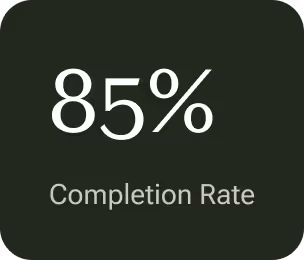
Mars Fort Smith’s sanitation department reached a 100% completion rate for all tasks site-wide after implementing Weever. The site also achieved an 89% completion rate for abnormalities addressed and corrected to date, demonstrating how automated workflows helped improve follow-through beyond sanitation alone.
Safety (BBSO)
Baywater Pipeline went from struggling to get frontline workers to submit safety observations to a 230% increase in monthly submissions after digitizing with Weever. A Fortune 100 CPG manufacturer saw a 500% increase in BBSO participation across 10 focused behavior categories, with more than 6,000 submissions in a program that had previously stalled.
5S Audits
Adient, an automotive parts manufacturer, digitized its 5S audits and saw plantwide scores climb from 85% to 97%. Open issues dropped from more than 60 per month to fewer than 5, and the audit team recovered about four hours a week on administration. The program was running plantwide in under three months.
Autonomous Maintenance (AM)
A global CPG manufacturer’s AM program was consuming 30% of the Maintenance Manager’s day in admin before digitization. After moving inspection workflows to Weever, participation climbed more than 500%, with 3,000+ 5S, CIL, and centerline reports completed in the first eight months. Automated reporting also gave the Maintenance Manager back 30% of his day.
Getting started: How to digitize without disrupting production
Most manufacturing leaders we work with start with a single program at a single plant. We built the following ADAPT framework to help them get up and running quickly while minimizing disruption to existing operations.
A - Assess the current reality.
Before configuring anything, we work with you to understand how your program actually runs on the floor. That means understanding what your operators need in the flow of their work, what supervisors need to see without having to chase people down, and what managers need to make decisions without drowning in manual data entry.
D - Digitize what already works.
We digitize your existing forms and routines exactly as they run today, so operators follow the same process they already use. Supervisors and managers gain structure and consistency without change-management headaches.
A - Align the solution to real conditions.
We configure Weever to match your plant’s reality. Operators access digital forms instantly, conditional logic shows only the fields they need, and real-time dashboards give everyone clear visibility into completion status and follow-up needs. The system feels natural on the floor and useful in daily management.
P - Prepare the team for quick adoption.
We start with one high-impact program, usually the one causing the most pain, configure it to match how your team already works, and get people using it within weeks. From there, the success builds momentum for the next program.
T - Tune and improve continuously.
Once your team is using Weever consistently, the focus shifts to continuous improvement. Real-time data shows you exactly where to streamline, where to coach, and where to invest. Because Weever connects the work on the floor to the systems that report on it, you get a continuous cycle of refinement based on what’s actually happening in your facility.
By the end of the process, your plant is running the same programs it always has, just faster, with cleaner data, and without the admin burden that comes with paper.
Make the move from paper logs to electronic logs in your manufacturing plant
Discover what an electronic log system for your sanitation, safety, 5S, or AM programs could look like. We'll digitize part of your existing paper process in Weever as-is, so you can see exactly how simple the transition can be.
Spend Less Time on Admin. More Time Improving Operations.
See how Weever automates data entry, reporting, and action items so you can focus on improvement not admin.