
What Your Master Sanitation Schedule Stack Should Look Like in 2026
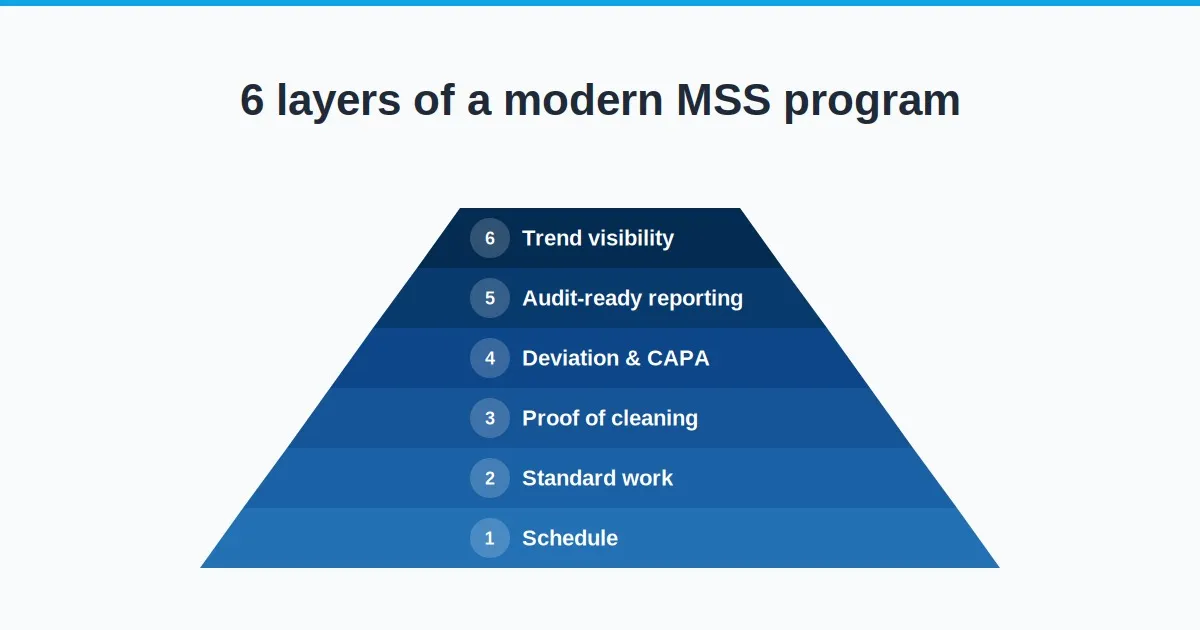
Table of contents

Share:


Sanitation in 2026 has changed. Auditors are sharper. Customers are demanding more documentation. FSMA 204 is coming.
According to The Master Sanitation Gap:
- 33% of sanitation managers say compliance is their #1 challenge
- 90% of plants still rely on paper to manage their sanitation programs
- 933 hours per manager, per year, lost to manual admin tasks
Those aren't abstract numbers. They're the gap between what a modern sanitation program is supposed to do and what most plants can actually prove on audit day.
If you're rebuilding your master sanitation program in 2026 (or just trying to figure out where to invest first) here's what a complete MSS stack should look like, and what each layer needs to do.
The 6 layers of a modern MSS stack
Think of your master sanitation program as a stack, each layer building on the one below it. Most plants are strong in the bottom one or two layers and thin everywhere else. The goal isn't to rip and replace; it's to know where the gaps are.
Layer 1: The schedule itself
The foundation. Every cleanable surface, every piece of equipment, every zone, every frequency, captured in one source of truth.
In a paper world, this is the 45-page packet. In a modern stack, it's a configurable schedule that:
- Auto-generates tasks at the right cadence
- Routes the right SSOP to the right operator at the right time
- Adapts when production changes (a line goes down, a SKU shifts, a zone is added)
- Doesn't require a person to reprint, re-distribute, or re-staple anything
If you want a primer on how to structure this layer from the ground up, Weever's Ultimate Guide to Food Plant Sanitation walks through it in detail.
Layer 2: Standard work and visual guidance
A schedule tells you when to clean. Standard work tells you how. In 2026, that means more than a printed SSOP in a binder.
A modern stack delivers:
- Step-by-step instructions on the device, in the operator's language
- Photo and video references for hard-to-clean surfaces
- Conditional logic (if this happened, do that)
- Versioning, so updates push to the floor the day they're approved
This is the layer that turnover hits hardest. When your most experienced sanitor leaves, the institutional knowledge has to live in the system, not in their head.
Layer 3: Proof of cleaning
This is where most paper programs lose the audit. The signature on the line is a record that someone said the work was done. It is not evidence.
A modern proof-of-cleaning layer captures:
- Digital signature, tied to a named user
- Timestamp at the point of work
- Photo evidence of clean surfaces at defined contact points
- ATP and allergen-specific test results, attached to the task
- Geolocation or zone confirmation where it matters
The shift here is subtle but important: the record exists because the work happened, not because someone documented it afterward. That's the threshold for what regulators and major retailers are now expecting.
Layer 4: Deviation and corrective action workflow
Things go wrong. A swab fails. A visual inspection finds residue. A step gets skipped. The question isn't whether deviations happen, it's whether they get caught, owned, and closed.
A strong CAPA layer:
- Triggers automatically when a deviation is captured
- Assigns an owner with a due date
- Blocks line release until the corrective action is verified, where appropriate
- Builds a trend over time, so you can see which deviations are recurring
The plants that pass audits cleanly aren't the ones with no deviations. They're the ones who can show, with one click, every deviation they've had this year and exactly how each one was closed.
Layer 5: Audit-ready reporting
This is the layer that pays back the investment fastest. The 933 hours of manual admin time per manager, per year — most of that is here. Compiling reports, transcribing logs into spreadsheets, hunting through binders for the specific records an auditor asked for.
Modern reporting should give you:
- Pre-built reports for SQF, BRCGS, FSSC 22000, and FSMA 204
- Filtering by date, line, area, shift, crew, or SSOP version
- Export to PDF, Excel, or directly to Power BI
- The ability to pull "every record for Line 3, last quarter" in seconds, not days
If an auditor asks for documentation and your team can produce it in minutes, the conversation that follows is very different from the one where someone disappears to dig through a filing cabinet.
Layer 6: Trend visibility and continuous improvement
The top of the stack. This is what separates a compliant program from a learning one.
Trend visibility means asking and answering questions like:
- Which contact points have the most failed ATP swabs this quarter?
- Which shift completes pre-op fastest, and why?
- Are deviations on Line 4 trending up since we changed the chemical?
- Which sanitor consistently catches issues others miss?
- Where are we actually getting better, and where have we stalled?
This is the layer that's missing from almost every paper-based program, because you can't analyze a binder. The shift to digital MSS isn't really about replacing paper. It's about unlocking this layer.
Where to start if your stack has gaps
Most plants don't need to rebuild everything at once. The teams that get this right tend to follow a sequence:
- Benchmark where you stand. Download The Master Sanitation Gap to see how your program compares to peers across North American food manufacturing on compliance posture, technology adoption, and admin burden.
- Map your stack. Walk the six layers above and rate each one honestly. Most plants are 4/5 on Layer 1, 2/5 on Layers 3 and 4, and 0/5 on Layer 6.
- Fix proof of cleaning first. Layer 3 is where audits get won or lost, and it's the layer where digital tools deliver the fastest, most visible improvement.
- Pilot one line. Pick your highest-risk line, digitize the full stack for that line, and run parallel to paper for a month. Compare the records.
- Build the dashboard before you expand. If the data you're capturing digitally doesn't answer trend questions, redesign before rolling it out plant-wide.
The bottom line
A modern master sanitation stack isn't a binder, a spreadsheet, or a single piece of software. It's six layers working together — schedule, standard work, proof, CAPA, reporting, and trend visibility — each one producing evidence the next layer depends on.
Paper can carry the first two layers. It struggles with the next two. It can't deliver the last two.
If your program in 2026 still depends on paper for the layers above Layer 2, you're not behind — you're with the 90% of plants the survey caught. But the audit environment is moving. The compliance bar is rising. And the manufacturers pulling ahead are the ones building the full stack.
Ready to see what your stack could look like? See how Weever’s Master Sanitation Schedule software delivers all six layers in one platform.



Spend Less Time on Admin. More Time Improving Operations.
See how Weever automates data entry, reporting, and action items so you can focus on improvement not admin.