
7 Tips to Ensure Successful 5S Audits in Manufacturing
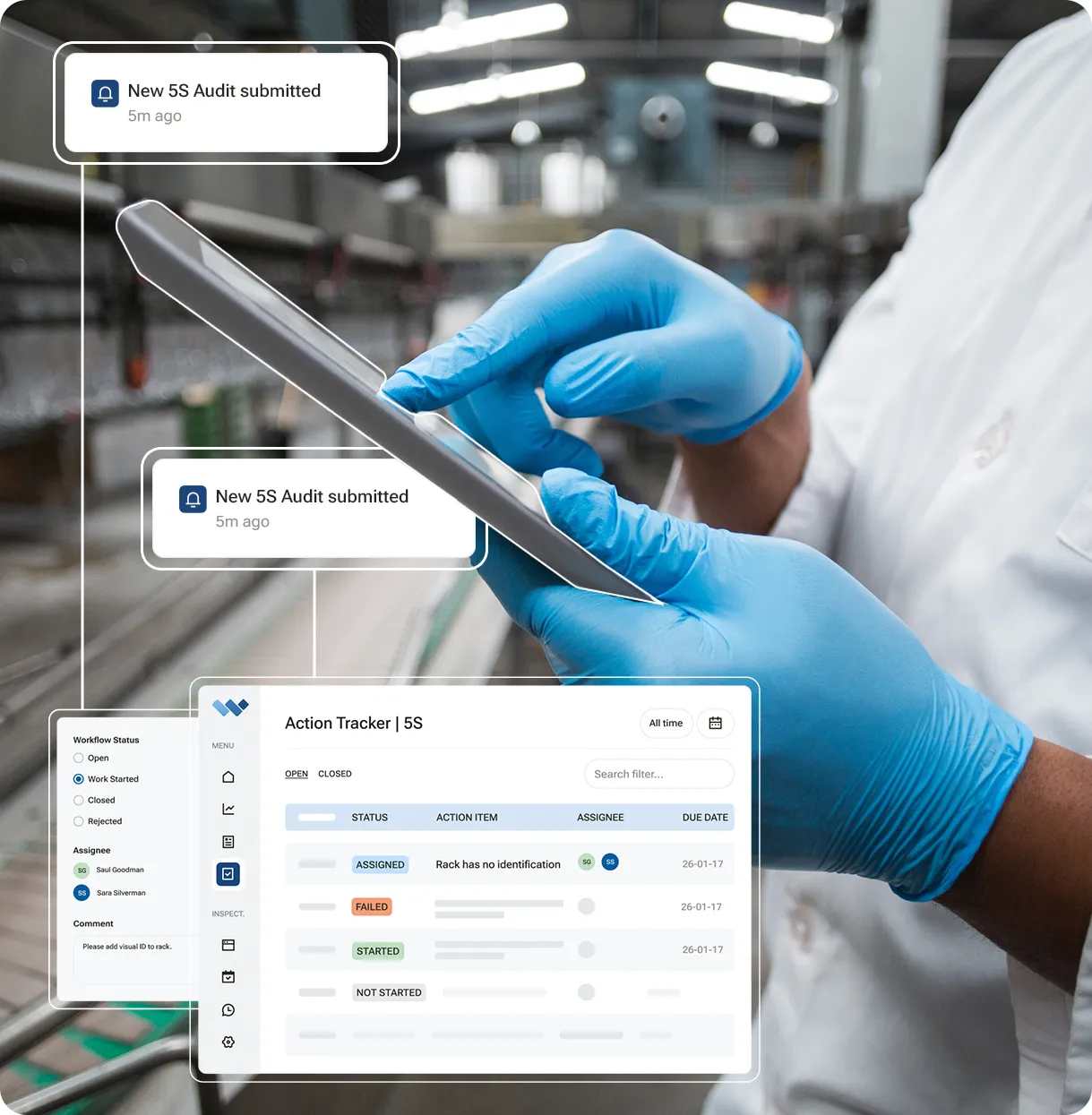
Table of contents

Share:


If you've rolled out 5S on your floor, you already know the first three S's are the easy part. Sort, Set in Order, and Shine give you a satisfying before-and-after photo. The hard part, the part that decides whether 5S becomes a real program or a one-time cleanup, is what happens in the months after.
That's what the audit is for. Done well, a 5S audit catches drift early, gives operators real feedback, and gives Continuous Improvement leaders the data to prove the program is actually working. Done poorly, findings pile up in a binder, the same issues resurface every quarter, and nobody can say with confidence whether 5S is helping or just generating paperwork.
Here's a quick refresher on 5S, followed by seven tips for running audits that actually sustain the program instead of quietly letting it fade.
What is 5S?
5S is a workplace organization methodology built around five Japanese terms:
- Seiri (整理) — Sort: remove what isn't needed from the workspace.
- Seiton (整頓) — Set in Order: arrange what's left so it's easy to find and use.
- Seiso (清掃) — Shine: clean the area and inspect equipment while doing it.
- Seiketsu (清潔) — Standardize: turn the new organization into a repeatable standard.
- Shitsuke (躾) — Sustain: keep the standard in place through ongoing discipline.
5S gives workers a structured way to organize a space for efficiency and safety: identify what's actually needed, decide where it belongs, keep the area and equipment maintained, and build habits that hold the new standard in place. Standardization, a cornerstone of Lean, is what turns individual cleanup into a shared understanding of how work should be done every time.
Sustain is one of five letters, but it's where most of the real work happens, and where most 5S programs quietly fail. That's exactly what a disciplined audit cadence is built to prevent.
1. Schedule recurring audits, not a one-time inspection
Once a workstation reaches its optimal state, the job isn't done, it's just started. Schedule audits on a fixed cadence to confirm the standard holds. Most manufacturers audit each workstation at least once a month, though higher-risk or high-turnover areas often warrant more frequent checks.
Keep the framing collaborative. The point of a 5S audit isn't to catch someone doing something wrong, it's to give the team feedback on the current state of a workstation so small issues get fixed before they become bigger ones.
2. Decide who conducts the audit, and build in oversight
Most plants have a supervisor assess each operator's workstation directly. Others use peer-to-peer audits, where operators evaluate each other's stations, with supervisor spot-checks to make sure the peer reviews stay consistent and fair.
Either model works. What matters is consistency: the same standard applied the same way, whether the person holding the checklist is a supervisor or a peer.
3. Use a consistent scorecard across every audit
A 5S audit scorecard (sometimes called a 5S audit sheet) gives structure to the review and turns a subjective walk-through into comparable data. Most scorecards rate each "S" on a simple scale:
- 1 = Not completed
- 2 = Partially completed
- 3 = Completed
Free 5S checklist templates are a reasonable place to start, and paper or Excel-based scorecards can get a new program off the ground. But both formats run into the same limits once a program scales past one or two workstations: no photo evidence, no automatic scoring, and no easy way to compare results across shifts, lines, or sites.
4. Digitize the audit to capture photos and context
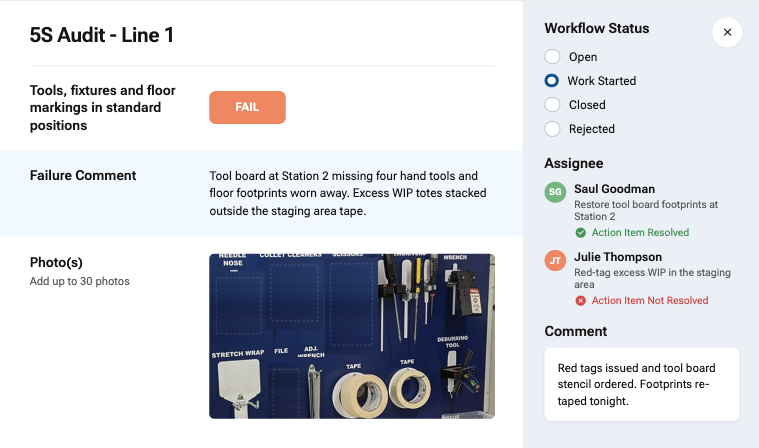
A digital 5S audit form solves the biggest limitation of paper: it lets you attach a photo directly to the finding, so feedback comes with visual context instead of a written note that leaves room for interpretation. Conditional logic can also prompt an operator or auditor for more detail only when a specific "S" fails inspection, keeping the form fast for the stations that pass.
Digitizing also removes the device barrier. Staff can complete audits using a shared tablet on the line or their own phone (BYOD), instead of tracking down a clipboard and a pen.
5. Compare current conditions to a reference photo of the optimal state
The original 5S rollout is complete when a workstation reaches its optimal, organized state. Every audit after that is really a comparison: how close is the station right now to that original standard?
A reference photo of the optimal state, attached directly to the audit form, makes that comparison concrete instead of relying on memory or written standards alone. With a digital form, that reference photo is available every single time the audit runs, for every auditor, not just the person who happened to be there when the standard was first set.
6. Run the 30-second rule as a simple, repeatable KPI
The 30-second rule is a quick, low-effort way to measure how well Set in Order is actually working at a given station. Time how long it takes an operator to locate a specific tool. Under 30 seconds is a pass. Over 30 seconds is a fail. This short video walks through the exercise.
Because it's fast and objective, the 30-second rule works well as a standing KPI you can track and compare across every workstation in the facility, giving Continuous Improvement teams an early signal on where organization is slipping before a full audit catches it.
7. Calculate a total score, and use reporting to find where to focus
To calculate a total 5S audit score, add the score for each "S" and divide by five. A perfect audit (a 3 on every "S") produces a total score of 3: (3+3+3+3+3) ÷ 5 = 3.
The single number is useful for a quick read, but the real value comes from reporting that breaks results down by workstation, shift, line, and individual "S." Radar charts in particular make it easy to spot exactly where a program is underperforming, whether that's one specific station, one shift, or one "S" (Shine consistently lagging Sort, for example) across the whole facility, so trainers know precisely where to focus retraining instead of guessing.
A 5S score without a breakdown tells you something's off. A breakdown by station, shift, and "S" tells you what to actually fix.
Why manufacturers digitize 5S audits with Weever
Paper checklists and spreadsheets can launch a 5S program. They're a lot harder to lean on once you're running audits across multiple lines, shifts, and sites, and leadership starts asking for proof the program is working.
- Faster audits, with photo evidence built in. Weever's digital 5S audit forms capture photos, apply conditional logic, and score each "S" automatically, so audits take minutes instead of a clipboard-and-spreadsheet routine after the fact.
- Findings that get tracked to closure. A failed item routes straight to the right person instead of sitting in a binder until the next audit rolls around.
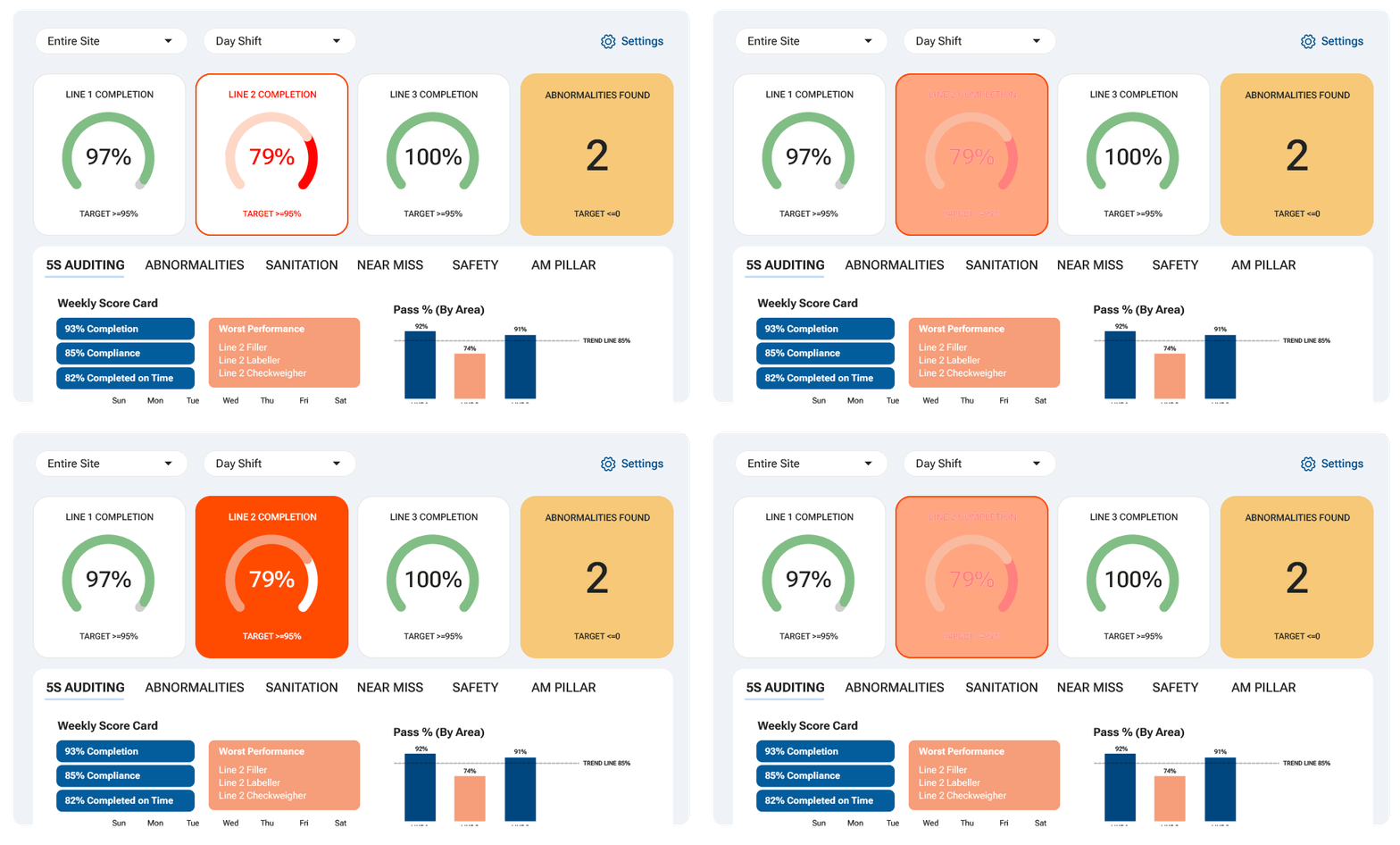
- Reporting leadership actually trusts. Automatic score trends by workstation, shift, line, and site replace the spreadsheet nobody's confident in, so a Continuous Improvement manager can show, with real data, whether the program is working.
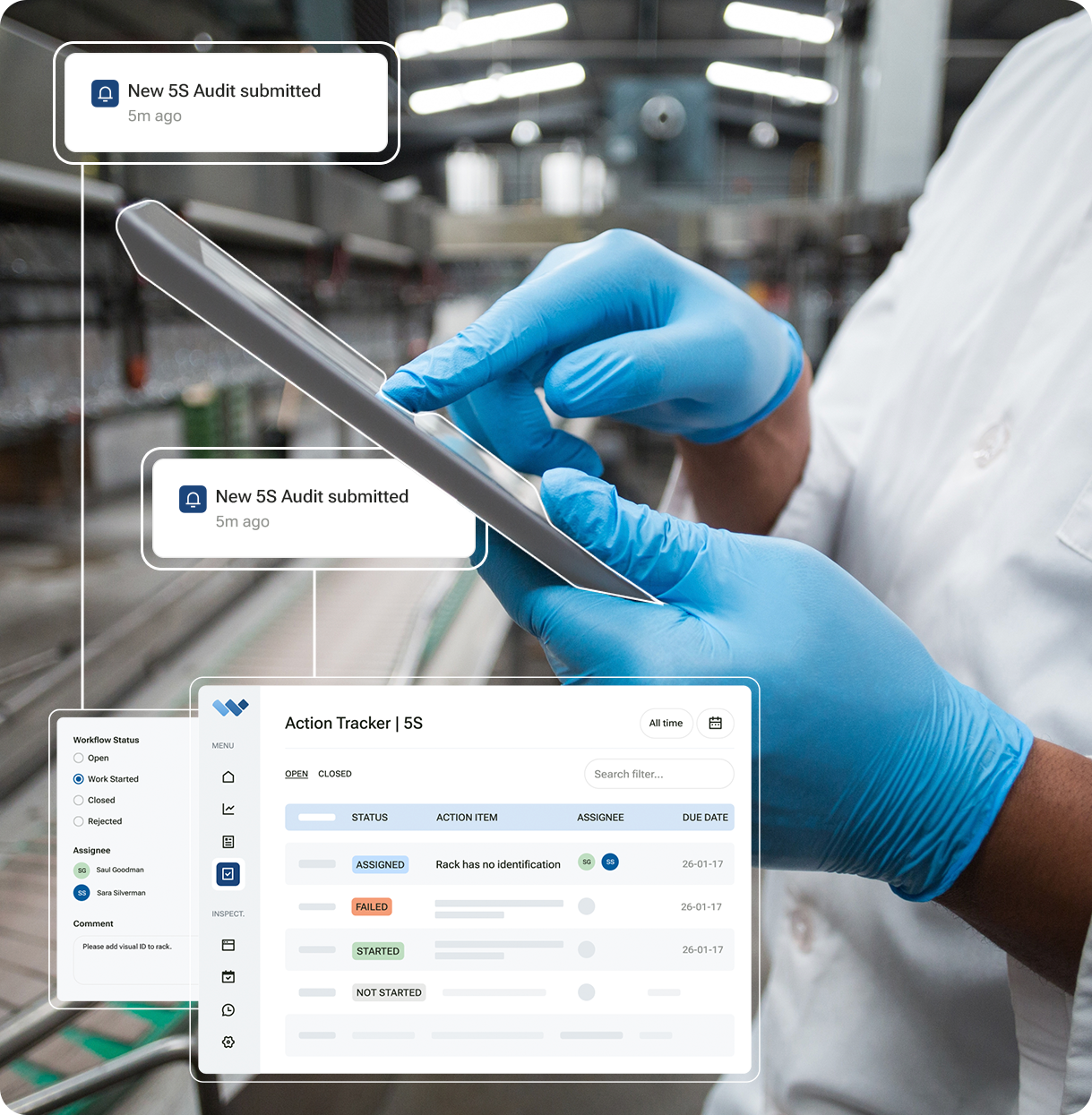
Want to see how Weever runs 5S audits, tracks findings to closure, and reports on trends across your own lines? Book a demo and we'll show you.



Spend Less Time on Admin. More Time Improving Operations.
See how Weever automates data entry, reporting, and action items so you can focus on improvement not admin.