
Connected Worker Software for Food and Beverage Manufacturing
Table of contents

Share:


Most connected worker software is sold to manufacturing generally. Food and beverage is a specific case, and the differences are not marketing distinctions. They are the reasons a platform that works beautifully in an automotive plant fails in a dairy.
Four pressures separate food and beverage from the rest of manufacturing. This article covers each one, what it changes about what "good" looks like, and which programs food plants should digitize first.
What makes connected worker software different for food and beverage?
Four things, and each one rules out platforms that would otherwise be perfectly capable.
- The risk is recall, not just efficiency. A missed sanitation step or an unverified allergen changeover is a public health and brand event, not a productivity problem.
- The physical environment destroys hardware and interfaces. Washdown, gloves, cold rooms, and wet floors.
- You are audited more than almost any other sector. A GFSI scheme, plus customer audits, plus retailer requirements, plus regulators.
- Turnover is high and workforces are frequently multilingual. The person running a procedure today may be on their second week, and may not read the language it was written in.
Take them in order.
1. Sanitation, allergen changeover, and CCP monitoring
In most manufacturing, a missed check costs you throughput. In food, a missed sanitation step or an unverified allergen changeover can end with product in the market and a phone call to a retailer.
That changes what the record has to do. It is not enough to know a clean was scheduled and marked complete. You need to be able to demonstrate, potentially eight months later and potentially to someone hostile, that a specific clean happened on a specific date, to a specific standard, by an identified person, with evidence.
Paper struggles here in a way that is structural rather than a matter of diligence. A round sheet completed at the end of a shift for the whole shift is indistinguishable from one completed in real time. A system-generated timestamp is not.
What to require for these programs specifically:
- Photo evidence bound to the individual step, not the submission. When someone asks about step 6 of a pre-op check from March, you need the photo attached to step 6.
- Pre-op checks that block start-up on failure, or at minimum escalate immediately rather than appearing in a daily digest.
- Allergen changeover verification with a hard sequence. Conditional logic that will not let step 4 be recorded before step 3.
- CCP monitoring with out-of-spec triggers that create an owned action and a hold decision path automatically.
The economics reinforce the case. Siemens' True Cost of Downtime 2024 puts unplanned downtime in fast-moving consumer goods at roughly $36,000 per hour. A hold or a recall is an order of magnitude beyond that.
2. Washdown, gloves, and cold environments
This is the section generic manufacturing content cannot write, and it is where most platform evaluations should start rather than end.
Washdown areas. Devices need appropriate ingress protection and sealed mounting. A consumer tablet in a case is not a washdown device, and discovering that after deployment is an expensive lesson. Ask specifically what IP rating the vendor's customers run in wet areas, and what they mount it in.
Gloves. Nitrile, cut-resistant, or cold-store gloves all change touch accuracy. Forms need large targets, minimal free typing, and pickers instead of text fields wherever possible. A form designed for an office worker fails on a wet line and it fails in a way that gets reported as "the crew will not adopt it."
Cold rooms and freezers. Two problems. Battery performance drops sharply, which changes device and charging decisions. And connectivity is often weak, so confirm network coverage in cold storage before deployment rather than after. A dropped connection is a tolerable bug in an office app and a compliance gap on a sanitation record.
Shared devices. Almost no food plant issues a device per person. Attribution has to work on a shared tablet without a full login before every task, or the login becomes the reason the check does not get done.
Hygiene zoning. Devices frequently cannot move between zones. That affects how many you need and where they live, and it is a cost line most software quotes ignore entirely.
Test all of this on your own floor, in your own worst area, before signing anything. A conference room demo proves nothing about any of it.
3. Retailer and GFSI audit pressure
Food plants host more audit days per year than almost any other sector. A GFSI scheme audit under SQF, BRCGS, or FSSC 22000. Customer and retailer audits, often several, often unannounced. Regulatory inspection. Internal audits ahead of all of them.
The common thread is that all of them audit whether the system was operated, not whether it exists. Monitoring gaps are findings. Corrective actions raised and never closed are findings. Records that cannot be produced inside the audit window are findings.
What this changes about platform selection: continuous visibility matters more than reporting depth. If you can see completion by line and shift daily, you never arrive at an audit with a gap you did not know about. The gap gets closed in week two rather than discovered by an auditor in month six.
On the regulatory timeline, one thing worth being current on. The FSMA 204 Food Traceability Rule compliance date was extended from 20 January 2026 to 20 July 2028. The substance of the rule did not change, and more importantly for most plants, retailer expectations did not move with the federal date. If a major customer has told you what they expect, that expectation stands regardless of what FDA is currently enforcing.
More detail in connected worker software and compliance.
4. Turnover and multilingual workforces
Food manufacturing runs higher turnover than most sectors, and the consequence for frontline programs is specific: the person performing a procedure may have been trained three weeks ago, or may be covering a shift on a line they do not normally run.
Two requirements follow.
The procedure has to teach as well as record. Reference photos showing what "clean" looks like on that specific piece of equipment. A defined sequence rather than a list. Enough guidance that a new hire on a covering shift gets the same outcome as someone with four years on the line.
Multi-language support has to be at form level, not interface level. This distinction matters and vendors blur it. An interface translated into Spanish while the sanitation steps remain in English is not a Spanish form. Ask to see one form rendered in two languages, with the same underlying data, so a report aggregates both.
There is a knowledge dimension too. Weever's 2026 State of Data Capture in Manufacturing research, a survey of 167 manufacturing leaders at companies with more than 500 employees, found 62% say important operational knowledge frequently or very frequently stays only in the experience of operators and inspectors. In a high-turnover plant, that knowledge does not just stay uncaptured. It leaves.
Which programs should food plants digitize first?
The Weever research measured where paper still dominates across frontline programs:
Frontline programs still primarily on paper, spreadsheets, or homegrown tools
Quality
66%
Safety
63%
Autonomous maintenance
41%
Sanitation
29%
None of the above
10%
Source: Weever, State of Data Capture in Manufacturing, 2026. n=166. Respondents could select multiple programs.
Sanitation is the least paper-dependent, which tells you something: food plants tend to digitize sanitation first because the recall exposure is most obvious. Quality checks stay on paper longest despite being the most frequently performed and most frequently audited program in the plant.
The recommendation for a food or beverage plant, in order:
- Sanitation and pre-op, if it is still on paper. Highest consequence, clearest audit exposure, and the program where evidence at the step matters most.
- Quality and in-process checks. Highest volume, so the largest capacity recovery, and the program most likely to be examined in a customer investigation. Mars Yorkville runs quality checks 400% faster and freed up 13 hours a day previously spent administering them.
- Allergen changeover verification, which is narrow, high-risk, and a fast win once the platform is in.
- Autonomous maintenance, once the food safety programs are stable.
- Safety observations and 5S, which benefit most from broad participation and are therefore best added once adoption is established.
Start with one program on one line, and digitize the process you already run rather than an improved version of it. More on sequencing in how to implement connected worker software without disrupting production.
What food and beverage plants have achieved
400%
Mars Yorkville
Quality checks 400% faster, and 13 hours a day of administration freed up. Read the case study
89%
Mars Fort Smith
Corrective action closure rate, with 100% task completion within a month of go-live. Read the case study
The pattern across all four is closure rather than completion. Completion proves the check happened. Closure proves what the check found actually got fixed, which is the only version that reduces recall risk.
The evaluation questions specific to food and beverage
Take these into any vendor conversation. They are the ones generic manufacturing platforms answer badly.
Questions that eliminate platforms
Questions 1 to 5
- 1
What IP rating do your customers run in washdown areas, and what do they mount devices in?
- 2
Show me a form completed with cut-resistant gloves on.
- 3
How did your customers confirm network coverage in freezers and cold storage before go-live?
- 4
How does attribution work on a shared tablet without a login per task?
- 5
Show me one form rendered in English and Spanish with the same underlying data.
Questions that separate the survivors
Questions 6 to 10
- 6
Show me a photo attached to step 6 of a pre-op check, retrieved eight months later.
- 7
Prove which revision of this sanitation procedure was in force in March.
- 8
Can a failed pre-op check block start-up, or only notify?
- 9
Can conditional logic enforce a sequence, so step 4 cannot be recorded before step 3?
- 10
Pull twelve months of sanitation records for one line while I watch.
Questions 1 through 5 are the ones that eliminate platforms. Questions 6 through 10 are the ones that separate the survivors.
Built for the plants that get audited most
Weever was built for food, beverage, and CPG manufacturing specifically. Sanitation, quality checks, autonomous maintenance, safety, and 5S on one platform, multi-language at form level, evidence bound to the step, and corrective actions tracked to closure.
Site-based pricing with unlimited users means every sanitor and operator can report, which matters because in a food plant the person most likely to notice a problem is rarely the person with a software licence.
Want to test it against your worst area rather than a conference room? Book a demo and bring your pre-op checklist.
Related reading: the complete guide to connected worker software, master sanitation schedule software, quality check software, and connected worker software and compliance.
Frequently Asked Questions
What is connected worker software for food manufacturing?
It digitizes the recurring frontline procedures a food plant runs each shift, including sanitation and pre-op checks, in-process quality checks, allergen changeover verification, CCP monitoring, and safety observations, capturing evidence at the point of work and driving any failure to a tracked corrective action.
Does it work in washdown areas and cold rooms?
Good platforms do, but this is the first thing to test rather than assume. Washdown needs appropriate device ingress protection and sealed mounting. Cold storage needs confirmed network coverage, because connectivity is often weak and battery performance drops sharply.
Can operators use it with gloves on?
They should be able to, with large touch targets, minimal typing, and pickers instead of free text. Test this with the actual gloves your crews wear. A form designed for office use will slow the round down, and that surfaces later as an adoption problem.
Which program should a food plant digitize first?
Usually sanitation and pre-op if still on paper, because the recall exposure and audit scrutiny are highest. Quality checks are next and often deliver the largest capacity recovery, since they are the highest-volume program in most plants and 66% still run on paper.
Does connected worker software help with GFSI audits?
It supports them by making records attributable, system-timestamped, evidenced at the step, version controlled, and retrievable. It does not confer certification. All three major schemes audit whether the system was operated, which is exactly what continuous completion and closure visibility demonstrates.
How does multi-language support actually work?
Ask whether translation is at interface level or form level. An interface in Spanish with sanitation steps still in English is not a Spanish form. You want one form rendered in multiple languages against the same underlying data, so reporting aggregates across both.
What is the FSMA 204 deadline now?
It was extended from 20 January 2026 to 20 July 2028. The rule's requirements did not change, and retailer and customer expectations did not move with the federal date, so plants under customer traceability requirements should continue as planned.
Is it worth it for a single food plant?
Often yes, and single-site plants frequently see results faster because there are fewer stakeholders to align. What determines fit is whether sanitation, quality, or safety programs are still on paper, not how many facilities you run.
Spend Less Time on Admin. More Time Improving Operations.
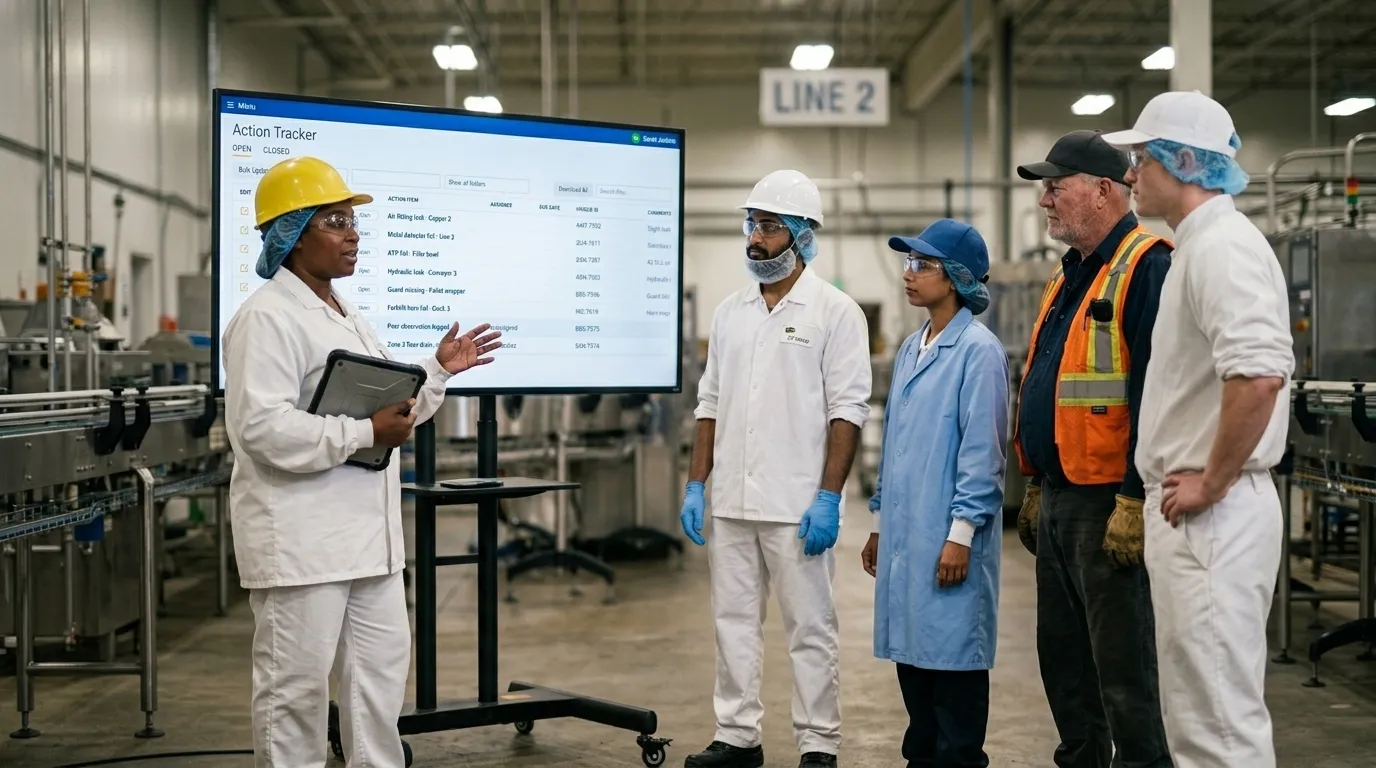
See how Weever automates data entry, reporting, and action items so you can focus on improvement not admin.