
Autonomous Maintenance Software vs a CMMS in Manufacturing: What Each One Is Actually For
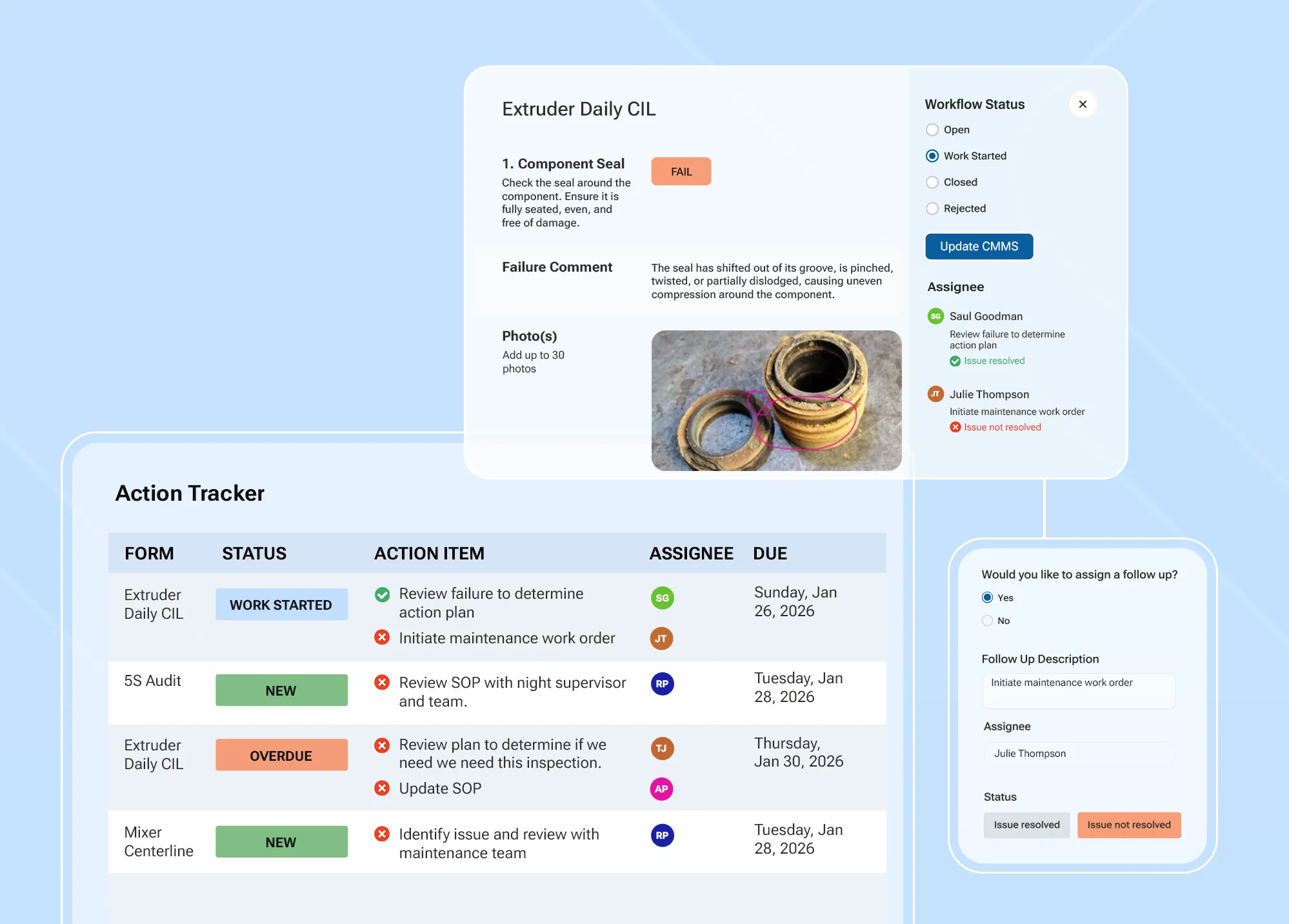
Table of contents

Share:


If you already run a CMMS, and someone just put an Autonomous Maintenance platform in front of you, your first question is the right one: why would we buy a second system to manage maintenance?
Here is the honest answer: A CMMS is built for the maintenance department. AM software is built for everyone else who touches the equipment.
- A CMMS is a system of record. It owns assets, work orders, parts, labour hours, and the reliability math that comes out of them.
- Autonomous Maintenance software is an execution layer. It owns what happens at the machine, on the shift, in the operator's hands: the CIL that got done or did not, the centerline reading that drifted, the abnormality someone noticed at 2am.
- Done right, the two feed each other. Done wrong, you have two systems and nobody trusts either.
This article breaks down what each system is actually built for, where the handoff between them belongs, and how to tell which gap you are actually trying to close.
The short answer, in one table
| What you need | CMMS | AM software |
|---|---|---|
| Asset registry and equipment hierarchy | Owns it | Reads from it |
| Work order lifecycle, labour hours, parts consumed | Owns it | Feeds it |
| MTBF, MTTR, cost per asset | Owns it | Supplies the input data |
| Parts and inventory management | Owns it | Not its job |
| Scheduled operator CILs, 5S and centerline rounds | Weak or unused | Owns it |
| Guiding an operator through a check at the machine | Not built for it | Owns it |
| Photo and video evidence at the point of work | Rare | Owns it |
| Abnormality capture by operators, not technicians | Awkward | Owns it |
| Completion data by line, shift, and equipment | Partial | Owns it |
| Participation across a whole plant floor | Licensed per seat, so limited | Site-wide by design |
Why the CMMS is usually not where AM lives
Most plants we work with have a CMMS, and most of them tried to run their AM program inside it first. It rarely holds, for four practical reasons.
Per-Seat vs. Site-Wide Licensing
CMMS platforms are priced per seat because they were designed for a technician headcount. AM asks 200 operators across three shifts to complete checks. The moment you price that per seat, someone decides only supervisors get logins, and now operators are dictating findings to a supervisor who types them in later. The data is secondhand before it is a day old.
Computer vs. Device Agnostic Interface
A CMMS work order screen assumes a trained technician with a laptop and time. An operator has a shared tablet, a running line, gloves, and four minutes. If it is not easy for them, it is not getting done.
Scheduling logic
CMMS PM scheduling is built around asset calendars and, in mature systems, meter readings. AM scheduling is built around shifts and lines. When the line is down for changeover, the checks for that line and shift need to come off the board, or your completion rate reports noise instead of performance.
Closure vs. Evidence
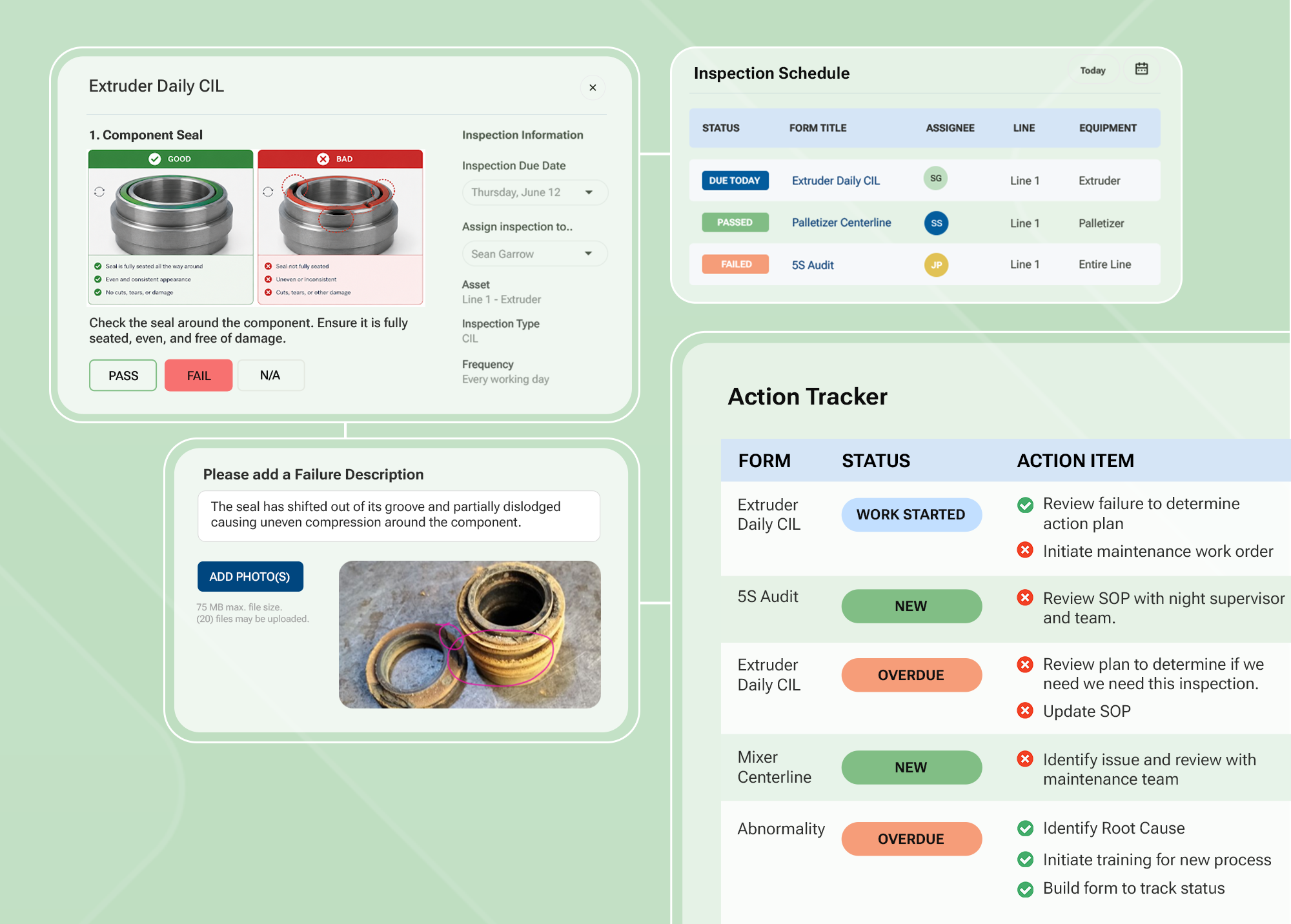
A CMMS records that a PM was closed, the inventory used and a description of the work completed. AM evidence proves that a check happened at the machine, with a reading, with a photo. Closure and evidence are not the same claim.
The CMMS tells you what maintenance did. Autonomous Maintenance software tells you what the floor saw. You need both, and only one of them is where operators live.
Where the handoff actually belongs
The clean division of labor looks like this, and it is the same at almost every plant:
- The operator finds something. A failed CIL step, an out-of-tolerance centerline reading, an abnormality: unusual noise, vibration, a leak, a guard that is loose.
- Autonomous Maintenance software captures it with context. Photo, annotation, line, equipment, shift, time, who found it. This is the part paper cannot do, because a checkmark is a claim rather than proof.
- The issue routes automatically. The right person is notified without anyone walking a form to an office.
- The CMMS takes it from there when the fix needs a work order, parts, or technician hours. Weever pushes into CMMS, ERP, and BI tools so failed checks and defects flow through without duplicate entry.
- Closure loops back to the operator. They see what happened to the thing they reported. This is the step most programs skip, and it is the reason reporting dries up. If reported abnormalities are not actioned visibly, operators stop reporting.
- Both data sets get analyzed. The CMMS gives you cost and reliability math. The AM layer gives you the leading indicators: which inspection points fail most, which shift catches the most, which equipment keeps generating the same abnormality.
Step 5 is worth dwelling on. It is not a technical requirement. It is the difference between a program that compounds and a program that quietly dies, which we cover in more detail in why AM programs die in month four.
What each system is genuinely better at
The CMMS wins on:
- Asset history in one place
- Work order cost
- Parts and inventory
- Technician labour tracking
- Meter-based PM triggers
- Structured failure codes
- Reliability KPIs
If those are the gaps you are trying to close, buy a CMMS. AM software will not do that work, and any vendor telling you otherwise is selling you a second problem.
Autonomous Maintenance software wins on:
- Getting the check done correctly by someone who is not a technician
- Capturing what they saw with evidence attached
- Routing it in seconds
- Giving you completion data you can defend in a review.
Also on participation, because site-wide access with no per-seat licenses and no app install is what lets a whole floor take part.
The reason this matters for reliability is that most of your equipment intelligence is generated by people who will never open your CMMS. McKinsey has found that proactive maintenance approaches can cut machine downtime by 30 to 50 percent and extend machine life by 20 to 40 percent. That gain does not come from better work order forms. It comes from earlier detection, and detection happens at the machine.
Why manufacturers run Weever alongside their CMMS
Built for the floor, not the maintenance office.
Shared devices, no app install, no login, 11 languages. Site-wide pricing with unlimited users, because full participation is what makes the program work.
Designed to feed, not replace.
Weever pushes clean data into Power BI, corporate EHS, ERP, and CMMS platforms, so failed checks and defects become work orders without anyone entering them twice.
Live in weeks, not quarters.
Customer Success builds the first version of your forms. Admin training runs about an hour. Operators pick it up in minutes.
Proof at scale.
22 million jobs completed on the platform across 100,000 users. Customers report 500 percent or more increases in AM participation, and one maintenance manager reclaimed roughly 30 percent of the day previously lost to reporting admin.

If you want to see the execution layer specifically, our autonomous maintenance software page walks through how CILs, centerlines, abnormality capture, and closure work on one system.
The Bottom Line
You are not choosing between a CMMS and Autonomous Maintenance (AM) software. You are deciding which layer of your maintenance program is currently invisible, and buying for that. The CMMS holds the record. AM software makes sure the record reflects what actually happened on the floor.
Want to see how the two fit together on your lines? Book a demo and bring your current CIL forms. We will show you where the handoff lands in your setup.



Spend Less Time on Admin. More Time Improving Operations.
See how Weever automates data entry, reporting, and action items so you can focus on improvement not admin.