
The Importance of Digital Data Capture in Manufacturing (And What Paper Is Costing You)
Table of contents

Share:


If you run a department in a manufacturing plant, you already capture a lot of data. Checks get completed. Logs get signed. Binders get filled. Somebody keys a stack of forms into a spreadsheet a shift and a half after the work actually happened.
The problem is not volume. It is that the data arrives too late to act on, gets recorded differently depending on who is on shift, and leaves out the one thing you actually needed: why it happened. The operator knew. The form did not ask.
Done right, digital data capture turns every check, observation, and sign-off into something you can see in real time, compare across shifts, and prove to an auditor in minutes. Done on paper, the same work produces a filing cabinet you cannot query and a recurring failure nobody ever spotted as recurring.
That gap is now measurable. In August 2026, Weever surveyed 167 manufacturing leaders at companies with 500 or more employees about the operational data underneath their AI programs. This article walks through what they told us, what digital data capture actually changes on the floor, and what to look for if you are replacing paper this year.
What manufacturers told us about their own data
We asked 167 operations, production, plant, manufacturing, and continuous improvement leaders a simple question: is the frontline data your AI will run on actually ready?
84% said yes. They are confident their frontline operational data is trustworthy enough to support AI. And they have earned some of that confidence. 86% capture more frontline operational data than they did three years ago.
Then the survey kept asking. Of the leaders who said their data was ready, 90% also reported at least one condition that undermines it: knowledge that lives only in an operator's head, the same issue logged three different ways, or manual processes they themselves say block AI-readiness.
Here is the rest of what they reported:
- 62% say critical knowledge stays in people, not systems. Important operational knowledge frequently or very frequently remains only in the experience of operators and inspectors. Only 8% say it rarely happens. Nobody said never.
- 51% say the same issue gets logged differently depending on who logs it. One operator writes "leak." The next writes "seal weeping." The third writes "minor drip, monitored." Same failure, three records, never counted together.
- 66% of quality programs and 63% of safety programs still run primarily on paper, spreadsheets, or homegrown tools. So do 41% of autonomous maintenance programs and 29% of sanitation programs. Two thirds of respondents run at least two programs this way. Only 10% run none.
- 36% name manual and paper-based processes as the single biggest factor hurting frontline data quality. That ranked ahead of disconnected systems at 26% and lack of standardized processes at 19%. Inconsistent software adoption came last among operational causes at 10%. Leaders are not blaming their people or their training budget. They are pointing at the method of capture.
- 73% say limited trust in frontline data already prevents them from relying on AI. Not as a future risk. Right now, while 83% of them have AI deployed or in pilot.
[Source: Weever, The State of Data Capture in Manufacturing, 2026 Edition, n = 167]
More data is not the same as more answers. A plant can go from two hundred completed checklists a month to two thousand, and every one of them can say the same thing: check complete, no issues found.
The volume grew tenfold. The number of captured reasons why anything happens did not grow at all. And because volume shows up on every dashboard while the missing reasons show up nowhere, it is easy to grade your data on the half of it you can see.
Why digital data capture matters more than it did five years ago
Real-time visibility instead of yesterday's paperwork
Paper data has a built-in delay. The check happens at 6:40am, the form gets collected at shift end, and the number reaches a manager sometime the next day, if it reaches them at all. By then the decision window has closed.
With digital capture, the entry exists the moment the work happens. Out-of-range values trigger an alert on the line instead of surfacing three days later in a review. Completion data reflects what actually got done, not what got initialled. Dashboards build themselves, so managers review results instead of spending hours compiling them.
Weever's managers solution page covers what this looks like in practice: data flowing from the floor into dashboards and Power BI automatically, with reports that update themselves.
The "human" context behind the event, not just the event
This is the finding most plants underestimate. Machine data tells you what happened: the line stopped at 2:14am, the temperature drifted, the changeover ran long. Most plants have had that for years.
What machine data cannot tell you is why. The operator knows the guard rattles when humidity is high. The inspector knows this particular blend runs differently. The night shift lead knows which changeover always slips and has a workaround nobody wrote down.
That context is what turns an event into a root cause, and 62% of leaders say it is not being captured. Not because anyone is hiding it. Because nobody gave the operator thirty seconds and a place to put it.
Digital capture closes that gap when it is designed for the floor: voice-to-text on a shared tablet, a photo attached to the entry, a required note field on any out-of-spec reading. Thirty seconds of context on the line is worth more than an hour of reconstruction eighteen months later. See how this works for abnormality reporting in autonomous maintenance.
Consistency, so a thousand entries become a dataset
Capturing data is half the requirement. Capturing it the same way every time is the other half, and free text is where consistency goes to die.
Structured fields, defined answer options, and evidence attached at the source are what let you count the same failure forty times instead of describing it forty ways. That is the difference between knowing issues were logged and knowing which issue keeps coming back.
It gets harder when quality, safety, sanitation, and AM each run on a different tool with a different set of fields, because the same failure gets described differently depending on which program caught it. One capture process across programs, with one set of field conventions, is what lets you compare an issue logged on a quality check against the same issue logged on a safety observation.
Compliance and audit readiness you can prove in minutes
Compliance is where paper costs are most visible and least negotiable. Digital capture gives you three things a binder cannot:
- A real audit trail. Timestamps, device, user, and photo evidence attached to the entry itself, not reconstructed later from memory.
- Electronic signatures. Sign-off captured at the point of work, which is what makes verification defensible rather than administrative.
- Traceability and instant retrieval. Search, filter, and export every task, record, and corrective action. Answer an auditor's question in minutes instead of digging through packets hoping nothing is missing. Weever's master sanitation schedule page walks through this for FSMA and GFSI programs specifically.
Security matters here too, because compliance records and proprietary process data are the same data. Weever is SOC 2 Type 2 certified; the details are on the security policy page.
Hours handed back to higher-value work
Paper checks take five to seven minutes each. Multiply that across every line, every shift, every program, and the number gets uncomfortable fast. Then add the downstream admin: re-keying, chasing missing forms, building the weekly report, following up on action items by email.
The point of removing that work is not a smaller team. It is a team that spends its hours on improvement instead of transcription. Adient's Liverpool plant, an automotive seating manufacturer we worked with, recovered four hours a week from paper audits and spreadsheet tracking and moved that time onto larger continuous improvement projects, while cutting carried open issues from 60-plus a month to fewer than five and lifting plant 5S scores from 85% to 97%.
That is the pattern across programs: fewer hours on admin, more capacity for the work that actually moves OEE, audit outcomes, and incident prevention. More examples are in the Weever case studies library.
Digital data capture is now the AI bottleneck
Line up the four majority findings from the research and the bottleneck describes itself.
The industrial AI bottleneck
| The condition | Manufacturing leaders reporting it |
|---|---|
| Critical knowledge stays trapped in operator and inspector experience | Leaders reporting it 62% |
| The same issue is recorded differently by person or shift | Leaders reporting it 51% |
| Disconnected systems limit AI effectiveness | Leaders reporting it 81% |
| Manual processes prevent frontline data from being AI-ready | Leaders reporting it 77% |
Source: Weever, The State of Data Capture in Manufacturing, 2026 Edition. Q13, Q16, Q20, Q27. n = 167.
These are four descriptions of one failure. Knowledge that is never captured cannot be standardized. Data that is not standardized cannot be connected. Data that is not connected cannot be analyzed with confidence. And an organization that cannot analyze its frontline data with confidence will not rely on AI built from it, no matter how much it has invested.
The difference between AI and a dashboard is what happens when the data is incomplete.
A dashboard built on incomplete frontline data looks incomplete. Somebody notices the blank column and goes to find the answer. AI does not behave that way. Ask it why line three underperforms and it will give you a fluent, confident explanation built from whatever data exists, and it will not tell you what was never captured in the first place.
The gap between what your plant knows and what your plant has recorded used to be an inconvenience. It is now the difference between AI worth trusting and AI that is confidently wrong. Which means the highest-leverage AI investment most plants can make this year is not another model. It is capturing what their people already know.
What good digital data capture looks like
The research points to four requirements. They are sequential, because each one depends on the one before it.
1. Make capture something operators will actually do.
If the tool is harder than the paper it replaces, the data will not exist. Most forms fail this test before an operator ever sees them, because nobody asked which fields belong there. Eliminate what nobody acts on, combine readings that always move together, reduce frequency where drift is slow, and simplify anything requiring a tool, a ladder, or a walk.
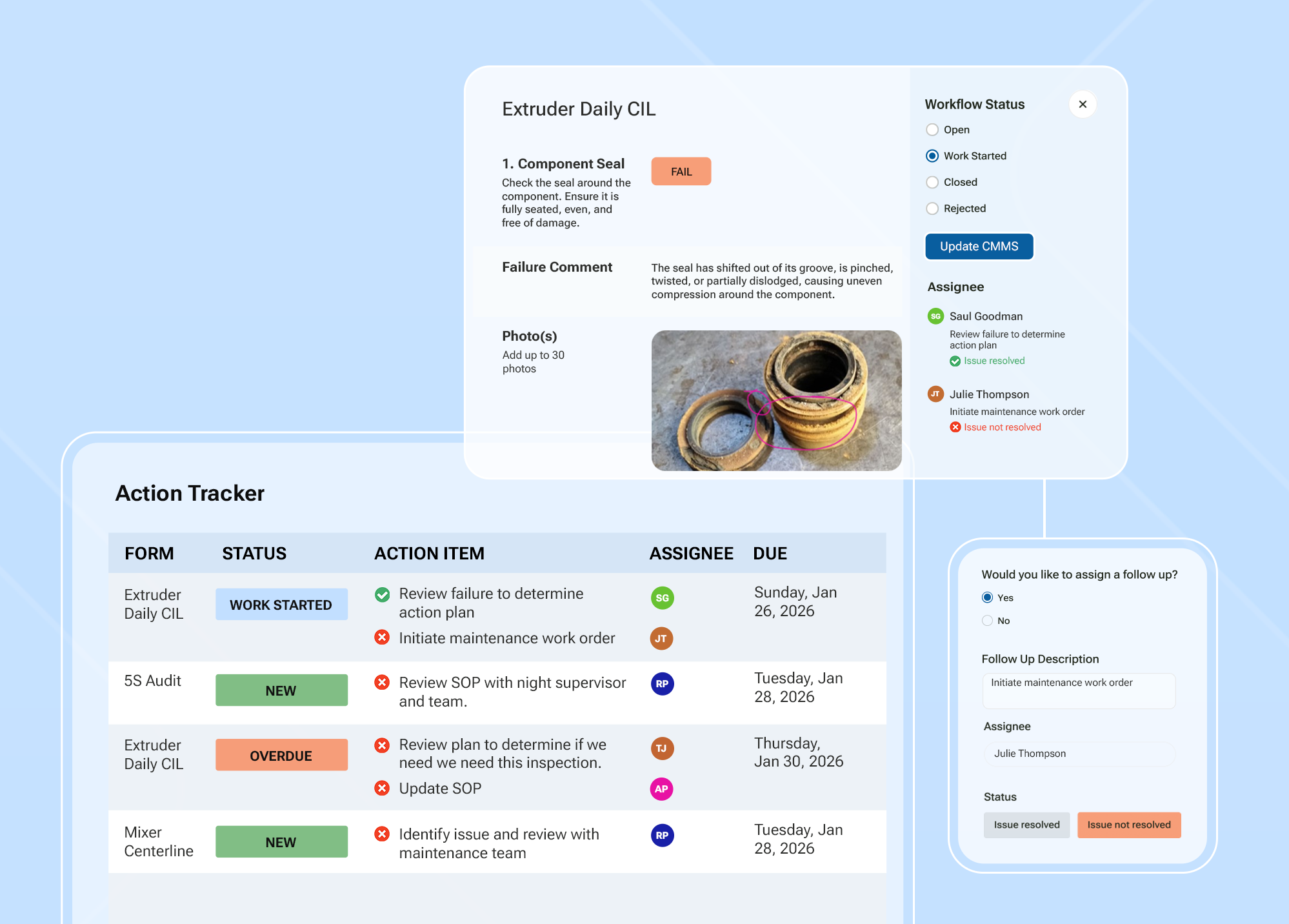
2. Structure it so the data becomes consistent.
Defined fields, controlled answer options, acceptable-value ranges, and evidence attached at the source. Conditional logic so operators only see questions relevant to what they are actually looking at.
3. Close the loop so the data keeps coming.
Every issue captured needs an owner, a due date, and follow-through tracked to closure. This is usually framed as accountability, and it is. It is also the only reliable way to sustain capture. When operators see their observations lead to changes, they keep reporting. When they do not, capture quality decays within a quarter and no policy will stop it.
4. Connect it, and keep it portable.
Frontline data has to connect across programs and sites, and it has to be able to leave. If it can only be read inside the tool that captured it, it cannot feed your BI stack, your enterprise systems, or any AI you want to rely on.
Judge any platform against those four in order. And judge the tool the way you would judge the form: can an operator complete it on a shared device, in their own language, in the middle of a shift, without training. If the answer is no, nothing downstream matters.
Why manufacturers choose Weever for digital data capture
Weever is the Connected Worker Platform built for food, beverage, and CPG manufacturers. Safety, sanitation, quality, autonomous maintenance, 5S, and continuous improvement run on one system instead of five point solutions that cannot share data.
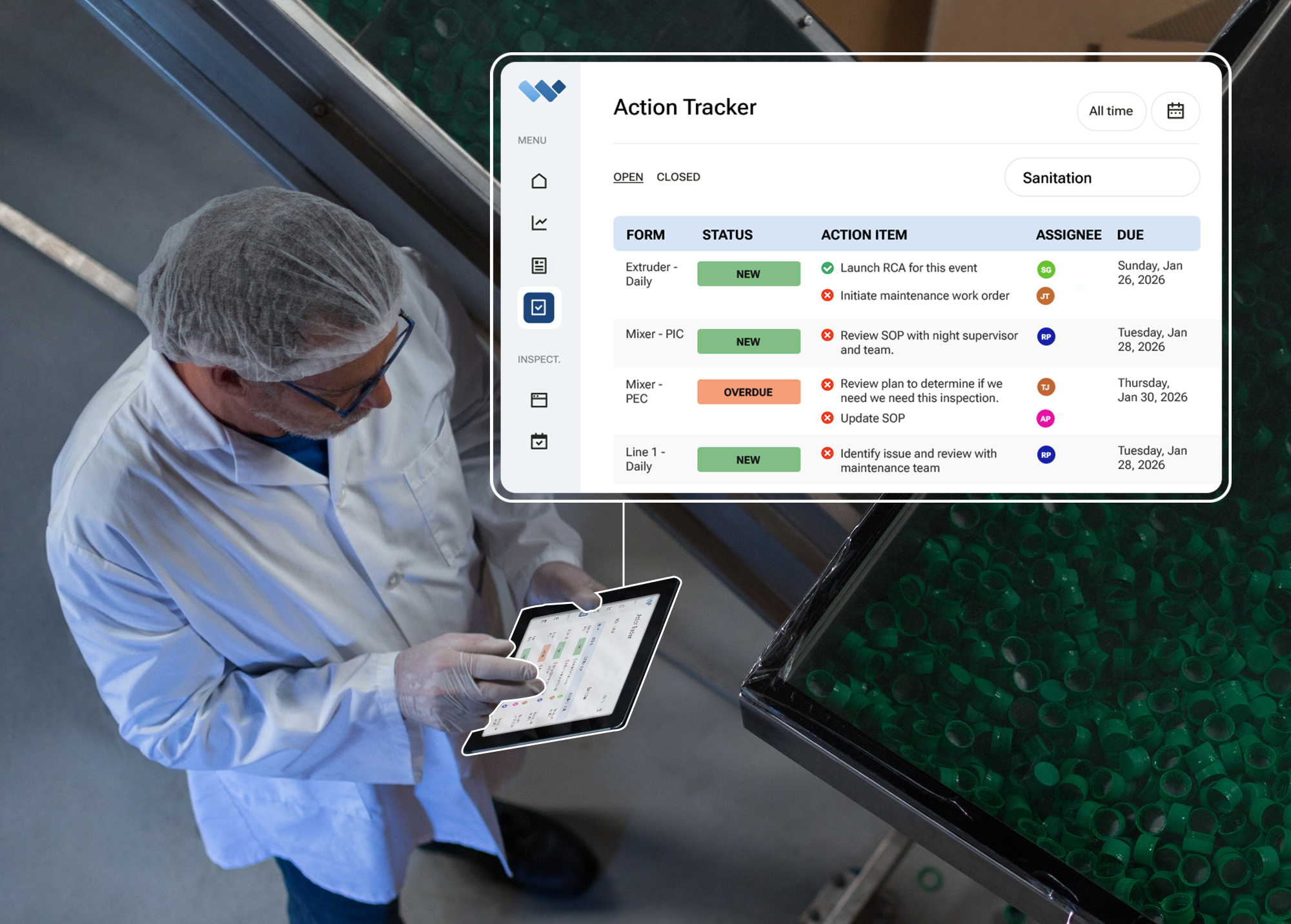
Built for the floor, not the office. Weever runs in any mobile browser on shared tablets, phones, or kiosks. No app install, no personal accounts, no per-seat licenses, so everyone participates. Forms are modelled on the paper checklists your team already knows, with multilingual support and visual task guidance for diverse workforces and third-party crews. More on that on the operators page.
Rich capture, not just checkboxes. Photo, video, and OCR capture. Voice-to-text for context. QR codes that link a physical asset or location to the right form. Automated calculations for scoring audits and qualifying readings. Conditional logic so forms adapt to the answers given.
Every issue gets closed. An out-of-spec entry creates an action item automatically, with an owner, a due date, and reminders. Nothing waits in an inbox or on a whiteboard.
Live in weeks, not months. No process redesign, no year-long rollout, minimal IT. Our team builds the first version of your forms and supports each rollout. See why plants choose Weever.
And when you are ready, the data is ready. Weever Radar is the optional AI layer that sits on top of your captured data, finds the patterns nobody has time to dig for, and tells you what is happening, what it means, and what to do about it. It works because the capture underneath it is complete, structured, and trustworthy. That is the whole argument of this article in one product decision.
The takeaway
73% of manufacturing leaders say limited trust in frontline data is already preventing them from relying on AI. That is a solvable problem, and it does not start with a model. It starts with giving the people doing the work thirty seconds and a place to put what they know.
Want to see what your own forms look like in Weever? Book a demo and we will walk through one of your current checks end to end, from capture to action item to dashboard.
.webp)

Spend Less Time on Admin. More Time Improving Operations.
See how Weever automates data entry, reporting, and action items so you can focus on improvement not admin.