
Manual vs. Automated Data Collection in Manufacturing How to Make the Right Decision for Your Plant

Table of contents

Share:


If you’re weighing whether it’s time to move your manufacturing plant from manual data collection — paper forms, spreadsheets, and binder-bound audit records — to an automated system, you’re not alone.
The question most leaders struggle with isn’t whether going digital makes sense. It’s whether switching will create more problems than it solves.
Automated data collection promises real-time visibility, fewer errors, and less administrative time. But it also brings a familiar set of risks. Many site managers we’ve worked with have lived through digital transformation projects that forced them to redesign their processes and endure change-management nightmares that left their programs worse off than before. So it’s no wonder so many are skeptical of moving away from the status quo.
The good news is there’s a better way to approach this challenge. This article will walk you through the real cost of manual data collection, what the right automated system actually delivers, and what switching looks like, so you can make the right call for your operation.
How manual and automated data collection compare in a manufacturing environment
Whether your plant captures data manually or through an automated system might not seem like a big deal. However, the methodology you choose actually has a real impact on how your operation runs day to day. Here’s how the two approaches stack up across six key areas that matter most on the plant floor.
Manual vs. Automated Data Collection
Data capture at the point of work
When plants rely on manual data collection, teams capture information using whatever tools are at hand. Operators write on paper forms attached to clipboards or stored in binders. Auditors carry printed scorecards through the facility. Supervisors update whiteboards and physical AM boards with flip cards. And administrators maintain spreadsheets alongside email threads and shared drives. No matter how the data is recorded, it ends up scattered and hard to consolidate.
With the right automated data collection system, every role that previously used a different tool can work from a single platform instead. Operators enter data directly into digital forms on shared tablets or kiosks, often launched by scanning a QR code at the equipment or workstation. Auditors run digital scorecards on any shared device. Supervisors see real-time dashboards instead of updating whiteboards. And administrators get consolidated reporting automatically, rather than reconciling spreadsheets. Required fields, dropdowns, and conditional logic guide information entry, and photos and videos can be attached at the point of work. The result is consistent, complete data captured in one place, instead of scattered across paper, spreadsheets, and whiteboards.
Entry error potential
Manual data collection introduces errors at two stages. The first is at the point of capture — operators miss fields, produce illegible handwriting, or lose records entirely in wet or high-traffic environments. The second is transcription, when someone takes that handwritten data and re-enters it in another system. Each step is another opportunity for mistakes to multiply. By the time those errors surface, they show up as repeat audit findings — a signal to regulators that your programs aren't under control.
The right automated system eliminates both problems. Data is collected once at the source, with validation rules that prevent incomplete or invalid submissions. No transcription means no compounding errors — just clean, accurate records from the moment information is captured.
Information visibility across the plant and sites
In a manual data collection process, information is buried across binders, paper logs, spreadsheets, and whiteboards. Even when teams can track down the data they need, it’s often out of date because someone has to gather the forms, transcribe the entries, or compile a report to make it usable. That means by the time supervisors and managers see the numbers, the window to respond to an issue has often already closed.
With the right automated data collection system, completion rates, open issues, and trends appear in real-time dashboards that anyone can access. The data can also feed directly into the systems and reporting tools the plant already uses, giving everyone a single source of truth for decision-making and responding to issues before they escalate.
Follow-up on flagged issues
When frontline teams flag an issue in a manual data collection system, it might be handwritten on paper, entered into a spreadsheet, or emailed to a supervisor. Follow-up depends on someone remembering to assign it, track progress, and ensure it is resolved, which is why it can easily fall through the cracks.
Compare that to the right automated data collection system, where corrective actions and follow-ups are auto-assigned to owners with due dates and escalation rules built in. Notifications go directly to the person responsible, and the system tracks the action through to closure, so issues are resolved before they become bigger problems.
Scaling and standardization across the business
With manual data collection, administrative work multiplies every time you add a line, shift, or site. There are more forms to print, more binders to maintain, more spreadsheets to reconcile, and more people to train on a local version of the process. Every site ends up running its own version of the same program, which makes standardization nearly impossible.
However, when you implement the right automated data collection system, it’s easy to roll out one standardized program across the business. Adding a new area doesn’t add proportional admin overhead. Instead, every site runs the same way, data flows into a single, consolidated view, and leadership can compare performance and implement best practices that make the entire organization run more effectively.
Audit readiness
Before an audit, manual programs require massive reconstruction projects. Teams must pull logs from binders, reconcile spreadsheets, and spend days assembling records that are often incomplete, illegible, or missing the traceability an auditor expects. And because corrective actions rarely close reliably on paper, the same findings tend to surface cycle after cycle
The right automatic data collection system makes audit prep a non-event. As operators complete work, the audit trail builds automatically — timestamping every task and tracking every corrective action to closure in the same system. When an auditor asks about a specific room, shift, or issue, the answer is easy to find.
Why manual data collection feels like the safe choice (and what that assumption misses)
For most manufacturing plants, manual data collection is simply the default. Programs have run this way for years, and when nothing appears to be broken, changing course can feel like introducing risk where none exists.
The problem is that manual systems tend to look more reliable than they are. Forms get filled out, binders accumulate, and on paper, everything appears to be under control. But what the records show and what's actually happening on the floor are often two different things.
Part of what masks that gap is the informal infrastructure people build around it. When the official process has known limitations, experienced team members quietly compensate — laminating instruction sheets and posting them at equipment, passing critical details verbally at shift handoffs that never get formally documented, keeping personal notebooks to track the context that standard forms don't have room for. These workarounds keep processes moving, but when those people move on, or when an auditor starts asking questions, the gaps that were always there suddenly become visible.
What manual data collection is actually costing your manufacturing plant
Even if your manufacturing facility has been using manual data collection for years, sticking with the status quo is likely costing you more than you realize. Here’s where the costs add up:
Manager and supervisor time lost to coordination
Sanitation managers who run Master Sanitation Scheduling (MSS) on paper lose an average of 933 hours a year to manual admin work such as scheduling, data entry, chasing signatures, reconciling spreadsheets, and following up on corrective actions Weever’s Master Sanitation Gap Report, 2026. That’s about 23 working weeks. The bigger problem is who’s doing the manual work. More often than not, it’s the CI Managers, sanitation managers, and supervisors who are stuck reconciling forms instead of focusing on the work they were hired to do, like overseeing the floor, coaching operators, or improving the programs themselves.
Errors and incomplete records create compliance exposure
Missing signatures, illegible entries, and incomplete corrective-action trails are common recordkeeping problems that can become audit findings, and the data collection process itself is often a root cause. When manufacturing records are handwritten and later re-entered into spreadsheets, errors become easier to introduce and harder to catch. The risk is especially clear in two-step, paper-based calibration processes, where manual re-entry has been estimated to produce errors in roughly 40% of calibration records.
Those errors can carry serious financial consequences, particularly when they affect food safety, quality, or compliance decisions. In food manufacturing, information gaps can make small problems harder to contain, increasing the risk of product holds, investigations, and, in the worst cases, recalls. The average food recall in the U.S. has been estimated at $10 million in direct costs alone, while 23% of companies in a GMA recall-cost survey reported recall-related financial impacts above $30 million. To make matters worse, when something goes wrong, the records you need to defend the plant are often the same paper records that make the problem harder to prove, trace, and resolve. One facility we worked with went from one to two PCQI holds per period to zero after implementation, avoiding more than $200,000 in annual costs.
Audit prep takes days, and the same findings keep showing up
Audit prep in a manual system rarely takes less than a few days. By the time the records are assembled into something an auditor can review, the team has spent anywhere from 2 to 5 days on preparation. And this isn’t the only problem. Because there's no way to automatically assign those actions to an owner, set a due date, and ensure a verified close, the same findings tend to recur cycle after cycle, costing the team up to 40 hours each time there's an audit.
Manual processes don’t scale across lines, shifts, or sites
Manual admin load grows in lockstep with the size of your operation. Each new line, shift, or site adds proportional overhead to your sanitation, safety, quality, and maintenance programs, and plants often end up assigning someone solely to keep the data-collection process running.
But the higher cost occurs at the corporate level. Without standardization across sites, plant managers and corporate leadership can’t compare performance, identify best practices, or govern these programs consistently across the business. Every site runs its own version of the same programs, and nobody can determine what’s working, how to avoid repeating costly mistakes, or how to improve efficiency.
The cost of paper itself
In our experience, a mid-size manufacturing plant goes through roughly 200,000 sheets a year. Once you account for printing, controlled storage, and proper disposal, that's around $60,000 annually before labor, delays, or rework are counted. For most plants, it's a cost that's been there all along, but nobody has ever considered adding it up.
How to decide if it’s time to switch from manual to automated data collection
The case for moving off manual data collection is straightforward: hundreds of hours in admin, audit exposure, findings that keep coming back, and programs that hit a ceiling the moment you try to scale them. The real question isn't whether to digitize. It's whether you can do it without creating more disruption than the problem you're trying to solve.
Why most automation projects in manufacturing fail
Most generic automation tools are built with a one-size-fits-all mindset. They use preset templates, locked-in workflows, and assume your plant will conform to the software. But real manufacturing programs don’t fit a prescribed mold, so even when the technology itself works, the implementation creates more friction than the paper system it replaced.
You’ve probably seen how this plays out. Operators start pencil-whipping the digital forms because the new process is slower than the old one, and managers stop trusting the data because the system can’t capture the exceptions and shift context embedded in your programs. Eventually, everyone reverts to the spreadsheets and clipboards they used before, while the software collects dust.
A failed implementation doesn't just waste the license fee. It consumes months of management time, creates organizational fatigue, and leaves your team no further ahead than when you started. And because a failed digital rollout is visible to everyone, the next attempt is harder to get off the ground.
How to digitize your frontline without redesigning your programs
Instead of forcing your plant to conform to generic software, there’s a better way to automate the programs you’re already running without changing how they work. That means digitizing your existing forms, scoring criteria, workflows, and action-item processes exactly as they are. The only thing that changes is how your team captures information.
McKinsey research shows manufacturers implementing digital tools see 15% to 30% improvements in labor productivity. Here’s what implementing the right software looks like in practice:
- View data in live dashboards the moment work happens, so supervisors can act on today’s problems instead of last week’s
- Capture information once at the source with validation rules, so there’s no transcription step and no illegible entries to chase down later
- Create corrective actions automatically, assign them to an owner, and track them through to closure, so the same findings stop coming back
- Roll out one standardized program across every line, shift, and site without rebuilding from scratch each time
3 signs you’re ready to make the switch from manual to automated data collection
In our experience, change typically happens when someone new joins your organization and doesn’t want to spend their time using outdated manual processes. But the signs that it was time to switch were usually there long before that.
- Your managers spend more time on admin than on the floor. When the people responsible for improving your programs are the same people who spend most of their time reconciling forms and chasing signatures, they’re not focused on the work they were hired to do.
- Audit prep takes days, and the same findings keep coming back. If your team spends a week pulling records together every audit cycle and the corrective actions from the last audit still aren't closed, you don’t have the right system in place.
- You can't see what's happening across every site without asking someone to compile a report.
When every site runs its own version of the same program and numbers only come together manually, there's no way to proactively identify gaps before they become problems.
If any of these sound familiar, you already have a case for automating data collection. The next step is making sure the tool you choose doesn’t create the disruption you’re trying to avoid.
What automating your manual programs looks like with Weever
If you decide to move forward with automating your data collection, getting up and running is simpler than most manufacturers expect.
That’s why we built Weever, a connected worker platform designed to digitize your frontline programs without changing how they work. Your frequencies, workflows, scoring criteria, action-item process, and anything else you've put in place stay intact, so the transition doesn't require you to adopt someone else's version of how your plant should operate.
Sanitation, safety, 5S, and AM — digitized as they already run
Manual data collection creates the same challenge for each of your manufacturing programs — information spread across binders, spreadsheets, and other tools that make it impossible to see what’s happening in real time. Here’s what changes when you run them through an automated, digital tool like Weever that was purpose-built for the manufacturing floor:
Sanitation (MSS)
Schedules, task assignments, and data verification all live in one place, giving sanitation teams a fully paperless sanitation log that’s always audit-ready. Operators scan a QR code at the workstation to pull up what needs to get done, and supervisors see completion rates in real time instead of compiling them after the fact.
Safety (BBSO)
Operators submit observations from any shared device in seconds. Action items get assigned automatically, and closure rates become visible across the organization.
5S Audits
Audits run faster than the paper version they replace. Scoring criteria sit inside the form, and open issues get tracked through to closure.
Autonomous Maintenance (AM)
Operators capture CIL and centreline checks at the equipment with photo evidence. Defects flow into the same reporting view leadership already uses.
The same frontline process, just faster and more reliable
What doesn't change during digitization is the process itself. Operators follow the same steps they always have, just in a digital workflow instead of on paper. Most plants are up and running in weeks, and because the programs look and feel familiar from day one, adoption happens quickly.
Built to integrate with the manufacturing systems you already use
If your plant has already invested in SAP, a CMMS, an OEE platform, or a QMS, Weever connects directly to these systems. Action items flow into SAP work orders, completion data feeds into Power BI dashboards, and defects sync with your CMMS. This ensures your frontline has the capabilities it needs without replacing the systems your plant already relies on for other parts of the business.
Results from manufacturers that have made the switch to automating data collection
We’ve worked with leading manufacturers across sanitation, safety, 5S, and AM to help them transition from manual to automated data collection without disrupting how their plants already run. Here’s what changed for them.
Master Sanitation Schedule (MSS)
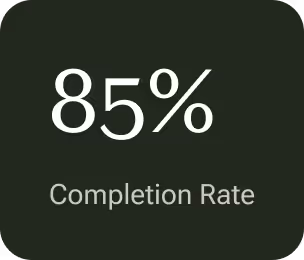
Mars Fort Smith, a food manufacturing facility, digitized its sanitation program with Weever and now runs at a 100% completion rate across all tasks managed through the platform, with 89% of flagged abnormalities tracked and closed without anyone having to chase them down.
Safety (BBS)
Baywater Pipeline struggled to get frontline workers to submit safety observations until it digitized the process with Weever. Monthly submissions increased by 230%. Additionally, a Fortune 100 CPG manufacturer revived a stalled BBSO program with Weever, increasing participation by 500% and generating more than 6,000 submissions across 10 focused behavior categories.
5S Audits
Adient, an automotive parts manufacturer, moved its 5S audits from paper and spreadsheets into Weever. The team sustained plantwide 5S scores in the 85% to 97% range, reduced open issues from more than 60 per month to fewer than 5, and saved about four hours a week on audit administration. The program was fully integrated into daily plant operations in under three months.
Autonomous Maintenance (AM)
At one global CPG manufacturer, manual AM reporting accounted for about 30% of the Maintenance Manager’s day. After digitizing CIL and centerline workflows with Weever, participation increased by more than 500%, with 3,000+ reports completed in the first eight months. Automated reporting also gave the Maintenance Manager back the time previously lost to spreadsheets and manual data entry.
Getting started: how to digitize without disrupting production
Most manufacturing leaders we work with start with a single program at a single plant. We built the following ADAPT framework to help them get up and running quickly while minimizing disruption to existing operations.
A - Assess the current reality.
Before configuring anything, we work with you to understand how your program actually runs on the floor. That means understanding what your operators need in the flow of their work, what supervisors need to see without having to chase people down, and what managers need to make decisions without drowning in manual data entry.
D - Digitize what already works.
We digitize your existing forms and routines exactly as they run today, so operators follow the same process they already use. Supervisors and managers gain structure and consistency without change-management headaches.
A - Align the solution to real conditions.
We configure Weever to match your plant’s reality. Operators access digital forms instantly, conditional logic shows only the fields they need, and real-time dashboards give everyone clear visibility into completion status and follow-up needs. The system feels natural on the floor and useful in daily management.
P - Prepare the team for quick adoption.
We start with one high-impact program, usually the one causing the most pain, configure it to match how your team already works, and get people using it within weeks. From there, the success builds momentum for the next program.
T - Tune and improve continuously.
Once your team is using Weever consistently, the focus shifts to continuous improvement. Real-time data shows you exactly where to streamline, where to coach, and where to invest. Because Weever connects the work on the floor to the systems that report on it, you get a continuous cycle of refinement based on what’s actually happening in your facility.
By the end of the process, your plant is running the same programs it always has, just faster, with cleaner data, and without the admin burden that comes with paper.
Make the move from manual to automated data collection in your manufacturing plant
Discover what automating your sanitation, safety, 5S, or AM program data could look like for your plant. We’ll digitize part of your existing paper process in Weever as-is, so you can see exactly how simple the transition can be.
Book a Demo



Spend Less Time on Admin. More Time Improving Operations.
See how Weever automates data entry, reporting, and action items so you can focus on improvement not admin.