
How to Build a Time-Based Maintenance (TBM) Program in Manufacturing to Cut Unplanned Downtime

Table of contents

Share:


If you're running a plant, you already know the pattern. A machine runs fine for months, then fails on a Tuesday afternoon, mid-shift, with no warning anyone caught in time. The line stops, a technician gets pulled off whatever they were doing, and the postmortem always ends the same way: "we should have caught that."
Time-based maintenance (TBM) is the most basic tool for avoiding that scenario, and it's still one of the most underused. Done well, it catches wear and drift before they become breakdowns. Done poorly (a spreadsheet nobody updates, a schedule nobody's assigned to) it becomes a compliance exercise that gets pencil-whipped the same way paper CIL checks do.
Here's what TBM actually is, how it fits alongside preventive and predictive maintenance, and five ways to run a program that holds up on a real plant floor instead of just on paper.
What is Time-Based Maintenance (TBM)?
Time-based maintenance is maintenance performed on a fixed schedule, weekly, monthly, seasonally, rather than in reaction to a failure or a real-time sensor reading. Because it's planned in advance, TBM is a form of preventive maintenance: you're servicing or inspecting equipment on a calendar, not waiting for it to tell you something's wrong.
A simple, familiar example: servicing an air conditioning unit every spring before summer demand hits it hard. The unit isn't failing yet. You're maintaining it because history tells you that's when it needs attention.
TBM works best for components and assemblies that wear down in a fairly predictable way, belts, filters, seals, lubrication points, where time (or run-hours) is a reasonable proxy for wear. It works less well for equipment whose failure patterns are erratic or load-dependent, which is where predictive maintenance (PdM), using sensor data and condition monitoring, tends to take over.
How TBM fits into a broader maintenance strategy
Most plants run some blend of three approaches, and none of them is meant to stand alone:
Reactive maintenance happens after something breaks. It's unplanned, expensive, and unavoidable in a plant with zero preventive program, since some rate of failure will always slip past. Reactive repairs typically cost 3 to 5 times more per event than planned maintenance, once you count expedited parts, overtime labor, and lost production (McKinsey & Company).
Time-based (preventive) maintenance is the layer that catches predictable wear before it becomes a breakdown. This is where TBM sits, alongside routine CILs (Clean, Inspect, Lubricate) and Centerline checks, verifying that machine settings like pressure, temperature, and RPM stay within their optimal range.
Predictive maintenance (PdM) uses condition data, vibration, temperature trends, run-hours, failure history, to predict when a specific asset will actually need attention, rather than servicing it on a fixed calendar regardless of its real condition.
McKinsey research on plants that shift from reactive to proactive maintenance strategies found downtime can drop 30 to 50%, with machine life extended 20 to 40% (McKinsey & Company, "Predictive maintenance: Moving beyond reactive and scheduled maintenance"). TBM is usually the first rung on that ladder: it's the easiest proactive strategy to start, and the inspection history it generates is what eventually makes predictive maintenance possible.

5 ways to optimize your Time-Based Maintenance program
1. Start with inspections, not full maintenance events
A full maintenance activity, tear-down, part replacement, deep clean, takes real time and pulls a technician off other planned work. An inspection is a fraction of that effort, and most of the time, it's all you need to confirm the asset is fine.
Build your TBM schedule around inspections first. If an inspection passes, you've confirmed the asset is healthy without spending the labor hours a full maintenance event would have cost. If it fails, you now have a specific, actionable reason to schedule the deeper work, instead of doing it blind on a calendar.
2. Stagger what you inspect, and when
Not every part or assembly needs the same attention on the same day. Trying to inspect everything at once creates a bottleneck once a month and silence the rest of the time, which is exactly the pattern that leads to rushed, superficial checks.
Spread your TBM schedule so different components are inspected on their own cadence, tied to how quickly they actually wear. This also gives you flexibility: if one inspection surfaces an issue, you can prioritize the follow-up work immediately instead of waiting for the next scheduled batch.
3. Assign every task to a named technician
An unassigned schedule is a wish list. If a TBM task doesn't have a specific technician's name on it, with a due date, it competes with everything else on someone's plate and loses. This is one of the most common reasons preventive programs quietly collapse: the schedule exists, but nobody actually owns each task.
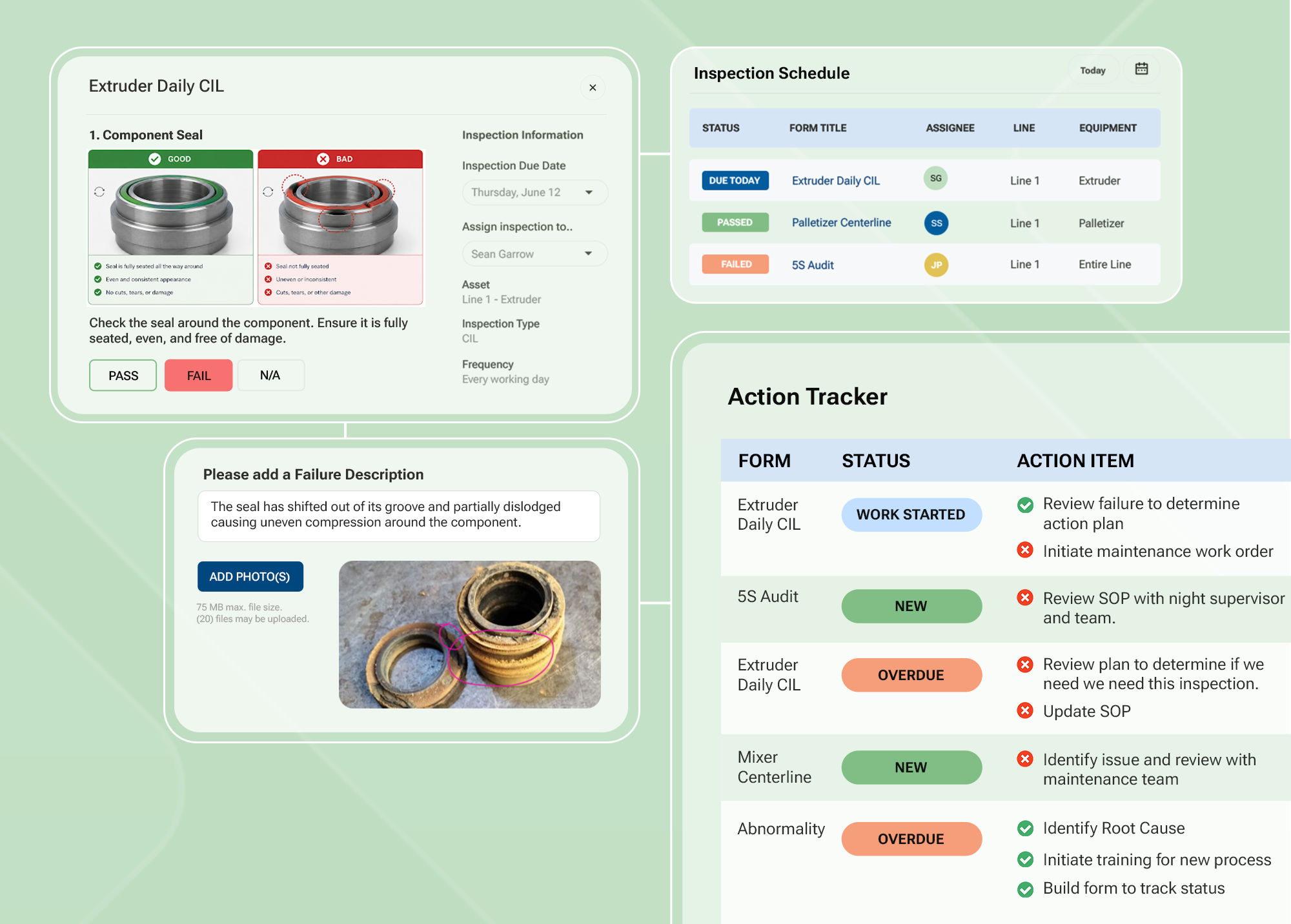
Assigning tasks explicitly, and making completion visible to a supervisor, closes that gap. With Weever, every inspection is assigned directly to a technician, so there's a clear record of who's responsible and whether it actually got done, not just whether it was supposed to.
4. Automate what happens when an inspection fails
A failed inspection is only useful if something happens next. If a failed check just sits in a binder or a shared spreadsheet until someone happens to notice it, you've lost the entire point of catching the issue early.
Automate the escalation: a failed inspection should immediately trigger a corrective action, route to the right technician or supervisor, and stay visible until it's closed. This is the same logic Weever uses for abnormality management in Autonomous Maintenance programs: catch the deviation, route it fast, close the loop, and track it so recurring issues get flagged instead of repeatedly re-discovered.
5. Use your TBM data to graduate toward predictive maintenance
Every completed inspection is a data point. Run enough of them over enough time, and clear patterns start to show up: which assemblies wear faster than expected, which lines see repeat failures on the same component, which technicians are catching issues before they escalate.
That history is exactly what predictive maintenance is built on. You don't need to start with sensors and vibration analysis. A well-run TBM program, tracked consistently over months, gives you the failure history to start predicting when specific parts and assemblies will need attention, before you invest in more advanced condition-monitoring tools.
A TBM schedule tells you when to look. A year of TBM data tells you what you're actually going to find.
Best practices for keeping a TBM program reliable
A schedule on day one is easy. Keeping it accurate, followed, and useful a year later is where most paper-based programs quietly fail.
- Keep the schedule visible to more than one person. If only one planner knows what's due when, the program depends entirely on that person's memory. Make the schedule visible to supervisors and technicians alike, so gaps get caught before they become missed inspections.
- Review and adjust the cadence, don't just set it once. Equipment usage changes, lines get reconfigured, run rates go up. A schedule built two years ago against different production volumes may no longer match how hard the equipment is actually working. Revisit cadences on a regular basis, not just when something breaks.
- Track completion data you can trust, not just completion rates. A 100% completion rate means nothing if inspections are being pencil-whipped in thirty seconds. Photos, timestamps, and required fields on each inspection make the record verifiable, not just filled in.
- Close the loop on every failed inspection. A corrective action that never gets marked resolved is worse than no record at all, because it creates false confidence that something is being tracked. Every failure should have a visible status until it's actually closed.
- Feed TBM history into your broader reliability strategy. Don't let inspection data live in a filing cabinet or a standalone spreadsheet. The real value of TBM compounds when that history feeds root cause analysis, breakdown analysis, and eventually predictive maintenance planning.
Why manufacturers run TBM on Weever
Paper and spreadsheets can launch a TBM schedule. They can't sustain one once you're running it across multiple lines, shifts, and technicians, which is where completion data quietly stops being trustworthy.
- Assignments that actually get done. Every inspection in Weever is assigned to a specific technician with a due date, so nothing depends on someone remembering a spreadsheet.
- Failures that don't sit in a binder. A failed inspection automatically triggers the next step, corrective action, escalation, or a work order, so issues get resolved instead of rediscovered next quarter.
- Reporting that turns history into foresight. Weever generates the reporting that shows you patterns across inspections over time, so you can start predicting breakdowns before they happen instead of just documenting them after.
Manufacturers like Monin and Ajinomoto have used this same digitize-first approach to move maintenance programs off paper and into a system technicians actually trust, and use. Want to see how Weever assigns, tracks, and escalates TBM inspections on your own lines?
Book a demo and we'll show you.

.webp)

Spend Less Time on Admin. More Time Improving Operations.
See how Weever automates data entry, reporting, and action items so you can focus on improvement not admin.