
What is AI data readiness in manufacturing?
Table of contents

Share:


What "AI data readiness" actually means
Most of the AI conversation in manufacturing right now is about models and tools. But far less of it is about what powers AI - the data it is fed.
That is what AI Data Readiness is. It is asking yourself... is the data coming off your plant floor good enough for an AI system to act on?
Not your ERP data or your sensor feeds, which are usually in decent shape, but the frontline data. Pre-op inspections. Sanitation checks. Autonomous maintenance tags.
That is the data most plants haven't looked at closely, and it's where readiness tends to suffer. An AI system works from the records it's handed. It has no way of knowing what never got written down.
This isn't a problem for later, either. When we surveyed 169 manufacturing leaders for The State of AI Data Readiness in Manufacturing, 63% told us their organization is already running or piloting AI. 97% also reported at least one gap in their frontline data.
In other words, most plants are running AI on data with holes in it, today.
Machines tell you when. People tell you why.
A sensor can tell you line 3 stopped at 2:14 a.m. It can't tell you the guard rattles when the humidity is up, or that the conveyor runs faster than spec because that's the only setting that keeps it from jamming. The operator knows both. Ask them and you'll have an answer in thirty seconds.
That knowledge almost never ends up in a system, but it's exactly what an AI needs to point you at the right fix instead of the right category.
In the survey, 66% of leaders trust their machine and sensor data for AI-driven decisions. Only 53% say the same about their frontline operational data.
The reason is structural. Sensor data is formatted by design. Frontline data is formatted by whoever was on shift, using whatever tool was closest, in however much time they had. So in manufacturing, AI readiness ends up being a question about how your frontline data gets captured.
The four things AI-ready frontline data has to get right
We measured four conditions in the survey. 59% of leaders were missing three or more of them.
1. It's captured digitally
A check initialled on a clipboard is a record for the auditor. It is not a record for an AI. Most leaders in the survey still have at least one core program (sanitation, quality, safety or maintenance) running primarily on paper, spreadsheets or something somebody built in-house years ago. Whatever is in the binder is invisible to the AI reading the rest of your data.
2. The same issue gets recorded the same way
One operator writes "leak." The next writes "seal broken." A supervisor reads those two issues and knows it's one seal. AI reads them and counts two unrelated issues, so the recurring problem never climbs to the top of the "to-do" list that you generated.
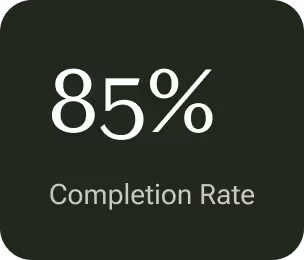
85% of leaders say the same issue gets recorded differently depending on who logs it, and 53% say that happens frequently.
3. It carries the why
A reason code tells you what happened. "Mechanical fault" is a bucket you can count. "Head 6 has been drifting light for weeks, the seal is worn, and we've been nudging the fill timing to keep it in spec" is a cause you can fix.
90% of leaders say important operational knowledge stays only with operators or inspectors at least occasionally. 59% say it happens frequently. And just over half say their organization isn't prepared to use frontline root-cause information for AI at all.
4. It's connected across departments
Most plants run separate systems for maintenance, quality and production, and each one holds a piece of what happened on the floor. 78% of leaders agree that disconnected systems limit how effective AI can be in their operations.
Here's the part that surprised us. Connecting the systems is not the same as connecting the records. Of the 83 leaders who described their systems as connected, 70% still said disconnection limits their AI. The integration is there, but each tool structures frontline data its own way, with different fields, labels and levels of detail. The data stays siloed with the pipes hooked up.
How plants get there
One thing predicted readiness more than anything else in the survey: whether operators use their frontline software. Where it's used consistently, 82% of leaders say their data is prepared for AI. Where it's used inconsistently, 6% do.
So owning the software isn't the point. Having the floor use it is. Four steps close most of the distance, and there's no required order.
- Make capture easier than paper. Put your system up against the clipboard. Can an operator finish a check on a shared device, in their own language, mid-shift, with no training? If initialling a sheet is faster, the sheet wins, every time.
- Standardize how issues get recorded. Use defined fields and picklists tied to real assets and real failure modes for the fault itself. Keep free text for the operator's account of why. Make a photo part of the record at the point of capture. Start with a short list of failure modes on your highest-impact assets and grow it from there.
- Close the loop. Every issue gets an owner, a due date and follow-through tracked to closure. When an operator flags a loose guard and sees it fixed by Friday, they flag the next one. Closed actions also give the AI the whole story: what was found, what was done, whether it worked.
- Connect it. Capture frontline data for quality, safety, sanitation and maintenance in one place, alongside your CMMS, QMS and MES rather than instead of them. Keep it reachable through an open API so it can feed your data lake and your BI tools.
See where your plant stands
AI data readiness in manufacturing comes down to a single question. When your AI looks at a frontline event, does it see the same record your best operator would give you? Captured digitally, recorded the same way every time, carrying the why, and visible to every department.
The full State of AI Data Readiness in Manufacturing report goes through all four gaps in detail, splits leaders into three readiness groups, and lays out where each group should start.
If you want to know which group you're in, take the AI data readiness self-assessment. It asks the same questions we asked the 169 leaders and shows you how your answers compare.

Spend Less Time on Admin. More Time Improving Operations.
See how Weever automates data entry, reporting, and action items so you can focus on improvement not admin.