
Benefits of Autonomous Maintenance: Why Implement It?

Table of contents

Share:


If you're making the case for autonomous maintenance, you've probably heard the objection already: "Operators are here to run the line, not fix it." And your technicians are already stretched across more equipment than they can reach.
That's exactly the problem AM solves. Done well, it puts the routine care with the people who are at the machine all day, so failures get caught early and technicians get their time back. Done badly (rushed, on paper, with nobody responding to what operators report) it adds work and changes nothing.
Below are the eight benefits plants see from a well-run program, the numbers behind them, and what it takes to get there. For the program itself, see the 7 steps of autonomous maintenance.
What is Autonomous Maintenance?
Autonomous maintenance (AM) moves basic equipment care (cleaning, inspection and lubrication) to the operators who run the machines. It's one of the core pillars of Total Productive Maintenance (TPM), and it changes the old "I operate, you fix" split into shared ownership of the equipment.
1. Less unplanned downtime
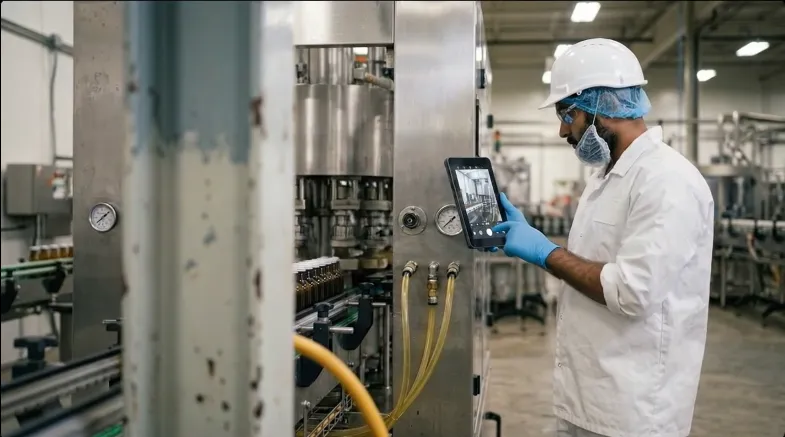
Operators who inspect their equipment every shift notice the new noise, the slow leak and the loose guard long before they turn into a stoppage. That matters because stoppages are frequent and expensive.
Cost of downtime
$125,000
Average cost of one hour of unplanned downtime for a typical industrial business
How often it happens
2 in 3
Industrial businesses with unplanned outages at least once a month
After an 18-month AM program
46%
Fewer breakdowns
After an 18-month AM program
64%
Lower overall maintenance cost
Sources: ABB Value of Reliability survey, 2023; Jain, Bhatt and Soni, Autonomous Maintenance: A Case Study on Assela Malt Factory, 2015.
In ABB's 2023 survey of 3,215 plant maintenance decision-makers, over two-thirds of industrial businesses had unplanned outages at least once a month, at close to $125,000 per hour [ABB Value of Reliability, 2023]. In the 18-month AM program at the Assela Malt Factory, breakdowns fell 46%.
What this looks like on the floor: during the morning CIL, an operator notices the infeed conveyor's drive belt has started to squeal at startup. On paper, that note sits on a clipboard until someone reads it. Logged with a photo, it reaches maintenance the same shift, and the belt is replaced at the next changeover instead of failing mid-run.
The gain compounds. Every failure caught early is a stoppage that doesn't happen, and the record of what operators caught shows maintenance which components fail most often, so preventive maintenance can target them.
How to track it: unplanned stoppages per week by line, and the number of abnormalities caught before they caused a failure.
2. Lower maintenance cost
Reactive repairs come with overtime call-ins, rush parts and collateral damage. Planned work doesn't. Every failure caught at the inspection stage becomes a planned job. At Assela, overall maintenance cost fell 64% over the same program.
Reactive work is expensive for reasons that never show up on the work order. The line stops with product half-processed, the technician drops planned work to respond, parts get expedited, and a failed bearing can take a shaft or gearbox with it. Planned work avoids all of that because it happens when you choose, with the part already on the shelf.
AM also lowers the cost of routine care itself. Cleaning, lubrication and visual checks done by operators during the shift don't need a technician to walk to the line.
How to track it: the share of maintenance hours spent on planned versus reactive work, and spend on overtime and expedited parts.
3. Technician time back for planned work
When operators handle routine CIL tasks, technicians spend their hours on preventive maintenance, root cause analysis and the repairs only they can do. Assela's maintenance team saved 23% of its person-hours and moved that time into preventive maintenance planning.
Most plants run lean on technicians, often a handful covering several lines. When they spend their shifts wiping down machines and topping up oil, the work only they can do (root cause analysis on repeat failures, PM planning, rebuilds, reliability projects) keeps slipping. AM gives that time back without asking anyone to work harder.
This is about where technician time goes, not how many technicians you have. The same team does more valuable work, and the data operators collect tells them where to point it.
How to track it: technician hours spent on routine CIL tasks before and after, and planned jobs completed each month.
4. Higher OEE
AM improves all three parts of OEE. Fewer breakdowns raise availability. Catching worn parts and drifting settings early protects speed. Keeping equipment inside its centerlines protects quality.
OEE multiplies availability, performance and quality, so a small gain in each adds up. Availability rises when breakdowns fall. Performance suffers quietly from minor stops and reduced speeds, often caused by worn parts, dirty sensors or settings that have drifted, and daily CIL and centerline checks catch those causes. Quality holds when equipment stays inside its centerlines and every changeover starts from known settings.
Because AM touches all three, it often shows up in OEE before it shows up anywhere else.
How to track it: OEE by line, split into its three components, so you can see which one AM is moving.
5. Better product quality
Operators who know their equipment notice when it starts making slightly worse product: a seal that's not quite tight, a fill weight drifting, a label skewing. Catching the equipment cause early stops the defects downstream.
Many quality defects start as equipment problems: a worn seal jaw leaving weak seals, a filler nozzle building up product and drifting fill weights, a label applicator out of alignment. QA catches them at the end of the line, after the product has been made. An operator checking the equipment every shift catches the cause before the defects pile up.
Centerline checks matter most here. When operators confirm temperatures, pressures and speeds are inside their ranges at the start of each shift, the line starts from settings known to make good product.
How to track it: defects and holds traced to equipment causes, and out-of-range centerline readings per week.
6. A safer floor
Regular inspections find hazards (loose guards, leaks on walkways, damaged cables) before someone gets hurt. AM training also builds lockout/tagout discipline into the routine.
Operators spend more time around their equipment than anyone else, so they're best placed to spot a missing guard, an oil leak on a walkway or a damaged cable before someone gets hurt. AM puts that observation on a schedule instead of leaving it to chance.
The training matters as much as the inspections. A good AM program teaches lockout/tagout before operators touch anything, defines what operators may and may not open, and writes safety requirements into every CIL standard. That discipline carries into the rest of the job.
How to track it: hazards reported through AM inspections, and how quickly they're closed.
7. More engaged operators
Operators who own the condition of their equipment treat it differently, and they're the first to suggest improvements. The proof is in participation: Royal Canin's Lebanon, Tennessee factory grew from a stalled abnormality program to 6,000+ monthly submissions across departments.
Ownership changes behaviour. An operator who cleans and inspects the same machine every shift learns what normal sounds like, notices when something changes, and starts suggesting fixes. But participation only holds when people see their reports acted on. If abnormalities disappear into a queue, reporting stops.
That's what turned Royal Canin's program around: simple reporting, a clear owner for every issue, and visible follow-up on what was overdue. Recognizing operators who catch problems early, in huddles or One Point Lessons, keeps the momentum going.
How to track it: submissions per operator per week, and abnormality close rate.
8. Production and maintenance on the same side
When operators report and maintenance visibly responds, the finger-pointing between departments fades. Both teams can see what was reported, what got fixed, and how fast.
Without AM, the relationship often runs on blame: production says maintenance is slow, maintenance says production broke it. With AM, both teams work from the same record. Operators report with photos and detail, maintenance responds, and the status of every issue is visible to both.
A shared language helps too. When operators know their equipment's components and failure modes, their reports are specific enough for technicians to act on, and technicians start relying on operators as their early warning system.
How to track it: time from report to first response, and the share of abnormalities that reach maintenance with enough detail to act on.
What it takes to get these benefits
The benefits don't arrive on day one. Plants that get them follow the steps in order, start with one line and one activity, and make sure every report from the floor gets a response. A short, trusted autonomous maintenance checklist does more than a long one nobody believes.

How Weever helps you measure the benefits
Weever puts CILs, centerlines, 5S and abnormality reporting on one system, so participation, close rates and recurring failures are visible by line and shift without anyone building a spreadsheet.
Royal Canin, Lebanon, TN
95%
Abnormality close rate, from a backlog of 300+ unresolved issues
Mars Fort Smith
89%
Abnormality close rate after moving AM onto Weever
Global CPG manufacturer
1,500+
AM submissions a month, after starting on a single line
Royal Canin, Lebanon, TN
6,000+
Monthly submissions across departments
Sources: Royal Canin case study; Mars Fort Smith case study; Global CPG manufacturer case study.
Customers see it in their numbers: a 95% close rate at Royal Canin's Lebanon factory, an 89% abnormality close rate at Mars Fort Smith, and over 1,500 AM submissions a month at a global CPG manufacturer that started on a single line.
What would autonomous maintenance be worth on your lines?
Put your own downtime, labour and line numbers into Weever’s Autonomous Maintenance ROI calculator.
Try the ROI calculator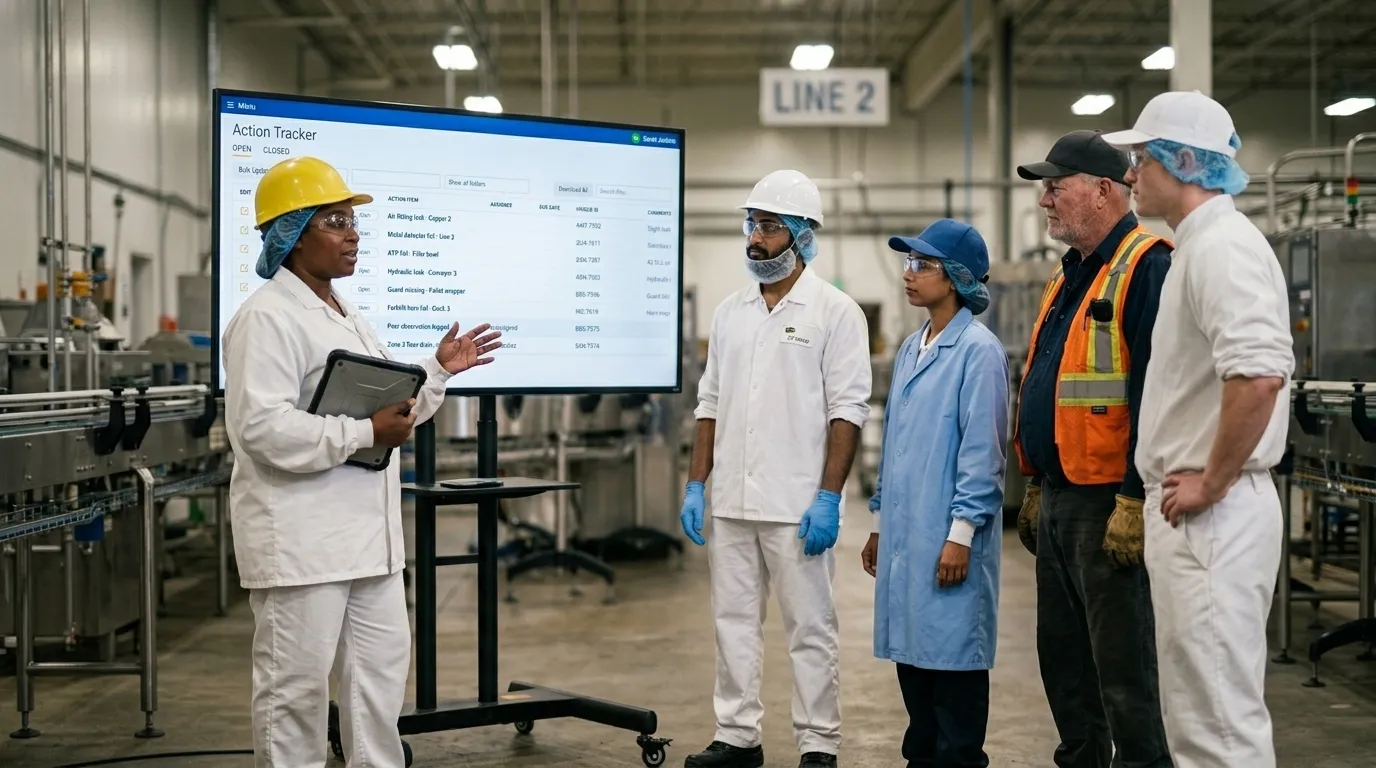
Spend Less Time on Admin. More Time Improving Operations.
See how Weever automates data entry, reporting, and action items so you can focus on improvement not admin.