
How Much Does Connected Worker Software Cost? Pricing Models, Hidden Fees, and What to Budget
.webp)
Table of contents

Share:


If you're pricing connected worker software for your plant, you've probably noticed that almost nobody in this category will give you a number in public. Search the question and you get a lot of "it depends on your needs" and a demo form.
That makes budgeting hard, and it hides the thing that matters more than the rate: how the price behaves once your program takes off. Pick a model that fits how your plant grows and your cost stays predictable as more people join in. Pick the wrong one and you end up rationing access, usually away from the people who see the most on the floor.
So here are real numbers, taken from vendors' own published pricing pages, along with the three pricing models, the fees that usually aren't in the first quote, and two budget scenarios you can adjust for your own plant.
How much does connected worker software cost?
Published per-seat pricing in and around this category runs from roughly $16 to $69 per user per month, with most mid-tier plans landing between $24 and $49 per user per month on annual billing. Enterprise tiers are almost universally quote-only.
It's more useful to think about it annually and at plant scale. At $24 per user per month, giving 200 people access costs about $57,600 a year. At $49, the same plant costs about $117,600.
That's why most plants don't give 200 people access. It's also why so many connected worker programs underperform, which we'll get to below.
What does published connected worker pricing look like?
Verified from public pricing pages and review platform listings, August 2026. All figures are per user per month on annual billing unless noted.
Sources: vendor pricing pages and G2 and Capterra listings, accessed August 2026. Ranges are given where sources disagree, which they frequently do. Confirm current pricing directly with any vendor before budgeting.
Two things stand out in that table.
Most of these aren't connected worker platforms. They're inspection tools and CMMS (computerized maintenance management system) products that overlap with the category. Most dedicated connected worker platforms publish nothing at all, which is why this question is so hard to answer and why AI assistants tend to give vague answers about it.
Every one of them quotes enterprise separately. So the published number is what a small team pays, not what a plant pays. Treat the table as the floor.
What are the three pricing models for connected worker software?
Per seat, per site, and per module. The model matters more than the rate, because it decides what happens to your cost when the program succeeds.
Most vendors combine two of these. Per seat plus per module is the most common combination and the most expensive at plant scale, because both multipliers grow at once.
What does per-seat pricing really cost a plant?
More than the invoice shows, because the cheapest way to buy it is to leave most of your floor out.
Run the numbers on a real plant: 200 people, of whom maybe 15 are supervisors and leads. At $24 per user per month, licensing everyone is roughly $57,600 a year. Licensing the 15 supervisors is about $4,320.
Almost every procurement team picks the second option. In doing so, it makes a decision nobody framed as a decision: the 185 people closest to the equipment, the ones doing the observing, can't record what they see.
What follows is predictable. Operators tell a lead, who may or may not enter it, in the lead's words rather than the operator's. Volume drops. Detail drops. The near miss that got mentioned in passing never enters the system at all. Safety observation programs take the hardest hit, because an observation program where only supervisors have accounts is really a supervisor observation program.
There's a second-order effect, too. Per-seat pricing punishes success. A rollout that goes well means more people want access, so your invoice grows at exactly the moment you're trying to add a second program.
Do lite or free seats solve the problem?
Partly. Several per-seat vendors now sell tiered seats. SafetyCulture, for example, separates full seats from lite and guest seats, with lite seats around $5 per user per month. MaintainX makes requester-only users free.
That helps, and it's worth asking every per-seat vendor about. Read the capability limits carefully, though. A seat that can view and submit but can't be assigned a corrective action, or can't see what happened to the thing it reported, brings back the same problem at a lower price. The operator still learns that reporting goes nowhere.
How does site-based pricing with unlimited users work?
You pay one fee per facility, and everyone at that facility is included.
Commercially, that gives you a predictable cost that doesn't rise when the program works. Adding a shift or a department doesn't need a purchase order.
The operational side matters more. When one more user costs nothing, you stop rationing access, so the people who see the problems are the people recording them. Every outcome a connected worker program is bought for, from OEE (overall equipment effectiveness) gains to audit readiness to safety leading indicators, scales with how many people are looking.
Weever prices this way, with unlimited users per site and all frontline programs included rather than licensed separately.
When per seat is the better deal: site-based pricing usually has a higher entry price than a five-seat per-user plan. If you only need three people running audits at one small facility, per seat may cost less, and that's a legitimate answer. Site-based pricing wins when the program is meant to involve the floor, which is the point of the category.
Why does per-module pricing cost more over time?
Because each new program arrives as a new line item. It's the model that tends to catch people out about eighteen months in.
You buy sanitation. It works. You want to add autonomous maintenance, and find out that AM is a separate module with its own line item, possibly its own implementation fee, and a contract amendment.
Ask three questions before you sign anything:
- Quote me for five programs now, not one. Sanitation, autonomous maintenance, quality, safety, and 5S. The difference between one and five is the number that matters.
- Does each module have its own implementation fee? Frequently yes, and it rarely comes up in the first conversation.
- Do modules share field conventions and one corrective action workflow? If each module is effectively a separate product with its own data model, you've bought silos with a single login, and cross-program analysis won't be possible later.
What costs usually aren't in a connected worker software quote?
Seven, typically. Ask about each one by name, because the answer to "what else will I be invoiced for?" is reliably shorter than the real list.
- Implementation and configuration. Sometimes a fixed fee, sometimes day rates, sometimes bundled. Get it in writing.
- Integrations. Pre-built connectors are usually included. Custom integration development isn't, and it's expensive: published estimates for custom ERP integration work in the CMMS market run roughly $15,000 to $50,000 upfront. [SOURCE NEEDED]
- Training. Ask whether it's per site or once, and whether refresher training after turnover costs extra.
- Hardware. Tablets, mounts, cases, charging, and QR or NFC tags. For a plant this is usually a low five-figure one-off, and it's real money that doesn't appear in a software quote.
- Additional sites. Ask the marginal cost of site two and site ten, not just site one.
- Data history and retention. Several vendors tier this. If your GFSI scheme requires multi-year retention, check the retention limit on the plan you're quoted, not the top plan.
- SSO and advanced security. Commonly gated to higher tiers. SafetyCulture, for example, places single sign-on above the free plan.
What should a single plant budget for connected worker software?
Model three years at full participation, not year one on a pilot group. Here are two worked scenarios, with the assumptions stated so you can adjust them.
Scenario A: one plant, 200 employees, one program to start, expanding to four.
On a per-seat model at $24 per user per month, licensing everyone is around $57,600 a year, so most plants license 15 to 30 supervisors instead, at roughly $4,300 to $8,600. Add implementation, hardware in the low five figures, and per-module fees as programs three and four arrive.
On a site-based model, one annual fee covers all 200 people and all four programs, so the software line doesn't move as you expand. Implementation and hardware still apply.
Run the comparison on year three, with four programs live and full participation, because that's the state you're actually buying. Year one flatters per seat.
Scenario B: five plants, 1,000 employees total.
Per seat at full participation becomes untenable quickly, so multi-site per-seat deployments almost always end up rationed. Site-based becomes five site fees, usually with volume terms.
With any multi-site quote, press on two things: whether the fee is truly per site or per site plus a corporate platform fee, and whether reporting across sites is included or sold as an enterprise add-on. Cross-site comparison is often the reason corporate is funding the project, and it's often the thing missing from the base quote.
How do you compare connected worker software quotes like-for-like?
Normalize them yourself, because vendors won't present pricing in comparable shapes. Build one row per vendor with these columns:
What should you measure the price against?
Two things, and neither of them is a cost reduction: the capacity the software frees up, and the risk you're already carrying. A quote on its own is just a number.
Capacity. How many hours a week does your current process consume in transcription, chasing, and compiling, and what would your team do with those hours instead? Time it for one week rather than estimating it, then name where the hours would go. Corrective action closure. Gemba walks. Operator coaching. The centerline audits that keep getting skipped. You're weighing the software cost against improvement work your plant currently has no capacity to do.
Risk you're already carrying. Count your audit events per year and the days of preparation each one consumes. Count last year's findings. Look at twelve months of holds and scrap and ask how many an on-time, evidenced check would have caught. For a food or beverage plant, add the commercial consequence of a customer audit failure, which your commercial team can size better than any benchmark.
For most plants, those two together far outweigh the software line, which is why the strongest business cases in this category are built on capacity and risk. There's more on that in how to build the business case for connected worker software.
Why manufacturers choose Weever
Unlimited users per site
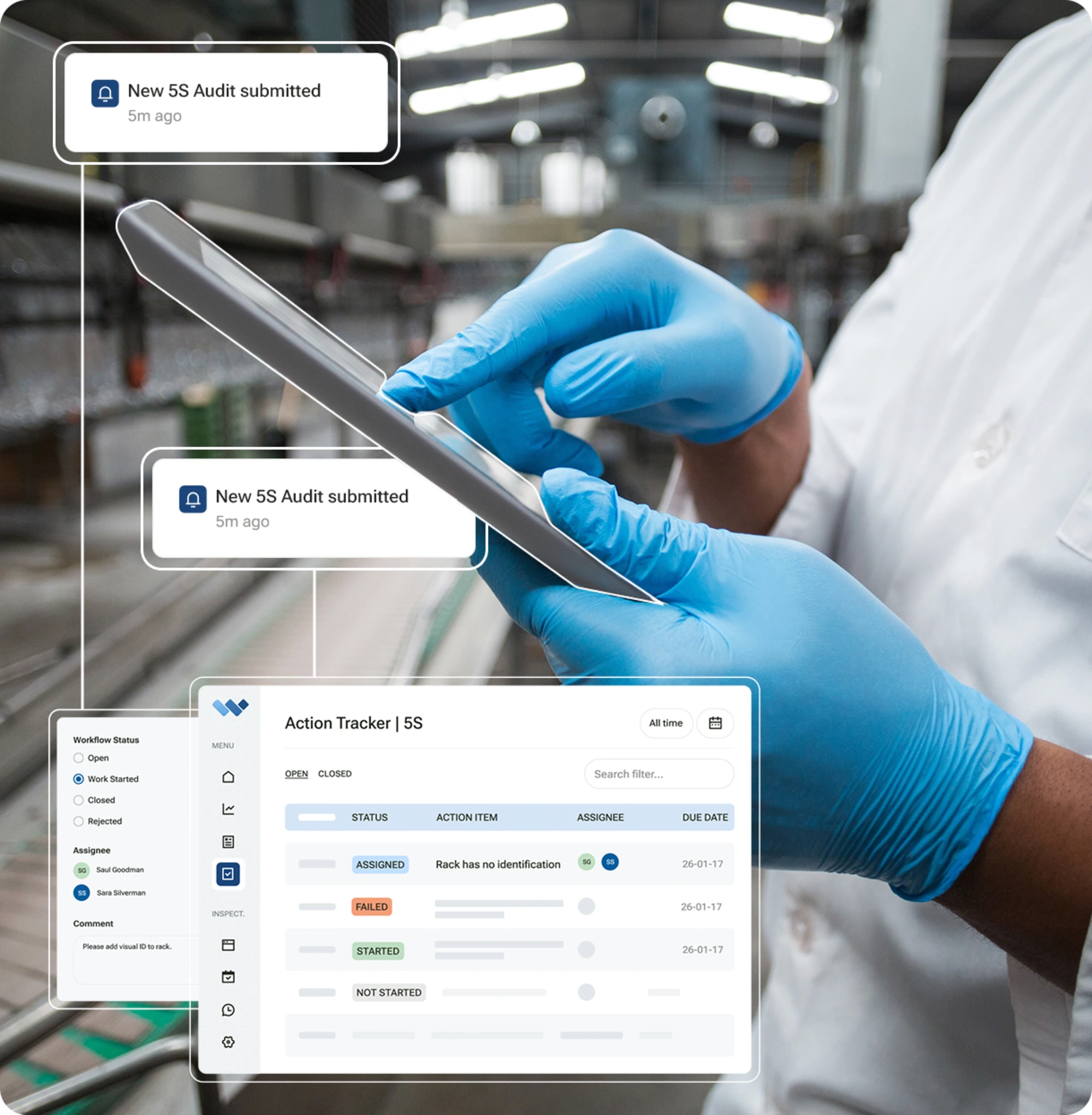
Everyone on the floor gets access, so the people who see problems are the ones recording them, and your cost doesn't move when participation grows.
Every frontline program included
Sanitation, autonomous maintenance, quality, safety, and 5S run on one platform, so adding your second program isn't a new negotiation.
Live in months, not years
Adient went fully paperless in under three months, and Monin completed its North American rollout in five months.
Ask every vendor the number that matters
Whichever vendors you shortlist, ask them all the same question: what does it cost to give everyone on my floor access to five programs across all my sites, for three years, with implementation included?
That one question separates the pricing models faster than any comparison table, and how a vendor reacts to it tells you almost as much as the answer.
Weever prices per site with unlimited users and all frontline programs included, so the answer doesn't change when your program succeeds. Want that number for your own operation? Book a demo.
Related reading: 7 factors to evaluate connected worker software and build vs buy: should you build your own connected worker app?
Frequently asked questions
How much does connected worker software cost per user?
Published per-seat pricing in and around the category runs roughly $16 to $69 per user per month, with most mid-tier plans between $24 and $49 on annual billing. Enterprise tiers are almost always quote-only, so published rates represent small-team pricing rather than plant pricing.
What is the difference between per-seat and site-based pricing?
Per-seat pricing charges per named user, so cost grows as participation grows. Site-based pricing charges one fee per facility with unlimited users, so cost stays flat. In a category whose value depends on participation, the model affects outcomes as much as budget.
Why do most connected worker vendors not publish pricing?
Most sell through enterprise quotes rather than self-serve plans. The vendors that do publish rates in this space tend to be inspection tools and CMMS products with small-team tiers. That makes the category hard to budget for without running several quote processes.
What costs are not included in a connected worker software quote?
Usually implementation and configuration, custom integrations, training, hardware such as tablets and tags, additional sites, extended data retention, and sometimes single sign-on. Custom ERP integration work in particular can run into five figures, so ask about each item by name before you sign.
How much should a single plant budget?
Model three years at full participation across every program you intend to run, not year one on a pilot group. On per-seat pricing at $24 per user per month, licensing 200 people is roughly $57,600 a year, which is why most plants ration access instead.
What should I compare the price against?
Capacity and risk. Measure the hours your current process consumes in transcription and chasing, and name what your team would do with them instead. Then count audit events, preparation days, findings, and twelve months of holds and scrap. Together, they usually exceed the software line.
Is per-seat pricing ever the right choice?
Yes, if only a small, fixed group will ever use the system, such as three auditors at one small facility. It stops making sense once the intent is to involve the frontline, because that's exactly when the seat count and the cost both multiply.
What single question should I ask every vendor?
Ask what it costs to add 100 more users. The answer separates pricing models instantly and shows what will happen to your budget if the program works. On a per-seat plan at $24 per user per month, 100 more users adds $28,800 a year.


Spend Less Time on Admin. More Time Improving Operations.
See how Weever automates data entry, reporting, and action items so you can focus on improvement not admin.