
Peer-to-Peer vs. Top-Down Behavior-Based Safety Observations: Which One Actually Changes Behavior?

.avif)
Table of contents

Share:


Ask a safety manager how their BBS program is going and you'll usually get one of two answers. Either "we're drowning in cards nobody follows up on," or "we stopped asking supervisors to do observations because they didn't have time." Both answers point to the same root cause: a program built around a small group of designated observers trying to watch an entire plant.
Peer-to-peer observation flips that model. Instead of routing every safety observation through a supervisor or EHS lead, everyone on the floor watches out for everyone else, and anyone can log what they see.
Done right, that means more eyes on more tasks, faster feedback, and a workforce that treats safety as a shared job instead of someone else's checklist. Done wrong (on paper, or in a system nobody opens), it means the same stack of forms in a binder, just with more names on them.
Here's what makes peer-to-peer BBS work, where it tends to break down, and what the data says about programs that get it right.
Why does a peer-to-peer model change participation?
Supervisors and EHS leads can only be in one place at a time. A peer-to-peer program spreads observation coverage across every shift and every task, because the people already doing the work are the ones reporting on it.
- Cultural buy-in. When observation isn't something that happens to the floor, it becomes something the floor does for itself. Teams that see safety as a shared responsibility report more, not less, because reporting stops feeling like getting someone in trouble.
- Reduced hierarchy barriers. Workers are far more likely to be candid with a peer than with a supervisor. Reporting an at-risk behavior to someone in the chain of command can feel like getting a coworker in trouble, so it gets softened or skipped. Reporting it to a peer doesn't carry that weight, which means the observation actually gets made, honestly and in the moment, instead of filtered on the way up.
- Behavior reinforcement. Positive feedback from a peer carries differently than a compliance checkbox from management. Gallup's Q12 research found the most engaged teams report 64% fewer safety incidents than the least engaged (Gallup Q12), and engagement is built shift by shift, observation by observation, not from a policy memo.
What's the cost of staying top-down?
A top-down model isn't free just because it uses fewer observers. It's expensive in a different way: it's slow, and it misses what happens when no one official is watching.
Organizations with mature leading-indicator programs, meaning programs built on observations and near-misses rather than after-the-fact injury counts, see an average 77% reduction in incident rates. Peer-to-peer reporting is what generates that volume of leading-indicator data in the first place. A top-down model that relies on a handful of trained observers simply can't produce the same wide base of the safety triangle: Heinrich's research puts roughly 300 near-misses beneath every major injury, and most of those near-misses are only visible to the people standing next to them when they happen.
Preventing a single major incident can save an organization $100,000 to $250,000 or more. That's the real cost of a program that only a few people are running.
Where peer-to-peer programs earn their keep
- Continuous improvement. Observations don't stop at "compliant" or "non-compliant." Peers surface the small process fixes that prevent the next near-miss, because they're the ones who'll hit the same hazard tomorrow.
- Real-time feedback and correction. Peer observers share a shift and a work area with the person they're observing, so an at-risk behavior gets corrected in the moment, not flagged a week later in a report nobody reads.
- Enhanced learning and skills transfer. Experienced operators pass on the safety knowledge that never made it into a training manual. That transfer happens naturally when observation is built into the job, not bolted on as a separate task.
- Customization and flexibility. A peer-to-peer program can flex to match how a specific line or shift actually works, instead of forcing every area into one standardized observer checklist.
- Cost-effectiveness. No dedicated observer headcount, no separate data-collection system. The program runs on the team that's already there.
What peer-to-peer programs need to actually work
Peer-to-peer programs are not executed well using paper forms or in a shared spreadsheet. When a peer files an observation and it disappears into a binder or an inbox, participation drops off within weeks, the same pattern the Center for Behavioral Safety found when programs lack a visible follow-through loop: sites with strong leading-indicator programs saw missed workdays fall 86.3% (from 10.9 to 1.5 days a month) within 18 months, and that kind of result only happens when every observation is tracked to a named owner and closed out, not just logged.
In our experience, peer-to-peer programs radically shift safety outcomes. One example is Walmart's shift to 60-70% proactive reporting after launching peer-to-peer BBSO.
Why manufacturers run peer-to-peer BBS on Weever
Built for the floor, not the office. Observations take seconds on a phone or tablet at the point of work, so peer reporting doesn't compete with getting the job done.
Nothing gets lost between shifts. Every observation routes to a named owner and stays visible until it's closed, so the team that reported it can see that it actually went somewhere.
Site-wide participation, not a designated few. Because Weever runs on a site-wide license, every employee can observe and report, which is the entire premise of a peer-to-peer program in the first place.
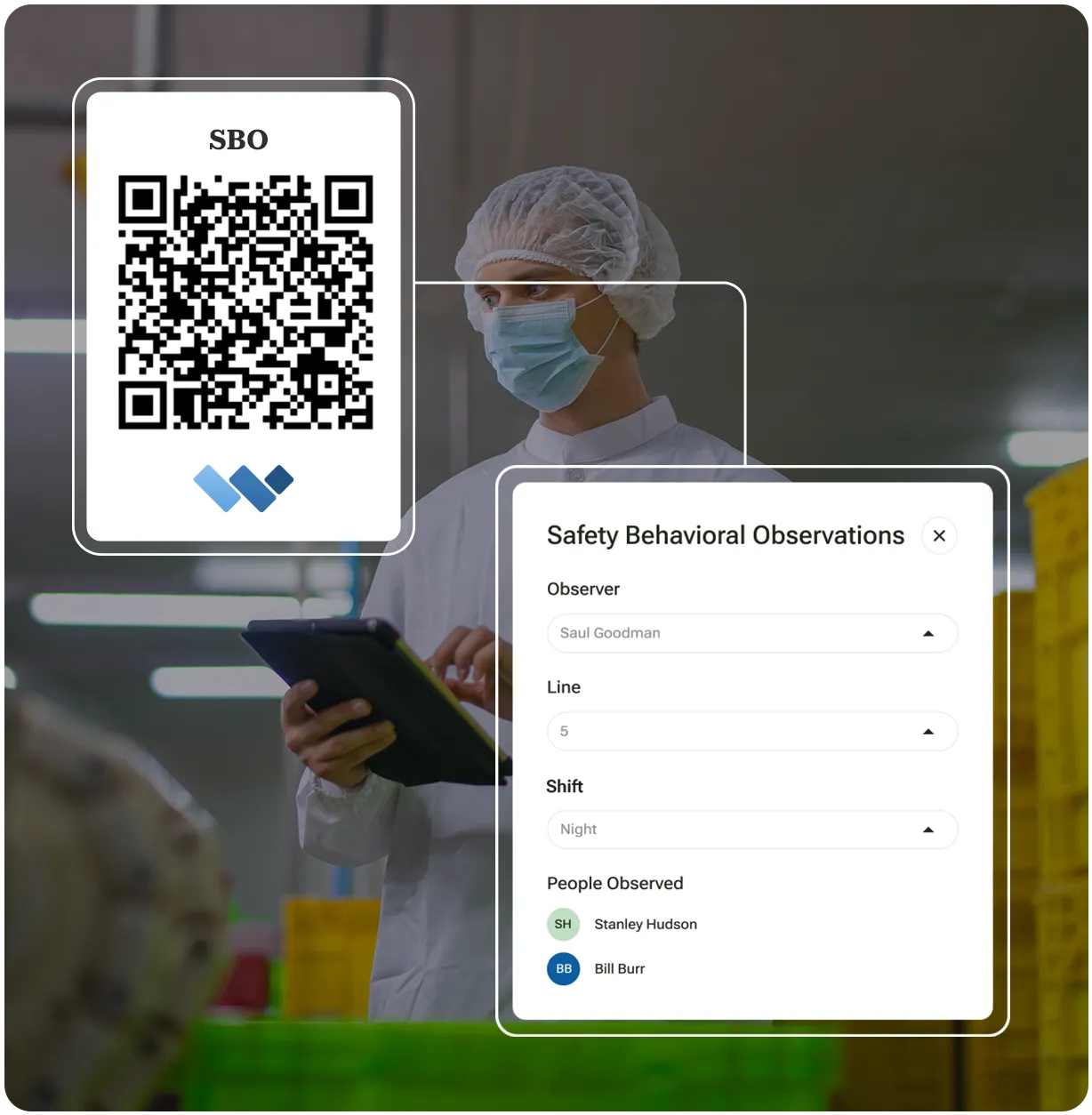
Want to see what a peer-to-peer BBS program looks like on your own floor? Book a Demo and we'll walk through it using your process, not a generic script.
.webp)

Spend Less Time on Admin. More Time Improving Operations.
See how Weever automates data entry, reporting, and action items so you can focus on improvement not admin.