
Autonomous Maintenance Step 7: How to Commit to Continuous Improvement
Table of contents

Share:


There's a moment in most autonomous maintenance programs when everyone relaxes. The routes run every shift, the standards are on every line, completion is high, and the program is declared done. Six months later, the routes are out of date, the abnormality reports have thinned out, and nobody can say when the data was last looked at.
Step 7 exists to stop that. It's the step where the program stops being a project and becomes how the plant runs: operators own routine care, the data they collect shapes what happens next, and the standard keeps getting better instead of quietly going stale. Get it right and each year's program is better than the last. Treat the finish line as the end and you'll be restarting at step 1 in two years.
Step 7 is the last of the 7 steps of autonomous maintenance. This guide covers what it means in practice, the review rhythm that keeps it moving, how to use AM data to improve the standard, how to expand what operators own, and how to keep the program from slipping.
What is step 7 of autonomous maintenance?
Step 7 is continuous improvement, sometimes called full implementation or autonomous management in older TPM materials. By now operators run routine equipment care on their own, and the job changes from building the program to improving it.
In practice that means three things. The team reviews AM data on a regular rhythm and acts on it. Repeat problems get fixed at the root instead of being reported every week. And operators take on more over time, from minor repairs to helping write and teach the standards.
Set a review rhythm
Improvement doesn't happen because people intend it to. It happens because there's a regular time when the right people look at the data and decide what to change.
The example is illustrative; match the cadence to your plant's existing meetings rather than adding new ones.
Use AM data to improve the standard
The checks operators run every shift are a record of how your equipment actually behaves. Five ways to put it to work:
Adjust intervals. A check that regularly finds problems may need to run more often. One that finds a problem every few months may run weekly instead of every shift.
Drop checks that never find anything. Every route grows over time. A check that has passed every time for a year is a candidate to remove, or move to the PM schedule, freeing operator time for the checks that matter. The maintenance manager at a global CPG manufacturer we worked with used Weever's inspection data to identify checks that could be eliminated and simplify the program.
Fix repeat problems at the root. When the same abnormality comes back on the same machine, the answer isn't another report. It's a structured problem-solving cycle (PDCA or a root cause analysis) that ends in a permanent fix.
Improve access and design. Points that are still hard to reach, guards that have to come off every week, or a part that keeps wearing early go to engineering as improvement projects.
Feed preventive maintenance. Operator findings show which components fail and how fast. Use them to adjust PM intervals and spare parts stock.
PDCA on a repeat problem
Plan, Do, Check, Act is the simplest way to turn a repeat problem into a permanent fix. Plan: define the problem and find its root cause. Do: try a countermeasure on one machine. Check: watch whether the problem comes back. Act: if it worked, write it into the standard and share it across lines (step 6 again); if not, go round again.
Expand what operators own
Once routine care is stable, operators can take on more, one task at a time and with formal sign-off: minor repairs such as replacing a worn belt or a sensor, more involvement in changeover checks, leading 5S audits in their area, and writing and teaching One Point Lessons. Each expansion goes through the same cycle as the original program: train, sign off, hand over, review.
Keep the program from slipping
Audit each step, every year. Many TPM programs audit lines against each step before they progress. Keep doing it after step 7: a yearly check that the standards still match the equipment and that operators still meet them.
Watch the leading indicators. Abnormality reports per week, time to fix, repeat issues and time per route all move before completion does. A steady fall in reports while completion stays high is the earliest warning sign.
Plan for people moving on. Name a deputy for the AM champion and every route owner, and keep standards and training in a system rather than in someone's head.
Share the wins. When the data shows a failure caught before it stopped the line, make it a story at the huddle and a One Point Lesson. It's the cheapest way to keep operators invested.
What a sustained program delivers
In an 18-month AM program at the Assela Malt Factory, breakdowns fell 46%, overall maintenance cost fell 64%, and maintenance teams saved 23% of their person-hours, which went into preventive maintenance planning [Jain, Bhatt and Soni, 2015: link needed]. The US Environmental Protection Agency estimates that most companies adopting TPM can improve equipment efficiency by 15 to 25% within three years [EPA]. Both are the result of years of steady improvement, not a single launch.
Where step 7 goes wrong
- Treating it as the finish line. The program is declared complete, reviews stop, and the standard ages.
- Data collected, never reviewed. If nobody looks at findings, repeat issues and route times, the checklist stays the same while the equipment changes.
- Improvements that never become standards. A fix that lives on one line, or one shift, is lost when that crew changes. Every improvement goes back through step 6.
- Routes that only grow. Adding checks after every incident without removing any eventually makes the route impossible to finish.
- One champion, no successor. The program stalls the week they move on.
When is step 7 done?
Step 7 is never finished, which is the point. You're in step 7 when operators own routine care and the team uses the data to adjust intervals and remove recurring causes, on a rhythm that keeps going without anyone pushing it.
How Weever helps with step 7
Weever turns every check and report into data you can act on. Reports by line, shift and equipment build themselves, and data can flow into Power BI and your CMMS. Weever Radar, the AI layer across the platform, looks across every CIL, centerline reading and abnormality report to surface the recurring patterns no one has time to dig for, and you can ask it a question and get an answer in seconds. When a standard changes, the new version is live on every line at once.
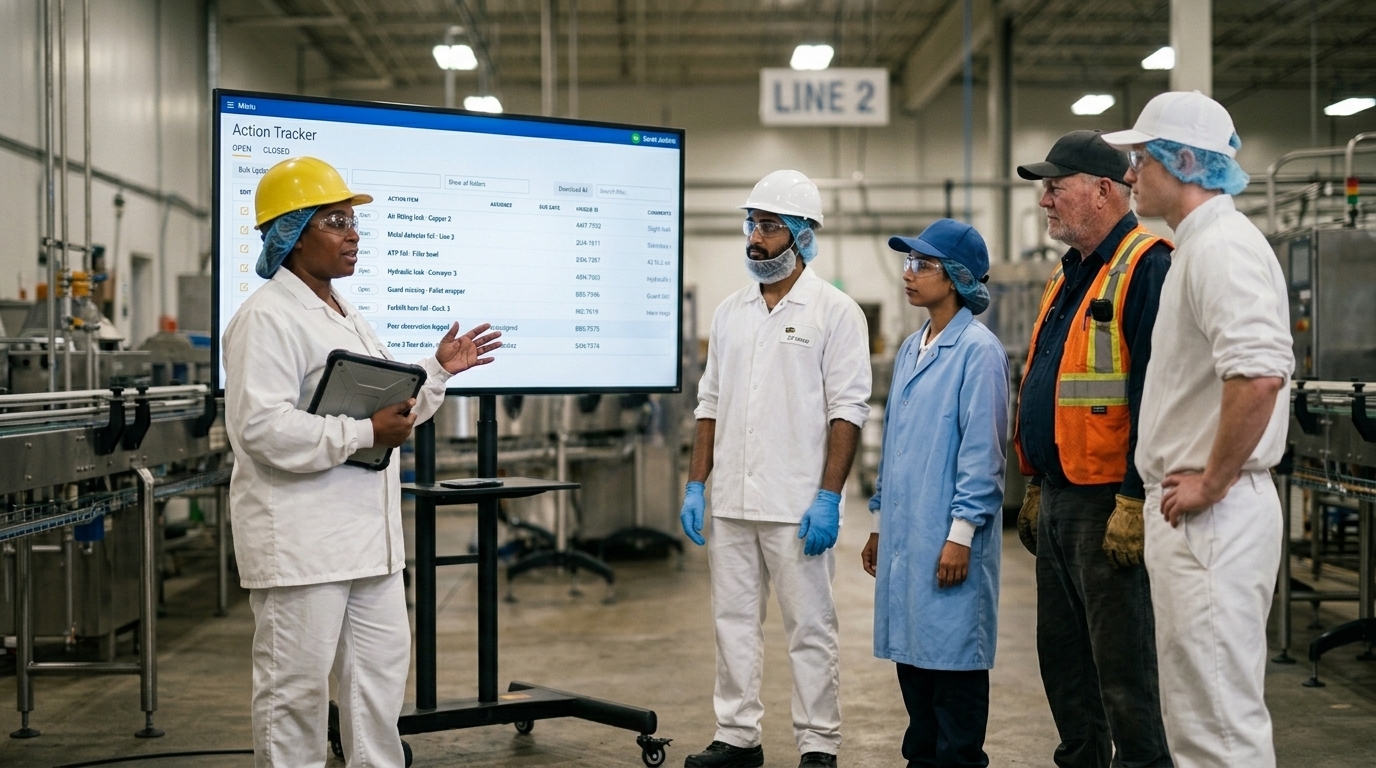
At Royal Canin's Lebanon, Tennessee factory, the abnormality program matured to the point where the Supply Excellence Manager only gets involved when an action item is overdue by 45 days, which happens only when parts are backordered. The factory reached a 95% close rate and became the leading Royal Canin facility in North America for abnormality handling. That's what step 7 looks like: a program that runs itself.
Back to the start
That completes the series. For the full picture, start from what autonomous maintenance is and how it works, or go back to step 6: standardizing and sharing best practices.
Spend Less Time on Admin. More Time Improving Operations.
See how Weever automates data entry, reporting, and action items so you can focus on improvement not admin.