
Autonomous Maintenance Step 6: How to Standardize and Share Best Practices
Table of contents

Share:


By step 6, your pilot line probably runs well. Operators own their inspection routes, findings get fixed, and the machine is in better shape than it's been for years. Then you walk to the next line, or the night shift, or your sister plant, and it's like the program never happened.
That gap is what step 6 closes. The best way to run a check, set a machine or organize a workstation usually exists somewhere in the plant; it just lives in one crew's habits or one person's head. Write it down, make it visual and share it, and every shift runs the same way and every new line starts from the best version. Leave it unwritten and each improvement stays exactly where it was made, until the person who made it moves on.
Step 6 of the 7 steps of autonomous maintenance turns what one line has learned into the standard for all of them. This guide covers what to standardize, how to make standards visual, how to roll them across shifts, lines and sites, and how to keep them current.
What is step 6 of autonomous maintenance?
Step 6 is standardization. Steps 1 to 5 focused on the equipment itself: cleaning it, fixing its sources of contamination, writing its CIL standard and teaching operators to inspect it. Step 6 widens the scope to everything around the equipment that affects how well it runs: the workstation, tools and spare parts, settings, changeovers, how abnormalities are handled, and how data is recorded.
Older TPM materials call this step Organization and Orderliness, which describes the same idea: an organized workplace where the right way of doing things is defined, visible and followed. The goal is simple to say and hard to sustain: the best way becomes the only way.
Why standardization matters
Without standards, every shift drifts toward its own version of the routine. Settings get nudged, checks get skipped or added, tools end up wherever the last person left them. None of it is careless; it's what happens when "the right way" isn't written down anywhere people can see it.
The cost shows up in three places. Results vary by shift, so it's hard to tell whether a problem is the machine or the method. Training takes longer, because every new hire learns whichever version their buddy uses. And multi-site programs stall, because a routine that runs differently in every plant can't be compared, supported or improved centrally.
What gets standardized in step 6
Start from your best shift. Where shifts or lines do the same job differently, don't average them. Find the one that gets the best results and make its method and settings the standard. This is sometimes called running to target: record the settings and steps from your best-performing runs, then make them the baseline for everyone.
Make standards visual
A standard that lives in a binder is followed when someone remembers it. A standard built into the equipment and the workstation is followed every time someone looks at it.
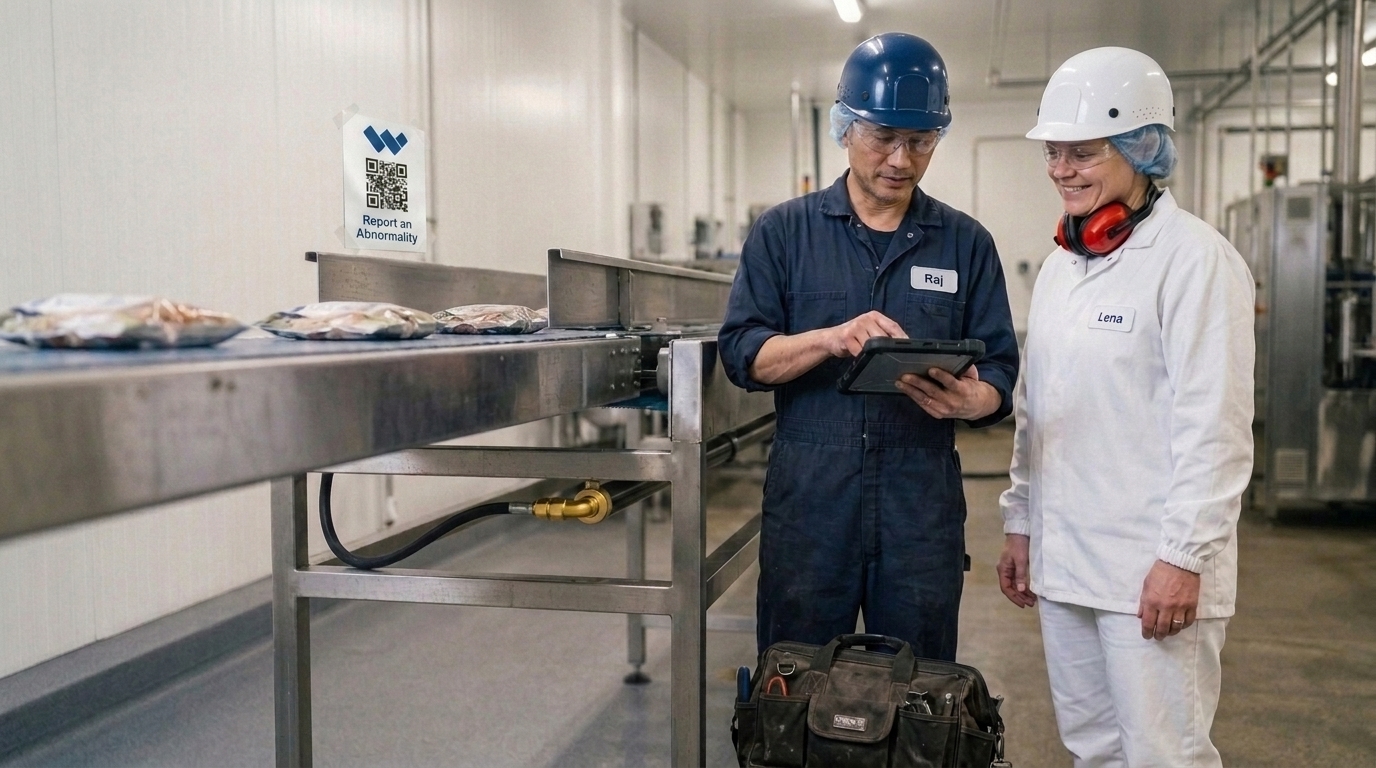
Green and red zones on gauges, match marks on critical bolts, flow-direction and fill-level labels, colour-coded lube points, shadow boards for tools, floor markings for where materials go, and QR codes that open the current standard at the machine all turn a judgement call into a glance. They also make abnormalities obvious: a gauge in the red, a missing tool or a moved match mark stands out to anyone.
For the workstation side, see how to standardize in 5S. For the line-side view of the program, see how to design an autonomous maintenance board.
How to roll standards across shifts, lines and sites
Write it once, with the people who do it. The crew that developed the best method writes the standard, in their own words, with photos of the real equipment.
Keep one master version. Every standard has an owner, a version number and a change log. When it changes, the old copies are retired the same day, not left taped to a guard.
Train to every change. A change to a standard is a training task for everyone it affects. Update the skills matrix when they're signed off on the new version.
Copy to the next line, then adapt. Start the next line from the pilot line's standards instead of a blank page. Change only what's genuinely different about the equipment, and record why.
Go site to site with a template. For multi-site programs, agree a common structure (the same route format, severity levels, data fields and KPIs) and let each site fill in its own equipment. That's what makes results comparable across plants.
Audit adherence, not just completion. Periodically watch a check being done and compare it with the standard. Gaps are either a training need or a sign the standard needs to change.
Share what works
Standards spread best practice down; sharing spreads it across. One Point Lessons are the simplest tool: when an operator finds a better way to do a check, or catches a failure early, turn it into a one-page lesson and share it at the next huddle, on every shift. Short cross-shift handovers, a monthly review across lines, and a regular call between sites running the same equipment keep improvements moving.
Where step 6 goes wrong
- Standards nobody updates. The equipment gets modified, the checklist doesn't, and operators learn to ignore the parts that no longer make sense.
- Every shift keeps its own version. If the night shift's method was never written down or retired, it's still the standard on nights.
- Copying blindly between sites. A route written for one plant's filler won't fit another's. Share the structure; adapt the detail.
- Too many standards. A binder of 200 SOPs is as hard to follow as none. Standardize what affects equipment condition, quality and safety first.
When is step 6 done?
Step 6 is done when the best-performing routine is documented and used on every shift and line: one current version of each standard, visual controls on the equipment, operators trained and signed off on the current versions, and a working way to share improvements.
How Weever helps with step 6
In Weever, each standard exists once. Routes, checklists and One Point Lessons carry their photos and target ranges, and when a standard changes, the new version is live on every line at once, so there's no out-of-date copy on the floor. QR codes at the machine open the right form, and forms run in 11 languages for mixed crews. Proven standards can be deployed to new lines and sites without starting over, and reports use the same fields everywhere, so results compare.
Mars Fort Smith, a Mars site we worked with, had AM spread across paper calendars, Microsoft Forms and SharePoint, with staff unsure which document was current. Within six months, it had all of its existing AM forms on Weever, accessed through iPads and QR codes. Monin, a flavoured syrup manufacturer we worked with, started with one location and rolled its standard forms out to all of its North American facilities within 5 months.
Next: keep improving
With the standard in place everywhere, the last step is to keep making it better. That's step 7: committing to continuous improvement. Back to step 5: autonomous inspection.
Spend Less Time on Admin. More Time Improving Operations.
See how Weever automates data entry, reporting, and action items so you can focus on improvement not admin.