
Creating a Successful Autonomous Maintenance Program

Table of contents

Share:


Most autonomous maintenance programs launch well. There's a kickoff, a deep clean, new checklists on every machine and a photo for the newsletter. Then, somewhere around month four, completion rates start sliding, the binders stop moving, and the program becomes something the plant used to do.
The difference between a program that lasts and one that fades is rarely the checklist. It's everything around it: who owns the program, how operators are trained, what happens when they report a problem, and whether anyone looks at the data. Get those right and AM becomes part of how the plant runs. Leave them out and you've built a cleaning schedule with a TPM label on it.
This guide covers what an autonomous maintenance program actually includes, the roles that keep it running, a phased rollout plan, how to make the business case, and the measures that tell you it's working. For the steps operators follow inside the program, see the 7 steps of autonomous maintenance.
What is an autonomous maintenance program?
Autonomous maintenance (AM) moves routine equipment care (cleaning, inspection, lubrication, tightening and abnormality reporting) to the operators who run the machines. It's one of the core pillars of Total Productive Maintenance (TPM), and it frees technicians for the planned and specialist work only they can do.
A program is more than the tasks. It's the structure that makes the tasks happen every shift: a sponsor who protects the time, a champion who runs it day to day, written standards, training that's tracked, a loop that gets every reported problem fixed, and a regular review of what the data says. Without that structure, the tasks are the first thing cut when production gets busy.
Why autonomous maintenance programs stall
Programs rarely fail in one dramatic moment. They erode, usually for one of five reasons.
- Forms before capability. Operators get a checklist before anyone teaches them what they're checking. Completion comes back at 100% and nobody believes it.
- Everything at once. CILs, centerlines, 5S and abnormality reporting launch plant-wide in the same month. Nothing gets done well, and the team concludes AM doesn't work.
- Reports go nowhere. Operators flag a leak, nothing happens, and they stop flagging. This is the fastest way to lose the floor.
- Data nobody trusts or reads. Paper sheets get keyed into a spreadsheet days later, if at all. Managers can't see trends, so the program can't improve.
- One person holds it together. When the champion moves on, the standards, the schedule and the know-how leave with them.
We've written more on this in why autonomous maintenance programs die in month four. Every building block below exists to prevent one of these.
The six building blocks of an AM program
| Building block | What it means | Sign it’s working |
|---|---|---|
| Sponsor and business case | A plant leader who owns the program, protects operator time and reviews results | AM time is on the production schedule, not squeezed in |
| Team and roles | A named champion, plus operators, technicians, supervisors and engineering with clear jobs | Anyone on the floor can name who runs AM on their line |
| Standards | Written CIL standards, centerline ranges and 5S expectations for each machine | Two operators on different shifts do the same check the same way |
| Training and skills | Structured training, tracked in a skills matrix, refreshed as standards change | New hires reach sign-off on a set timeline |
| Response loop | Every abnormality gets an owner, a due date and a visible outcome | Close rate is high and operators keep reporting |
| Measurement and review | A short set of KPIs reviewed weekly at the line and monthly by leadership | Standards change because of what the data shows |
Sponsor and business case. AM asks for operator time during production, so it needs someone with the authority to protect that time. A plant manager or operations director usually fills this role. Their job isn't to run the program; it's to make sure it isn't the first thing cut on a busy day, and to ask about results every month.
Standards. Every check needs a written standard: what to clean, inspect, lubricate or tighten, how, how often, and what "good" looks like. 5S belongs here too. A machine sitting in clutter can't be inspected properly, and a well-organized workstation makes abnormalities obvious.
Response loop. This is the block most programs underbuild. When an operator reports an abnormality, three things must happen: someone owns it, it gets fixed or scheduled, and the operator can see the outcome. Without that loop, every other block decays.
Who owns what in an AM program
| Role | Owns | In a typical week |
|---|---|---|
| Plant sponsor | Time, budget and priority for AM | Reviews KPIs, removes blockers, recognizes wins |
| AM champion | Day-to-day running of the program | Updates standards, tracks training, chases overdue issues |
| Operators | CIL checks, centerline checks, abnormality reporting | Completes checks each shift, reports what they find |
| Supervisors and team leaders | Shift execution and coaching | Checks completion, coaches, runs the shift huddle |
| Maintenance technicians | Training operators, fixing what’s reported, planned work | Teaches one skill, closes reported issues, does PM |
| Engineering or CI | Root causes and design fixes | Leads PDCA on repeat failures, improves access |
Write these roles down and put names against them. Build a cross-functional core team from them (one person per role is enough on a pilot line) and pick people who are respected on the floor, not just available.
How to roll out an AM program: a phased plan
The most common rollout mistake is going plant-wide on day one. A phased plan lets you prove the approach on one line, fix what doesn't work, then copy what does.
Prepare
About 2 to 4 weeks
- 1
Build the case and the team
Name the sponsor and champion; record downtime and technician-time baselines.
- 2
Choose the pilot line
Real problems, and a supervisor who wants it to work.
Pilot
Months 1 to 3
- 3
Steps 1 to 3 on one line
Deep clean, remove contamination sources, write CIL standards.
- 4
Start the response loop
Every defect tag gets an owner and a due date from day one.
Prove
Months 3 to 6
- 5
Hand over routine checks
Train general inspection; operators run the checks; KPIs reviewed weekly.
- 6
Show the before and after
Breakdowns, response times and technician hours, for the sponsor.
Scale
Month 6 onward
- 7
Roll out line by line
Reuse pilot standards and training; pilot operators become trainers.
Phase 1: Prepare (about 2 to 4 weeks). Build the business case, name the sponsor and champion, choose a pilot line, and record a baseline: breakdowns, unplanned downtime, and how much technician time goes to routine tasks. Pick the pilot line carefully: one with real problems but a supervisor who wants to make it work.
Phase 2: Pilot (months 1 to 3). Take the pilot line through steps 1 to 3 of autonomous maintenance: the deep clean, eliminating contamination sources, and writing CIL standards. Start the response loop from the first defect tag.
Phase 3: Prove (months 3 to 6). Add general inspection training and hand routine checks to operators. Start reviewing KPIs weekly. Fix whatever is slowing the response loop. By the end of this phase you should be able to show the sponsor a before-and-after.
Phase 4: Scale (month 6 onward). Roll out to the next lines, reusing standards and training from the pilot instead of starting over. Keep the review rhythm going, and move pilot-line operators into training roles.
Timing varies with plant size and starting condition; treat these as typical ranges, not targets.
How to make the business case
Leadership needs to see what downtime costs today and what AM changes. Start with your own numbers: unplanned downtime hours on the pilot line, the cost per hour, and how many technician hours go to cleaning and lubrication.
Industry figures help frame it. In ABB's 2023 survey of 3,215 plant maintenance decision-makers, over two-thirds of industrial businesses had unplanned outages at least once a month, at close to $125,000 per hour [ABB Value of Reliability, 2023]. In one 18-month AM program at the Assela Malt Factory, breakdowns fell 46% and overall maintenance cost fell 64% [Jain, Bhatt and Soni, 2015].
Frame the return as capacity, not headcount: technician hours moved from routine tasks to planned work, and production hours no longer lost to breakdowns. Then take leadership on a short floor walk past the machines that stop most often. Seeing a leak that's been there for months does more than a slide.
What to measure
Track a few leading indicators that show the program is running, and a few lagging ones that show it's working.
- Leading: CIL completion by shift, abnormalities reported per week, abnormality close rate, and time from report to first response.
- Lagging: breakdowns per line, mean time between failures, the split of planned versus reactive maintenance hours, and OEE.
Review the leading indicators weekly at the line, and the lagging ones monthly with the sponsor. If completion is high but abnormalities reported is near zero, that's a warning sign: checks are being ticked, not done.
Where software fits
A CMMS is built for maintenance work orders, parts and asset history. It's the right home for the repairs AM generates, but it's rarely built for operators doing quick checks on a shared device mid-shift. Most plants run AM checks in a tool designed for operators and send failed checks into the CMMS as work orders, so nobody enters the same issue twice.
How Weever helps you build the program
Weever runs CILs, centerlines, 5S and abnormality reporting on one system. Checks run on a schedule with reminders, operators see photos and target ranges at the machine with no app or login, failed checks route to maintenance automatically, and reports by line and shift build themselves. Site-wide pricing means every operator can take part without per-seat costs.
That was the deciding factor for the maintenance manager at a global CPG manufacturer we worked with. He piloted on one line with a small internal team, then rolled out across the site, and the plant now averages over 1,500 AM submissions a month.
“I was attracted to Weever because of the platform’s single site licensing fees, which meant I could get everyone involved without having to worry about increasing costs.”
Mark, Maintenance Manager, Global CPG Manufacturer
Read the case studyMars Fort Smith, a Mars site we worked with, followed the same pattern: a soft launch with a core group of staff, then all of its existing AM forms on Weever within six months, and an 89% abnormality close rate.
Start with one line
A successful AM program is built, not launched. Pick one line, name the people, protect the time, and make sure every report from the floor gets an answer. Then copy what works.
What would autonomous maintenance be worth on your lines?
Put your own downtime, labour and line numbers into Weever’s Autonomous Maintenance ROI calculator.
Try the ROI calculator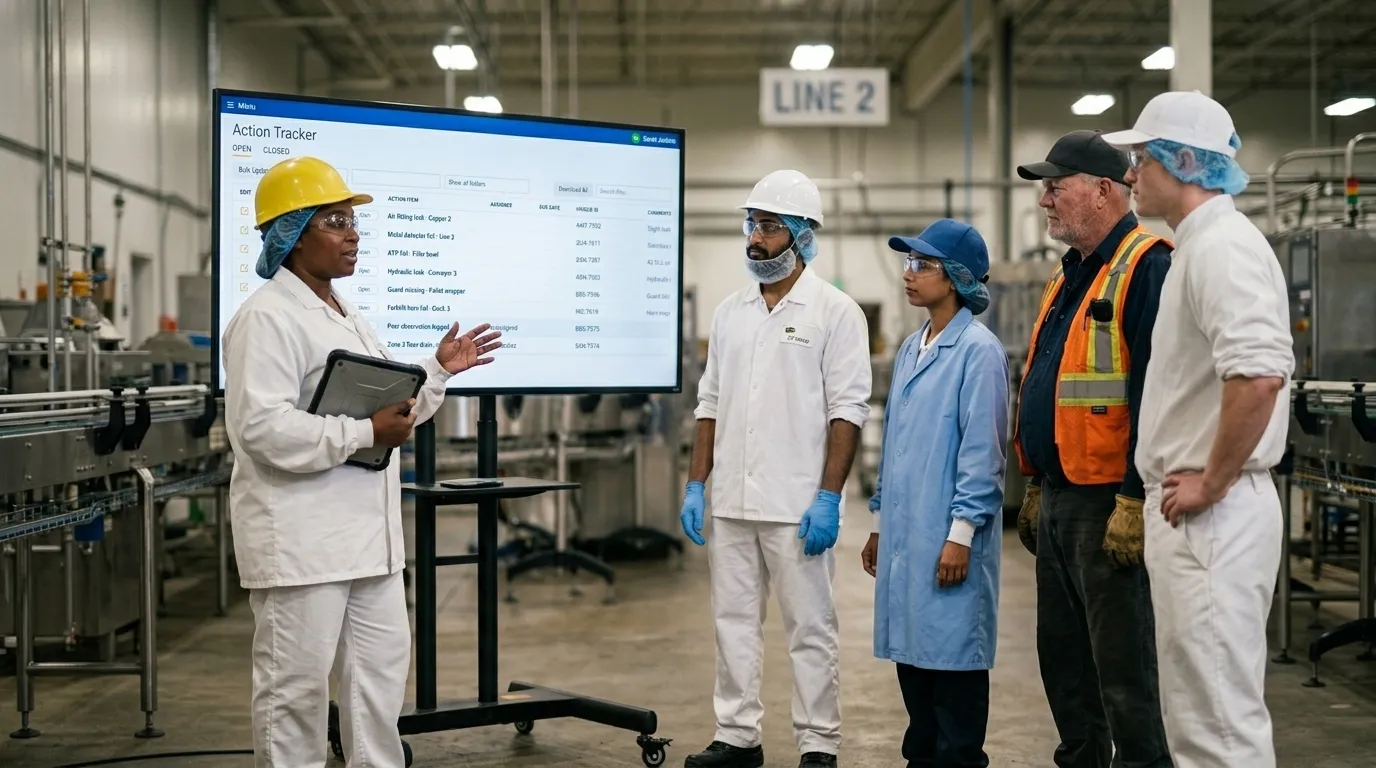

Spend Less Time on Admin. More Time Improving Operations.
See how Weever automates data entry, reporting, and action items so you can focus on improvement not admin.