
Why Autonomous Maintenance Programs Die in Month Four
-%20smaller.webp)
Table of contents

Share:


The launch goes well. Week one, operators are interested. The checks are new, someone from corporate visited, there was a kickoff meeting with coffee. Completion sits near 100 percent. Month two, still good. Month three, a supervisor mentions that the night shift has been behind, but the numbers look fine so nobody digs.
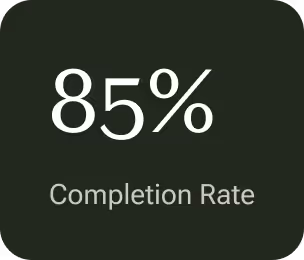
Month four, the program is dead. Not cancelled, dead. The forms still exist. The schedule still generates checks. Completion still reports somewhere in the nineties. And nobody in the plant believes the number, including the person who reports it.
Well-run AM programs cut breakdown frequency by 30 to 50 percent in the first year and lift OEE 15 to 25 percent within two years of sustained practice. Almost none of that value accrues in the first ninety days. It accrues in the years after, which means the entire return on your program depends on surviving the thing that happens in month four.
Here is what actually kills it, in the order it usually happens.
Failure one: the loop never closed
An operator finds something. A weeping seal, an unusual noise, a guard that rattles. They report it, which is exactly what you trained them to do.
Then nothing visible happens.
Maybe it got fixed and nobody told them. Maybe it went into a queue. Maybe the form sat in a tray. From the operator's side these are indistinguishable, and all three teach the same lesson: reporting is paperwork, not action.
This is the root cause of most AM decay, and it is not a motivation problem. It is a feedback problem. People stop doing things that appear to have no effect. If reported abnormalities are not visibly actioned, reporting dries up, and once reporting dries up you have lost the entire early-warning function of the program while keeping all of its administrative cost.
The cost of a paper AM program is not the paper. It is the abnormality that got reported, filed, and never fixed, until it became the breakdown you did not see coming.
The fix is unglamorous: the person who reported the issue has to be able to see what happened to it, without asking. Not a monthly summary. The specific item they raised, and its status.
Failure two: the checks were never completable
Somebody built the CIL form with the best intentions and put forty inspection points on it. It takes twenty-six minutes. The shift has four.
What happens next is predictable and it is not dishonesty. The operator triages. They do the eight points that matter, and they mark the rest complete because the alternative is submitting an incomplete form and having a conversation about it. Within a month, the entire form is being completed in ninety seconds.
This is pencil-whipping, and it is a design failure rather than a character failure. The tell is a completion rate that stays high while abnormality reports fall toward zero. High completion and low findings is not a healthy program. It is a program that has stopped looking.
The remedy is ECRS: eliminate, combine, reduce, simplify. Most lines have hundreds of potential inspection points and need somewhere between 5 and 20 of the highest-impact ones. Fewer points that actually get done beat comprehensive coverage that gets performed. We go deeper on scoping in how many centerline points your line actually needs.
Failure three: the standard aged out and nobody noticed
Equipment moves. A machine gets rebuilt, a new sleeve gets installed, a lubrication point relocates. The CIL form still asks about the old configuration.
Operators notice immediately, and the first time an operator is asked to check something that no longer exists, the form loses authority. Not just that step. The whole form. From then on it is treated as a bureaucratic artifact rather than a working instruction, and every subsequent step is completed with that assumption.
Paper makes this nearly impossible to prevent at scale. If your standards live in binders across four lines and three shifts, you cannot know which version anyone is holding.
Failure four: it depended on one person
Every dying program has a person whose name comes up. The CI lead who built it. The maintenance manager who chased completion every morning. The supervisor who cared.
Then they take a role at another site, and the program's institutional memory leaves with them, because it was never written down. Which components matter, why that centerline range and not the OEM default, what the workaround is on line three. This is the same reason experienced operators taking tribal knowledge with them hurts so much, and food manufacturing has lost roughly 15 percent of its workforce since 2020, so this is not a hypothetical.
If the program cannot survive one person's departure, it is not a program. It is that person's habit.
Failure five: the data could not answer a question
At some point a plant director asks a reasonable question. Which equipment keeps generating the same issue? Which inspection points fail most often? Are our fixes holding?
If the answer requires someone to spend a day with a spreadsheet, they ask twice and then stop asking. And once leadership stops asking, the program loses its only external pressure. It becomes something the floor does rather than something the plant manages, and things in that category get dropped the first week production gets tight.
The four numbers that tell you it is happening
Completion rate will not warn you. It is the last number to fall. Watch these instead:
- Abnormality reports per week. Should be stable or rising as operators get better at seeing. A decline is your earliest and most reliable warning sign.
- Average time from report to confirmed fix. When this stretches, reporting is about to fall. It is a leading indicator of the leading indicator.
- Repeat issues on the same equipment. Tells you whether fixes are holding or whether you are re-reporting the same problem. Rising repeats with steady completion means the loop is running but not resolving.
- Completion time per check. If the average drops sharply, the checks are being performed rather than done.
Two of these are hard to get from paper at all, which is part of why paper programs decay invisibly. We break down the measurement side in more detail in how to reduce equipment downtime in manufacturing.
What programs that survive do differently
They are not more disciplined. They are built so that the right thing is the easy thing.
- Closure is visible to the reporter. Every issue traceable from submission to fix, by the person who raised it.
- The check fits the shift. Scoped with ECRS, 5 to 20 points, revisited when completion times start drifting.
- Standards live in one place and update everywhere. Including the reference photo of what correct looks like, attached to the step.
- Wins get shared. When AM catches a failure before it becomes downtime, that story gets told, ideally as a One Point Lesson with the operator's name on it. Recognition is the cheapest sustaining mechanism available and almost nobody uses it.
- Leadership asks a data question monthly and gets an answer in minutes. The pressure stays on because the answer is cheap to produce.
Why manufacturers use Weever to keep programs alive
The loop closes where operators can see it. Every reported abnormality is trackable from submission to closure by the person who reported it, which replaces finger-pointing with shared accountability.
Standards travel with the check. Reference photos, centerline ranges, One Point Lessons, and short videos live inside the form, so the current version is the only version anyone sees.
Participation holds. Site-wide pricing with unlimited users, no app install, no login, 11 languages, on shared devices. Customers report participation increases of 500 percent and more, and one site logged more than 100 abnormalities from 60 active users inside the first 90 days.
Questions get answered in minutes. Completion by line and shift, closure times, and repeat issues without compiling anything. One maintenance manager recovered roughly 30 percent of his day from reporting admin.
If you want the full picture of how the program holds together, our autonomous maintenance software page walks through it end to end.
Month four is a design problem, not a discipline problem
Programs do not die because operators stopped caring. They die because the system asked for more than a shift allows, gave nothing visible back, and could not answer the question that would have justified fixing it.
If your completion rate looks healthy but your abnormality reports have been falling, that is worth a look this week. Book a demo and bring your current CIL form. We will tell you honestly whether it is completable in the time your operators actually have.



Spend Less Time on Admin. More Time Improving Operations.
See how Weever automates data entry, reporting, and action items so you can focus on improvement not admin.