
5 best layered process audit software and apps for manufacturing in 2026

Table of contents

Share:


Quick summary
Layered process audit (LPA) software should do more than schedule checklists across operators, supervisors, and managers. The real difference is how teams assign actions, track progress, escalate issues, and spot recurring problems after a finding is logged. Some platforms are built specifically for LPA, while others connect audits with broader quality workflows or existing manufacturing systems.
Here are our top three picks:
Does your LPA software close the loop, or just record the audit?
Most layered process audit tools can handle the obvious parts: digital checklists, recurring audits, mobile forms, and dashboards. Operators complete checks, supervisors verify them, managers review the results, and the system records what happened.
The bigger problem starts after a finding is logged. If failed items are not assigned, tracked, escalated, and compared across sites, the same issue can keep resurfacing even while audit completion looks healthy. That is the difference between digitizing an LPA and managing the full process around it.
The platforms in this guide close that gap in different ways. We compare five LPA software options based on how well they support the full workflow, from scheduling and evidence capture to corrective action and cross-site visibility.
Why listen to us
Weever's team comes from actual plant floors, where writing down a finding doesn’t automatically mean it gets fixed. That space between the audit and the resolution is the exact problem this list is built to evaluate.

Top manufacturers like Adient, Monin, and HelloFresh deploy Weever to run their frontline operations and audits more effectively. Operators, supervisors, and plant managers tell us where findings stall after they are logged and why they fail to reach resolution. That is the problem Weever was built to solve, and the same standard we used when comparing every platform here.
What is layered process audit checklist software?
Layered process audit checklist software helps manufacturers manage recurring process checks across different levels of the organization without relying on separate schedules, scorecards, and follow-up systems.
The “layered” part means that the same critical process is checked by people at different levels and at different frequencies. For example:
- Operators or team leads: Frequent process checks
- Supervisors: Weekly verification
- Managers or plant leaders: Periodic higher-level audits
This repeated verification is what separates an LPA from a standard one-time inspection. AIAG’s CQI-8 Layered Process Audit Guideline formalizes the methodology and covers areas such as roles and responsibilities, process-specific checksheets, recording findings, management review, and measuring LPA effectiveness.
At a basic level, LPA software is a more specialized form of manufacturing audit management software. It gives manufacturers a digital system for planning recurring checks, recording results, and reviewing whether required audits are being completed.
The depth of scheduling, scoring, follow-up, reporting, and system connectivity varies considerably between platforms.
How LPA software improves manufacturing quality
The value of an LPA comes from repetition. Critical process controls are checked repeatedly by different levels of the organization while production is still running. Software helps keep that repetition useful instead of letting it become another box-checking exercise.
Finds process drift while there is still time to correct it
LPAs are designed to verify critical process controls while the work is happening, not months later during a formal review. AIAG notes that this kind of repeated verification can help reduce variation, scrap, rework, and the need for end-of-line inspection.
Software makes those checks easier to coordinate across roles and frequencies, so process drift is more likely to surface before it becomes a recurring quality problem.
Shows whether the same standard holds up at every level
An operator and a plant manager may audit the same process weeks apart, but both should be checking against the same critical controls.
Digital checklists and scoring rules make those results easier to compare. If one shift, line, or site keeps interpreting the same requirement differently, the inconsistency becomes easier to spot.
Keeps findings moving after the auditor walks away
A failed check has little value if it ends as a note on an audit form. Digital findings can carry the score, photos, comments, location details, and follow-up owner in the same record.
That gives the next person enough context to act without having to reconstruct the issue from paper notes, spreadsheets, or separate systems.
Makes audit discipline easier to maintain at scale
The layered model creates a lot of moving parts. Different people audit different areas at different frequencies, and that workload grows quickly across several shifts or plants.
Recurring schedules, reminders, and visibility into missed audits reduce the amount of manual coordination required by CI and quality teams.
5 best layered process audit software at a glance
The five platforms below approach LPA from different angles. Some are built specifically around layered audits, while others position LPA within broader inspection, quality, or production workflows:
1. Weever - Multi-site process manufacturers who want full control over LPA audit configuration
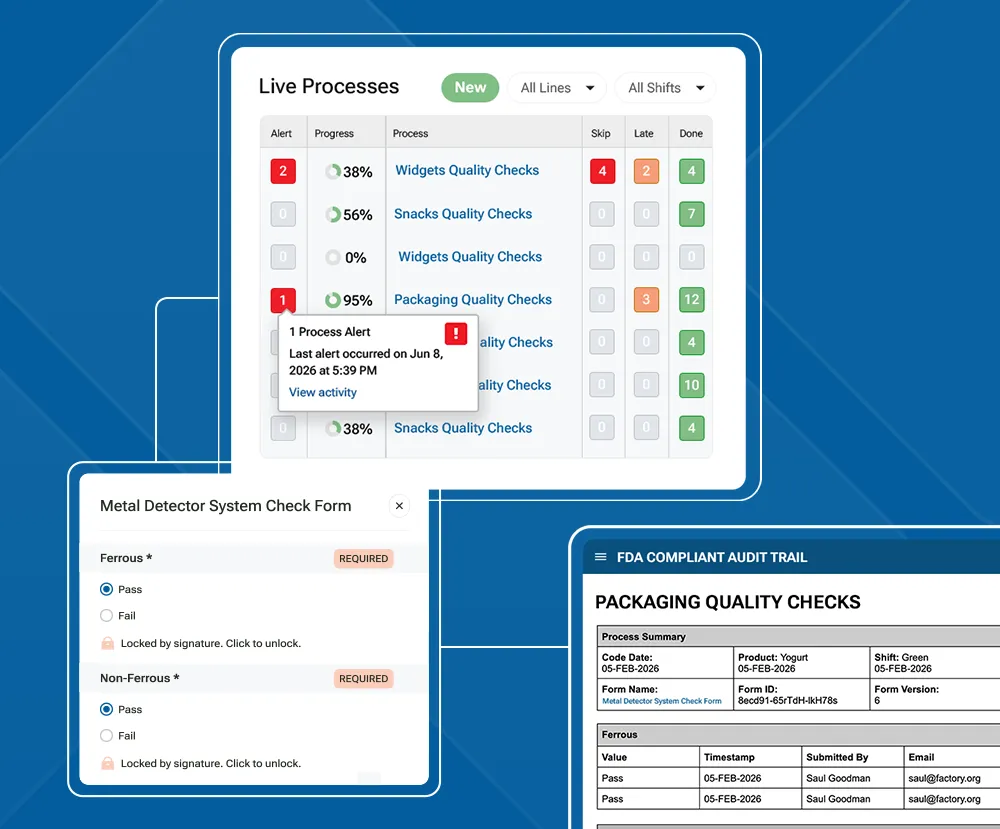
Weever is a connected worker platform built for food, beverage, and CPG manufacturers, running programs such as 5S auditing, quality checks, safety audits, autonomous maintenance and sanitation. For layered process audits, it uses the same scheduling, scoring, evidence capture, and action-tracking capabilities to manage audit checks across different roles, frequencies, and sites.
Audits are built as digital process templates rather than fixed forms inside the platform. This allows quality managers to configure the checks, fields, and logic around their own processes instead of working around someone else's template. Each layer is assigned to a specific job role at its own cadence, daily checks for operators, weekly reviews for supervisors, monthly audits for managers. A step that goes past its due date gets flagged automatically instead of waiting for someone to notice.
Every layer works from the same standardized checklist, so a pass or fail means the same thing whether an operator or a plant manager is holding the device. A failing item can require a photo before the form will submit, so managers get documented proof behind a score rather than a bare pass or fail.
When something fails, Weever generates a corrective action with an owner, due date, and reminders built in. Steps can carry their own logic too. So a failed or out-of-range answer can require an extra step or flag the item as a critical issue rather than sitting on the form. Loop-back alerts notify the original reporter once the issue is resolved. That way, findings stay visible through closure instead of ending with the audit submission.
Additionally, every audit keeps its own timestamped activity history, who completed each step, when, and what they submitted. This history is exportable as a PDF, allowing your team to serve the record on request anytime.
For multi-site programs, dashboards show audit completion, scores, open actions, overdue work, and trends across layers and locations.
Plants can also run 5S audits, GMP and quality audits, safety audits, Gemba walks, process confirmations, and compliance verification audits in the same platform, with findings following the same corrective-action process.
Already have an established tech stack? Weever works alongside your existing QMS, CMMS, ERP, or EHS platform rather than replacing them. APIs, webhooks, and Power BI connect LPA data to broader quality, maintenance, and reporting systems, while audit work stays easy to manage on the floor.
Key features
- Configurable process templates: Build audits, fields, and logic around your own process instead of a fixed template
- Job-role scheduling: Assign the same audit process to different roles and cadences, from daily operator checks to monthly manager walks
- Missed-step visibility: See an overdue or incomplete step as soon as it passes its due date
- Failure rules built into the form: Require photo evidence on a failed item, or route an out-of-range answer to an extra step or critical-issue flag
- Closed-loop actions: Assign failed items to an owner with a due date and reminders, then notify the original reporter once it's resolved
- Floor access: Run audits on phones, tablets, shared devices, or through QR-code and no-login access
- Multiple audit programs: Run LPA, 5S, GMP/quality, safety, Gemba, and other audits in the same platform
- Enterprise integrations: Connect to your QMS, EHS, CMMS, or ERP through APIs, webhooks, and Power BI
How Weever performs in real plant environments
Mars Snacking’s Waco plant used Weever to digitize recurring quality checks and replace paper-based processes with real-time reporting. In some areas, audit and quality-check completion increased by up to 46%, while missed checks dropped from 7 per period to just 2. The plant also reduced paper use enough to save roughly two trees per month.
Value props
- Reduces the risk of LPAs becoming a separate system that sits outside the plant's existing QMS, EHS, CMMS, or ERP
- Makes it easier to scale participation across the workforce without restricting the program to a small group of licensed auditors
- Gives CI teams a better chance of spotting recurring process problems across sites before they become isolated local issues
- Keeps LPA from becoming another compliance exercise by linking audit activity more closely with follow-through
- Supports broader standardization across plants without forcing every location to abandon the systems and processes already in place
Why we picked this platform
Weever runs layered audits with more configurability than most platforms on this list. It builds each layer as its own recurring process, tied to a job role and a cadence, instead of a fixed template. An operator's daily check, a supervisor's weekly review, and a manager's monthly walk of the same process can all run in the same system, with the same standardized checklist and a full activity history behind every submission.
Scoring stays consistent across every level, and trends show up across levels too, not just within a single audit. And it doesn't stop at the record when an item fails. Most inspection tools turn a failed item into a form submission. The submission sits there. Weever turns it into an owned, dated, tracked action instead.
Combine all this with the data portability it brings, connecting to your QMS, EHS, CMMS, and ERP, and Weever earns its spot at the top of this list.
What customers are saying
Monin's quality team was running paper equipment inspection and cleaning forms that operators walked to the quality department for review, while supervisors rebuilt KPI reports by hand. That was costing 3 to 4 hours a day. Weever digitised the forms and automated the reporting, and the approach worked well enough that Monin took it from one location to every North American facility in five months.
"Using Weever ensured that we did not lose documentation for compliance reporting. We could also see where issues were happening and make adjustments quickly," - Johanna Velez, VP Quality Assurance, Monin.
Mars Fort Smith runs three separate Weever programs side by side, sanitation, safety, and autonomous maintenance, and each one closes out at a rate that used to be unreliable on paper. Sanitation tasks hit 100% completion site-wide. Maintenance abnormalities get addressed and corrected 89% of the time. 18000+ safety observations have been completed to date.
Pricing
Weever uses site-wide pricing with unlimited users, with the exact quote available on request. Since a layered audit program involves multiple levels by design, operators, supervisors, and managers, unlimited-user pricing makes it easier to expand participation without licensing every additional person separately.
2. EASE
Best for: Plants running formal LPA programs across mixed mobile device fleets
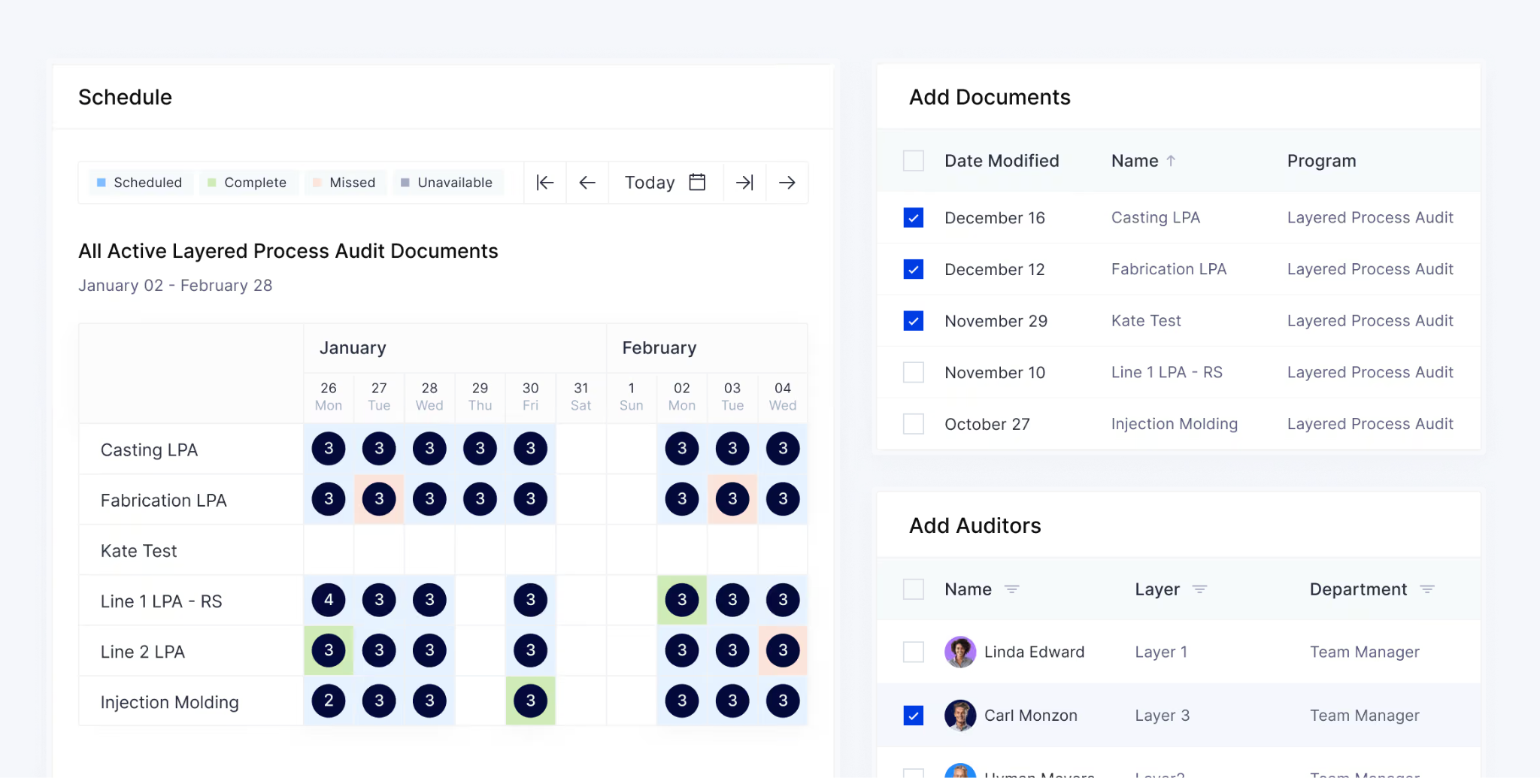
EASE is a dedicated manufacturing audit software with a strong focus on layered process audits. It supports formal LPA programs with tools for layered scheduling, question management, mobile and offline auditing, and cross-plant reporting.
Mobile is where EASE pulls ahead of the field. Its app runs offline natively on iOS, Android, and Windows devices, and switches between online and offline on its own as connectivity comes and goes. Completed audits upload automatically once a connection returns. Most platforms here support offline only inside their iOS and Android apps, so a plant running Windows tablets on the floor loses offline capture entirely. EASE fills that gap.
The app is localized in more than 25 languages. Anyone can log a non-conformance from the app outside a scheduled audit, so an issue spotted between checks still enters the system.
EASE also publishes LPA benchmark data and implementation resources, which can help quality teams compare their program against a broader manufacturing sample.
Key features
- Cross-platform offline auditing: Run full audits on iOS, Android, or Windows without a connection, with automatic upload once back online
- Central question library: Keep approved LPA questions in one place and reuse them across sites, lines, and audit layers
- In-app achievements: Track auditor completion and issue identification to keep participation up
Value props
- Offers the most robust mobile OS support
- Audits keep running in dead zones and cold rooms where shop-floor Wi-Fi drops out
- Supports other recurring manufacturing audits alongside LPA
Why we picked this platform
EASE earns its spot for how directly it is built around LPA, rather than adapted from a broader inspection or quality tool. That focus shows most clearly on the floor. Offline auditing works natively across iOS, Android, and Windows, which is unusual in this category. Plus, the app is built so an audit never stalls because of a weak signal or the wrong kind of device. For a plant running a formal LPA program across mixed hardware, that reliability matters more than another dashboard feature.
Pricing
The EASE pricing plans start at $720 per site per month; EASE Plus at $890; and EASE Pro at $1,290, all billed annually. Pricing varies by site headcount, and implementation fees apply.
3. Mitti
Best for: Smaller plants that want ready-made LPA templates
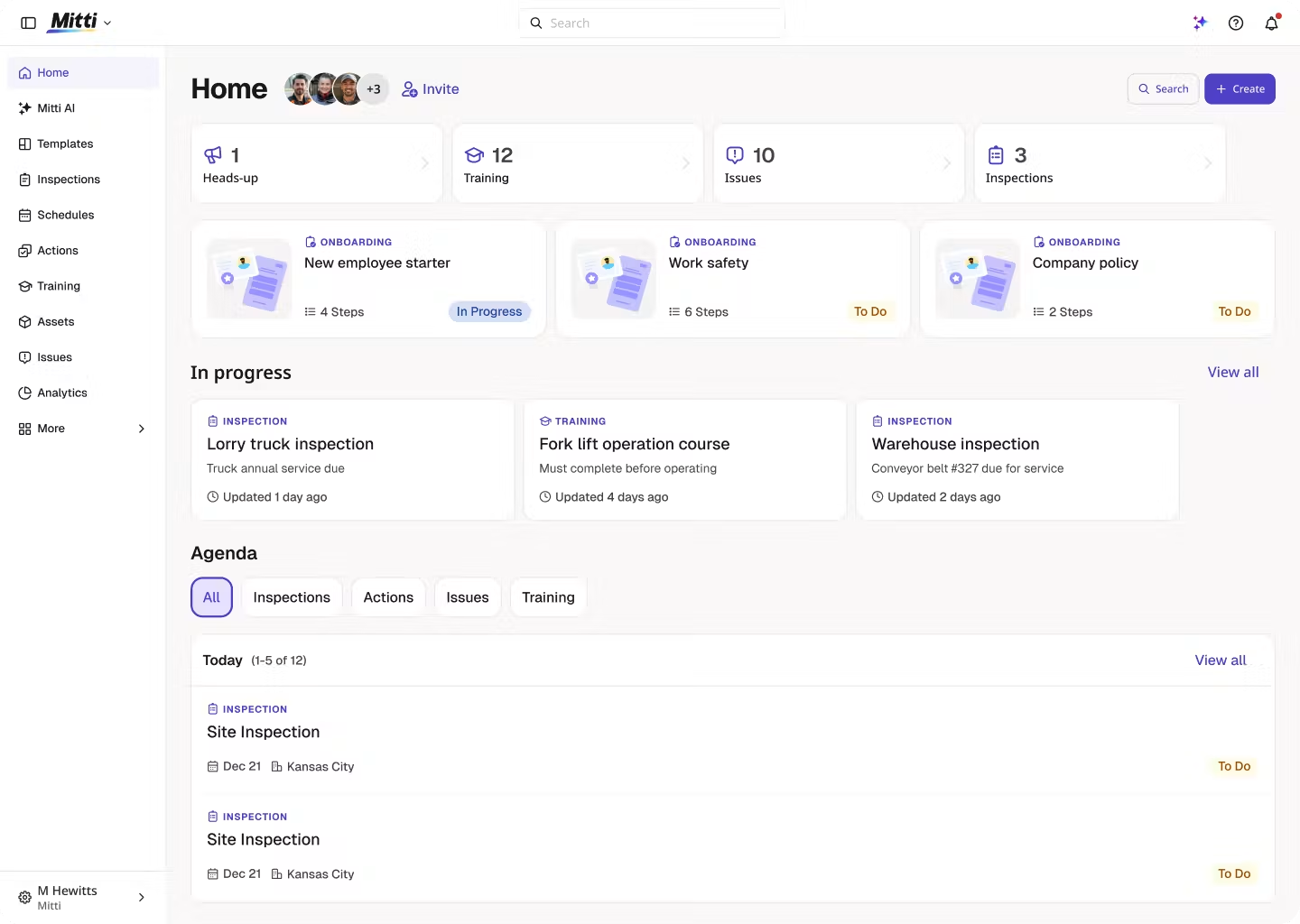
Mitti, formerly SafetyCulture, is a frontline operations platform used for inspections, audits, issue management, training, and other site-level workflows. For LPA programs, its main advantage is the template library, including a ready-made 10-question LPA checklist. Teams can edit them for their own production lines, processes, and audit requirements.
While these templates help get your team started fast, the supported scheduler is capable of running only one layer at a time. Nothing ties an operator's version of that check to a supervisor's, or a supervisor's to a manager's.
Key features
- Scheduled inspections: Set recurring audits and track inspections that become missed or overdue
- Report exports: Share completed audit results in PDF, Excel, or web formats
- AI template creation: Build a checklist from a prompt, or import an existing one from PDF, Word, or Excel
Value props
- Reduces the setup work involved in converting existing paper audits into mobile forms
- Makes it easier to adapt the same base checklist for different production areas and processes
- Gives auditors visual references when pass/fail decisions depend on a specific condition
Why we picked this platform
Mitti earns its place for the range of LPA templates available through its template library. Its own 10-question LPA checklist gives manufacturing teams a practical starting point. The library also includes templates for specific areas such as assembly lines, molding, maintenance, and quality labs.
Pricing
Mitti offers a free plan for up to 10 users. Premium costs $29 per user/month, while Enterprise pricing is custom.
4. GoAudits
Best for: Manufacturers wanting randomized questions in each LPA
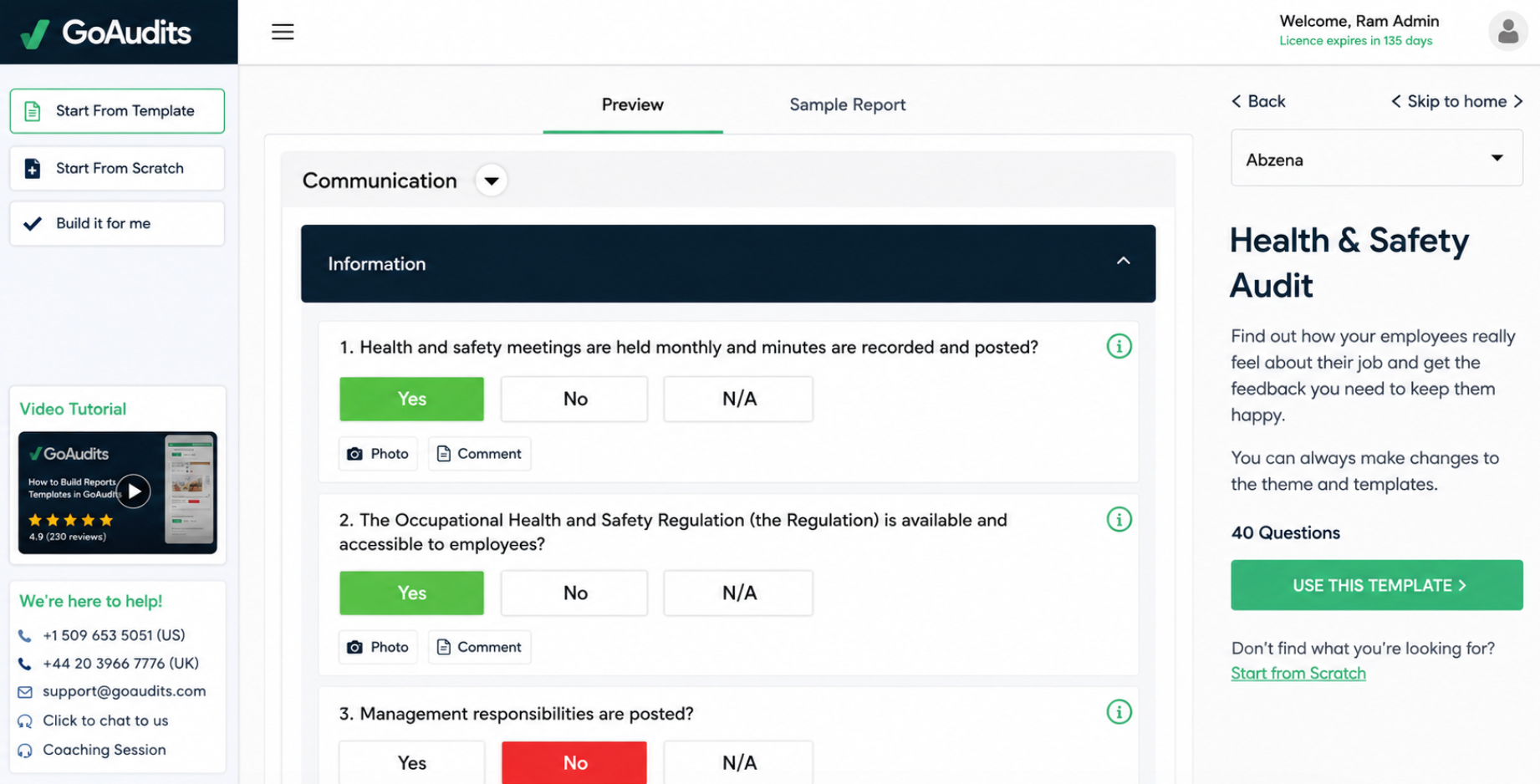
GoAudits is a digital inspection platform for layered process audits and other manufacturing checks. Teams can create or customize checklists for different audit layers and schedule recurring checks from the same platform.
Its main differentiator for LPA is the use of checklist randomization. Questions can appear in a different order across repeated audits, making it harder for experienced auditors to work through the checklist from memory. GPS and timestamp verification can also provide additional confirmation that the audit was completed at the expected place and time.
Key features
- GPS and timestamp verification: Confirm an audit was completed at the expected place and time
- Automatic reports: Generate inspection reports with scores, photos, and findings after an audit is completed
- Audit scheduling: Assign recurring inspections by user and location, with notifications for upcoming or overdue work
Value props
- Makes recurring LPAs less predictable by varying the order of questions between audits
- Lets small teams start without a user minimum, with existing checklists digitized during the trial
- Reduces manual reporting by compiling completed inspection data automatically
Why we picked this platform
GoAudits earns its spot for question randomization. It adds variety to recurring LPAs and reduces the likelihood that audits are completed on autopilot. This helps keep each check focused on the process rather than the checklist sequence.
Pricing
GoAudits offers two paid plans. Starter costs $12.5 per user per month, and Enterprise costs $30 per user per month when billed annually.
5. WorkClout
Best for: Automotive suppliers keeping LPA tied to quality and ISO records
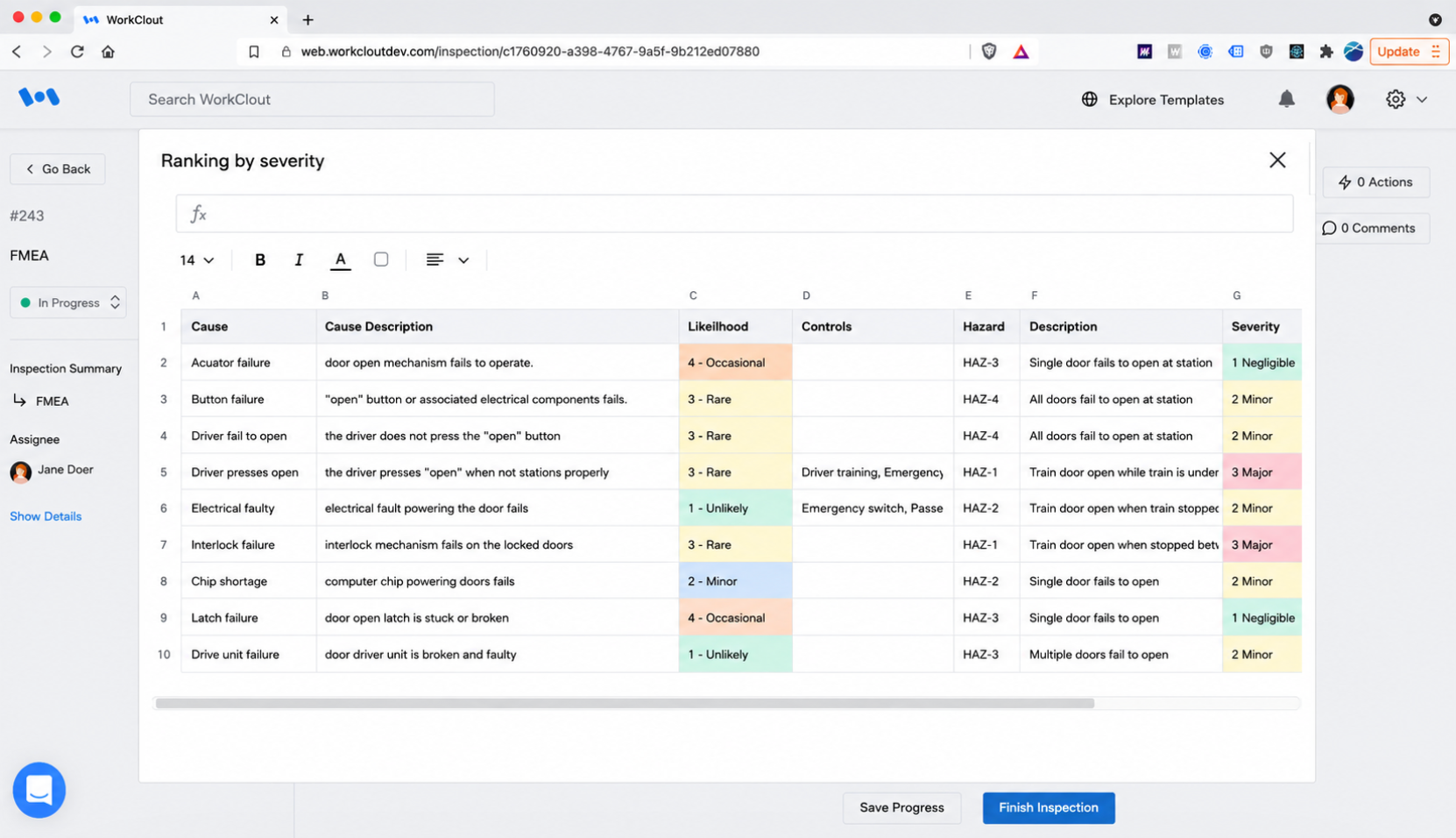
WorkClout is a manufacturing quality management platform that includes layered process audits within a broader QMS and has a strong focus on automotive suppliers. LPA activity is integrated with ISO documentation, CAPA, inspections, and other quality records rather than operating as a separate audit system.
Its main appeal is centralization. Teams can keep audit results and supporting quality records in one environment, including structured risk information such as FMEA likelihood, controls, hazards, and severity rankings.
That centralization comes with a gap, though. The audit trail doesn't show who signed off at each level, or what backed up their score. For a layered program, that's an important component, and one where Workclout lacks.
Key features
- Conditional audit logic: Show or hide LPA questions based on earlier responses, so auditors only see checks relevant to the situation
- Failure metrics: Track LPA completions, nonconformances, corrective actions, completed actions, and overall scores
- Controlled documents: Manage work instructions, revisions, and approval workflows within the broader quality platform
Value props
- Connects audit failures with wider quality workflows rather than treating LPA as an isolated program
- Gives quality teams a common place to manage audit data and controlled process documentation
- Supports automotive and other manufacturers working with formal quality-management requirements
Why we picked this platform
WorkClout earns its spot for the direct way it ties LPA to a supplier's broader ISO and quality documentation. It’s a natural fit for automotive manufacturers who already live inside that kind of record-keeping.
Pricing
WorkClout starts at $35/user/month for Starter, with Plus at $225/month and Professional at $525/month. Enterprise pricing is custom.
How different types of LPA software compare
LPA software generally falls into a few different categories. The right fit depends on whether you need a dedicated LPA system, a broader quality platform, or a better way to run on-the-floor audits alongside your existing systems.
How to choose manufacturing floor LPA software
Start with how your LPA program runs today, not with the longest feature list. The right platform should fit your audit structure, existing systems, and the way findings are handled on the floor.
1. Map every audit layer and frequency
List who performs each audit, what they check, and how often it happens. Make sure the software can support different cadences for operators, supervisors, managers, and other roles without creating extra scheduling work.
2. Define what should happen after a failed check
Decide whether a failure needs a photo, corrective action, supervisor alert, escalation, or immediate stop-work response. This is one of the clearest ways to separate basic inspection software from platforms built for deeper follow-through.
3. Check how much standardization you need
Consider whether every plant should use the same checklist and scoring rules or whether some sites need their own versions. Also consider weighted scoring, conditional questions, and question randomization if they are part of your LPA process.
If different auditors interpret the same requirement differently, review how your manufacturing audit checklist defines questions, scoring criteria, and evidence requirements.
4. Look at how it fits with your existing systems
If your QMS, EHS, CMMS, ERP, or MES is staying in place, check how LPA data will move between systems. APIs, webhooks, BI connections, and existing integrations can matter more than adding another standalone database.
5. Test the reporting against management questions
During a demo, ask the vendor to show how you would identify missed audits, recurring failures, overdue actions, site differences, and score trends. A dashboard is useful only if it answers the questions your CI and quality teams already ask.
Weever is built to close the gap other LPA tools leave open
A layered program needs every level rolled into one system, and every finding closed, not just logged. Most LPA platforms only solve part of that. Dedicated audit tools run the checklist well but leave it standing alone. QMS platforms centralize documents but don't track which level audited what, or when. Inspection tools run one audit at a time, without connecting an operator's check to a supervisor's or manager's review of the same process.
Weever is built for that gap. It schedules audits by role and level, captures evidence at the point of failure, and turns every failed item into an owned, tracked action. It does this while connecting to the QMS, EHS platform, CMMS, or ERP already in place.
Book a demo to see how manufacturers like Adient, Monin, and HelloFresh use Weever to strengthen audit execution and follow-through.
FAQs
1. How much does layered process audit software cost?
Layered process audit software pricing varies by vendor. Some platforms charge per user, while others use site-wide, module-based, or custom enterprise pricing. Many vendors do not publish full prices, so manufacturers usually need to request a quote based on plant size, number of users, sites, and required workflows.
2. Can manufacturers switch from paper LPAs without disrupting the current audit schedule?
Manufacturers can usually move from paper LPAs to software without changing the existing audit cadence. A good rollout keeps the same audit layers, frequencies, and responsibilities while replacing paper forms with digital checklists and automated scheduling. Teams can then adjust the process gradually once the digital workflow is running reliably.
3. How often should layered process audits be performed?
Layered process audit frequency depends on process risk, customer requirements, past findings, and the organizational layer completing the audit. Operators may check critical controls more often, while supervisors and plant leaders usually audit the same process at longer intervals.
4. Who should perform layered process audits?
LPAs usually involve several levels of the manufacturing organization, from frontline or team-level roles through supervisors and plant leadership. The exact structure depends on the facility, but each layer should have clear responsibilities and an established audit cadence.
5. How do you measure whether an LPA program is working?
An effective layered process audit program should be measured using more than audit completion rates. Quality teams should also track repeat findings, overdue corrective actions, closure time, recurring nonconformances, and process compliance trends. A strong LPA program should show that recurring problems are decreasing over time, not just that more audits are being completed.


Spend Less Time on Admin. More Time Improving Operations.
See how Weever automates data entry, reporting, and action items so you can focus on improvement not admin.