
AI and the Connected Worker: Turning Frontline Data Into Operational Intelligence
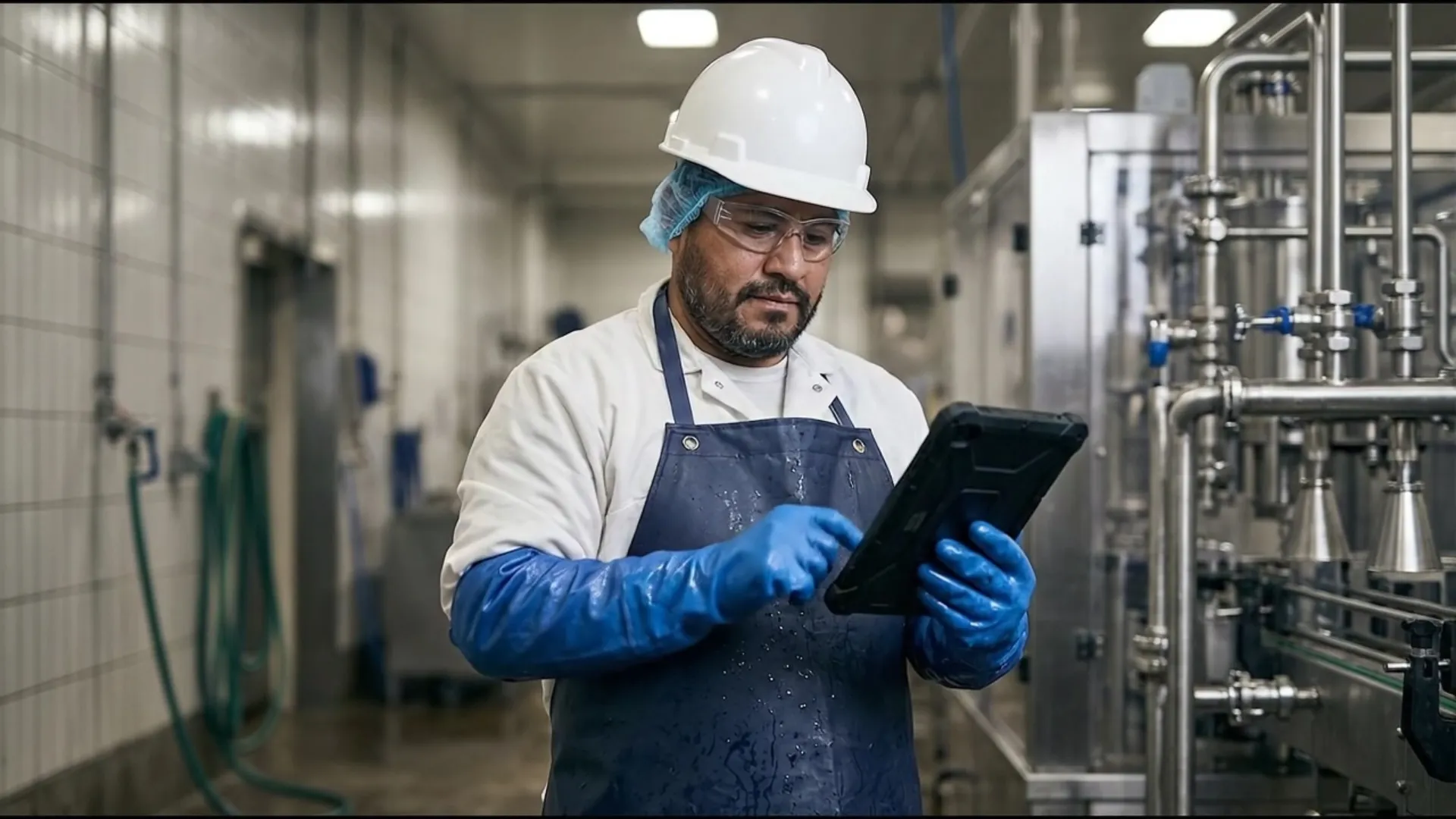
Table of contents

Share:


If your plant is being asked what it is doing about AI, you have probably already had the meeting. Maybe a pilot. Maybe a vendor demo that looked impressive.
Then someone asks the model why line 3 underperforms, and the answer comes back fluent, confident, well-organized, and thin. Nobody can quite say what is wrong with it. So it gets read, nodded at, and not acted on.
Get this right and the work your team already does every shift becomes the thing you run the plant on. Get it wrong and you have bought a very articulate summary of the half of your operation that happens to be written down.
The gap is almost never the model. It is what your forms were asking for three years ago. Here is what AI can genuinely do with frontline data, what it cannot, and how to feed it something worth reasoning over.
What can AI actually do with frontline data?
Three things, concretely.
- AI can find patterns that span programs, connecting a sanitation miss, a quality hold, and a maintenance abnormality that share one root cause but live in three separate places.
- AI can turn thousands of individual operator observations into a countable trend, including the free-text and photo observation nuance nobody has ever mapped.
- AI can surface a problem you did not know to ask about, which is the one thing a dashboard structurally cannot do, because a dashboard only answers the questions someone built into it.
What it cannot do is invent an observation that was never recorded. Everything below turns on that one limit.
Why AI needs structured frontline data first
No amount of AI extracts a trend from a binder. Every plant manager already knows that.
The part that catches people out is that plants with fully digital systems frequently have the same problem and cannot see it.
In Weever's 2026 State of Data Capture in Manufacturing research, a survey of 167 manufacturing leaders at companies with more than 500 employees, 84% said their frontline operational data is trustworthy enough to support AI. Of that confident group, 90% also reported at least one condition that undermines it.
- 62% said frequently or very frequently important operational knowledge stays only in the experience of operators and inspectors.
- 51% said the same issue is frequently recorded differently depending on who logs it.
- 77% agreed that manual or paper-based processes prevent their frontline data from being AI-ready.
Leaders who trust their frontline data, and the conditions undermining it
Say frontline data is trustworthy enough for AI
84%
Of that group, report at least one undermining condition
90%
Knowledge stays only with operators and inspectors
62%
Same issue recorded differently by who logs it
51%
Manual or paper processes prevent AI-ready data
77%
Source: Weever, State of Data Capture in Manufacturing, 2026. Survey of 167 manufacturing leaders at companies with more than 500 employees.
Both answers are honest, which is what makes the finding useful rather than embarrassing. When a leader says they trust their frontline data, you have learned how they feel about it. You have learned very little about what an AI system will find when it gets there.
What AI catches, and what it cannot
AI is good at finding records that should exist and don't. A sanitation check scheduled every shift with no Tuesday completion is a clean anomaly, and a well-built system will surface it faster than a dashboard will.
The harder gap is the work nobody scheduled.
The filler on line 3 drifts light on head 6. An operator adjusts the timing, rechecks, carries on. Four minutes. It happens roughly forty times over six weeks across eleven operators. No schedule expected those records. No field asked why a filler was adjusted. There is no hole for AI to find, because there was never a slot to be empty.
Two limits follow. AI can tell you Tuesday's check was missed; it cannot tell you the seal was lifting. And "adjusted filler," timestamped with no reason, is a record that exists and says nothing.
Ask why line 3 underperforms and you will get a fluent answer from what exists, possibly flagging the checks it can see were skipped. It cannot flag the question your forms never asked.
83% of organizations in the survey are already deploying or piloting AI in operations. Whatever state your frontline data is in today is the state AI is reasoning from today.
Finding patterns across programs that no single report shows
Continuous improvement is the work of turning unknown unknowns into known problems, and known problems into standards that prevent them. The hard part has always been the first step, because you cannot standardize against something nobody has named yet.
Your people are what surface those unknowns. A machine breakdown, a near miss, a non-conformance, a failed inspection. Human intelligence notices the abnormality, and no model substitutes for that.
What AI adds is the step after. One abnormality is an event. Forty are a pattern, and the pattern is usually spread across programs that never talk to each other:
Sanitation
A sanitation miss on line 3 on Tuesday night
Quality
A quality hold on the same line on Thursday
Maintenance
A maintenance abnormality logged the week before, same asset
Same line, same asset
One root cause
Three records, three programs, three owners.
Three records, three programs, three owners, one root cause. No standard report asks that question, because reports answer questions someone already thought to ask. This is the one nobody thought of, which is why it has been recurring for a year.
The prerequisite is consistency across programs, not just within them. If quality, safety, sanitation, and autonomous maintenance each run in a separate tool with separate fields, the same failure gets described four ways depending on which program caught it, and the connection cannot be made after the fact. One capture process with one set of field conventions is what makes the unknown findable at all.
Turning free-text observations into trends
Operator comments are the richest and least-used data in most plants.
They are rich because they contain the context. Machine data tells you the line stopped at 02:14. The operator comment tells you the guard rattles when humidity is high. One is an event, the other is a cause.
They are unused because nobody is going to read four thousand of them. Free text has historically been write-only data: captured dutifully, filed, and never trended.
This is the clearest legitimate win for language models in manufacturing. Grouping "leak," "seal weeping," and "minor drip, monitored" as similar failures is exactly the kind of task that was impossible at scale.
It makes messy text usable. It does not make missing text appear. If the observation was never typed because the form had nowhere to put it, no model recovers it.
How to prepare your data so AI is actually useful
Four steps, in order. Skipping one does not save time, it moves the failure later.
- Make capture something operators will actually do. If the tool is harder than the paper it replaces, the data will not exist and everything downstream is theoretical. Most forms fail this before an operator sees them. Run every candidate field through the same discipline you would use to size a centerline program: eliminate what nobody acts on, combine readings that always move together, reduce frequency where drift is slow, and simplify anything requiring a tool or a ladder to reach.
- Structure capture so the data is consistent. Defined fields instead of free text where it matters, evidence attached at the step, and one set of conventions across every program. This is what lets an issue logged on a quality check be compared with the same issue logged on a safety observation.
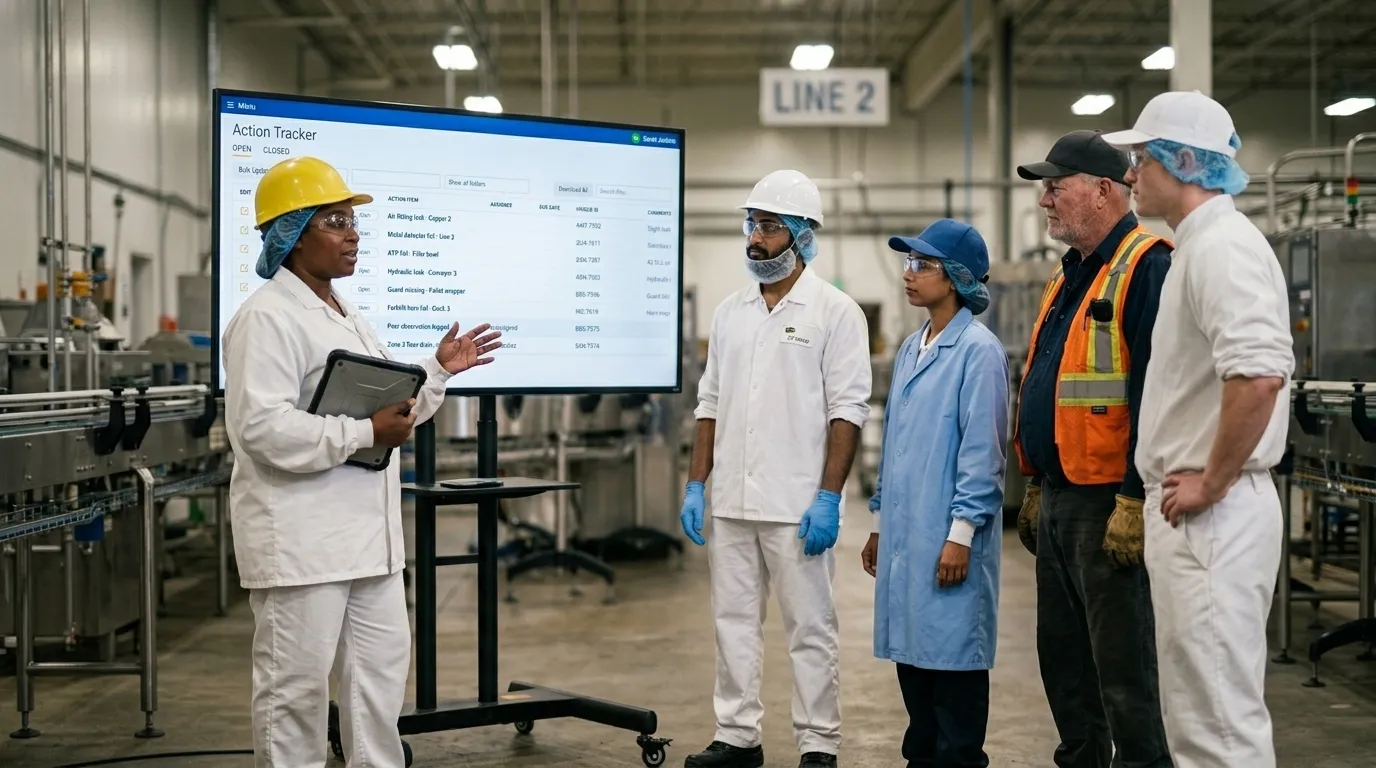
- Close the loop. Owner, due date, tracked closure. This is an accountability requirement and also the only reliable way to sustain capture quality over time.
- Keep it connected and portable. If your frontline data can only be read inside the tool that captured it, it cannot feed your BI stack, your enterprise systems, or any AI you want to rely on. Data portability is an AI readiness requirement, not a procurement footnote.
Improve the data loop
Continuous improvement gets applied to the line, the changeover, and the cleaning procedure. It rarely gets applied to the form.
Most checklists are digitized once, from whatever the paper version happened to ask, and then left alone for years. Nobody audits whether the fields still earn their place.
- AI can tell you what to start capturing. When a failure keeps recurring and the records cannot explain why, that is a diagnosable gap. Forty filler adjustments logged with no reason field is a pattern of missing context, and a system reading across your programs can say so: this asset generates repeat findings, the form captures what was done and never why, add a cause field here. That is the difference between knowing a problem recurs and being able to act on it.
- AI can tell you how to structure what you already capture. Free text is where consistency is challenged. If "leak," "seal weeping," and "minor drip" are being used interchangeably by three operators, AI can identify that those describe one failure and propose the dropdown field that ends the ambiguity. Same for fields in the wrong order, conditional logic that should branch earlier, and readings that always move together and could be one entry.
- AI can tell you what to stop capturing. Every field costs operator time, and time is what determines whether the check gets done properly. A field nobody has filtered, sorted, or acted on in twelve months is not a data point, it is a habit. AI can flag those directly, because it can see what is queried and what is never touched.
A sixty-field form is not more rigorous than a twelve-field form. It is a twelve-field form with forty-eight fields answered from memory at the end of the shift.
Shorter forms also protect the thing everything else depends on. When capture is efficient and does not waste operator time, people keep doing it properly. That is the loop actually closing: capture, act, analyze, and then improve the capture itself, so the next cycle starts from better data. Weever Radar is built to run that last step, reading across every program to recommend what to add, what to restructure, and what to drop.
The plants getting value from AI are not the ones with the most sophisticated models. They are the ones whose forms are getting better every quarter.
The bottleneck is the floor, not the model
Knowledge that is never captured cannot be standardized. Data that is not standardized cannot be connected. Data that is not connected cannot be analyzed with confidence. And an organization that cannot analyze its frontline data with confidence will not rely on AI built from it, however much it has spent.
73% of the leaders in the Weever survey say limited trust in frontline data is already preventing them from relying on AI. That is not a future risk. That is this quarter.
Which makes the highest-leverage AI investment most plants can make this year an unglamorous one.
Why manufacturers choose Weever
Capture built for the floor
Forms your operators can complete with gloves on, faster than the clipboard they replace.
One set of conventions across every program
Sanitation, autonomous maintenance, quality, safety, and 5S on one platform, so a failure logged on a quality check is comparable with the same failure logged on a safety observation.
Data that stays yours
Structured, exportable, and portable into your BI stack and enterprise systems.
Radar on top
Reading across programs to surface what is happening, what it means, and what your forms should be asking next.
Want to see what your plant is not currently capturing? Book a demo.
Related reading: the complete guide to connected worker software and how connected worker software integrates with ERP, CMMS, historians, and BI tools.
Frequently Asked Questions
Can AI improve manufacturing operations without good frontline data?
Not reliably. AI answers from whatever data exists and does not flag what is missing. If the observations that explain plant performance were never captured, the model produces a confident explanation built from incomplete inputs, and nothing in the output signals the gap.
What data does AI need from the plant floor?
Structured records of what was checked, what was found, what was done about it, and whether it was closed, captured consistently enough that the same issue is recognizable across shifts, lines, and programs. Machine data alone tells you what happened, not why.
Are manufacturers actually using AI in operations yet?
Yes. In Weever's 2026 research covering 167 manufacturing leaders, 83% of organizations were deploying or piloting AI in manufacturing operations, with half actively deploying across production. Data readiness is no longer something to schedule ahead of an AI initiative.
Why do leaders think their data is AI-ready when it is not?
Because volume is visible and missing context is not. A plant can go from 200 completed checks a month to 2,000, and every one can read "complete, no issues." The volume grew tenfold. The number of captured reasons why anything happened did not grow at all.
Can AI analyze operator free-text comments?
Yes, and this is one of its clearest legitimate uses. Grouping "leak," "seal weeping," and "minor drip" as the same failure was impractical manually and is now routine. It makes messy text usable. It does not recover observations that were never written down.
What is Weever Radar?
Radar is the operational intelligence layer inside Weever. Because the frontline data underneath it is captured at the source and structured consistently across programs, it surfaces what is happening and what to do about it across lines, shifts, and sites, including patterns nobody thought to query.
Should we fix our data before investing in AI?
In practice most organizations are doing both at once, since AI deployment is already underway in the majority of plants. The sequencing that matters is within the data work itself: adoption, then consistency, then closed-loop follow-through, then connection and portability.
Spend Less Time on Admin. More Time Improving Operations.
See how Weever automates data entry, reporting, and action items so you can focus on improvement not admin.