
Mitti (formerly SafetyCulture) platform review for CPG manufacturers: Features, strengths, pricing & a better alternative
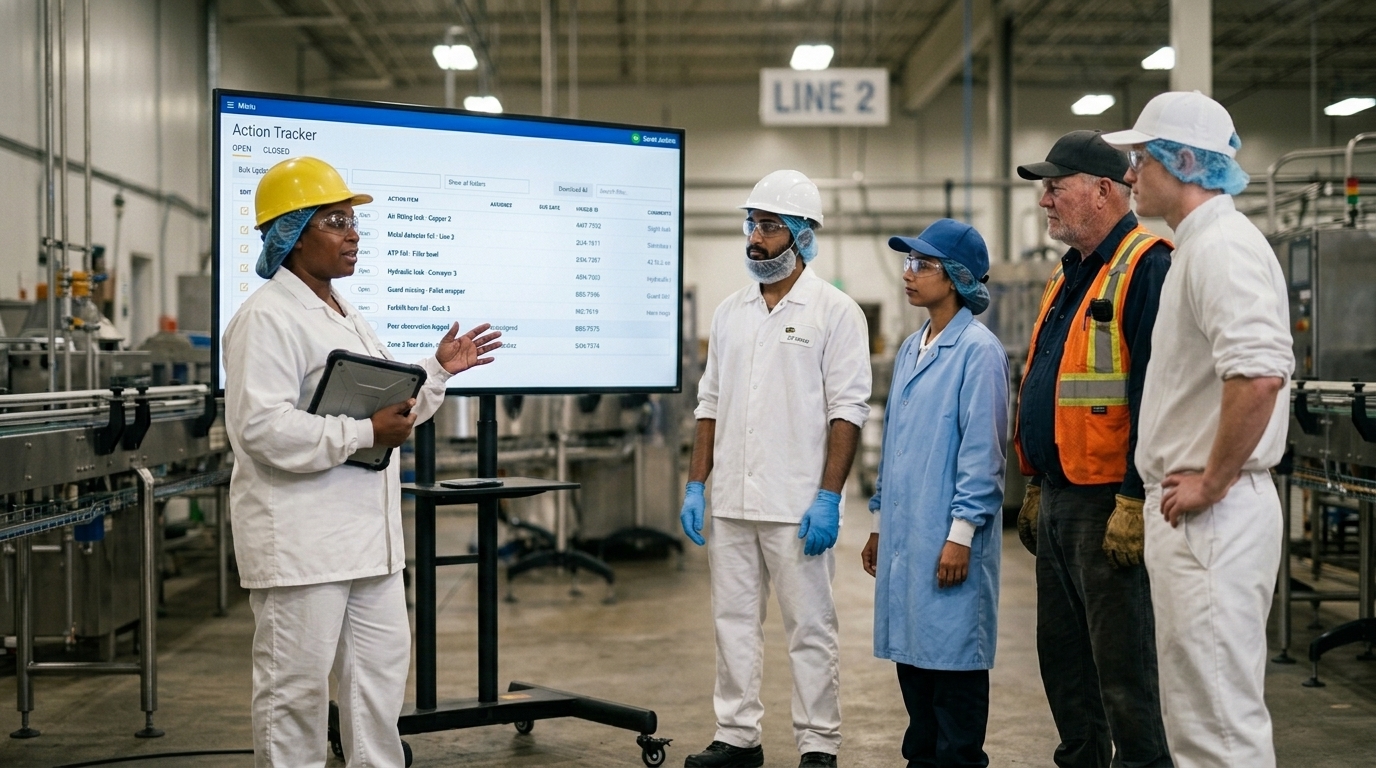
Table of contents

Share:


Quick summary
Mitti, formerly SafetyCulture, is a frontline operations platform built around general mobile inspections, checklists, and a large template library. It has a 4.6/5 rating, and Premium starts at $24 per user per month when billed annually. Its quick setup and broad feature set make it a good fit for teams that want to digitize inspections across different sites and use cases. For CPG plants looking for purpose-built solutions and more depth beyond individual inspections, a more focused platform is worth considering.
Is Mitti still the right fit for your plant?
Getting an inspection onto a phone is one thing. In a CPG plant, the harder part is making sure the check happens every shift, the right person gets notified, and the issue closes.
That follow-through carries real weight. FDA food recalls reached 571 in 2025, up 15.4% from the year before and the highest annual total in nine years, according to the State of the Nation U.S. Product Safety and Recall Index.
Mitti, formerly SafetyCulture, gets plenty of praise for being easy to use and quick to get inspections running. Reviews also raise reservations about pricing, while several advanced features sit on higher tiers.
For a CPG manufacturer, that makes the bigger question one of fit. This review looks at Mitti’s features, pricing, user feedback, and limitations to help you decide whether it has the structure and follow-through your plant needs.
Why listen to us
Weever is a connected worker platform built for food, beverage, and CPG manufacturers. Plants use the Weever platform to run master sanitation schedules (MSS), 5S audits, autonomous maintenance, safety observations, and in-process quality checks, each configured around their own SOPs. We’ve partnered with some of the biggest names in the industry, including Mars, Unilever, Diageo, Royal Canin, Monin, and Ben & Jerry’s, many of which already had inspection software when we arrived. So we’ve spent a lot of time on the problem this review is about: what a plant needs once digitizing the individual check is no longer the hard part.
Monin went from one location to every North American facility in five months, and its quality team saved three to four hours a day that used to go on managing data and building reports by hand.
Mars Fort Smith is another example. The plant completes 100% of the sanitation tasks it manages in Weever, corrects 89% of reported abnormalities, and has logged more than 18,000 safety observations.
What is Mitti (formerly SafetyCulture)?
Mitti, formerly SafetyCulture, is a mobile-first general inspection and operations platform used across manufacturing, construction, retail, hospitality, and facilities. Teams build digital checklists, complete them on a phone or tablet with photo evidence, raise issues and corrective actions from the findings, and track results in dashboards. Training, asset tracking, and AI assistance sit around that inspection core.
Mitti features overview
Mitti's core features sit in five groups:
1) Inspections and templates
Inspections are the core of Mitti. You rebuild a paper checklist as a digital form, or upload the checklist and let Mitti's AI draft the template for you.
An inspector completes it on a phone or tablet, attaches photos, and shares the report before the shift ends. Paid plans export reports as PDF, Word, Excel, or a web link, and add templates in multiple languages. Inspections also work without a signal and sync once the device reconnects.
2) Training
Mitti delivers short courses that workers complete on their phones between tasks or during a break. You build the course, assign it, and track completion. The feature list also covers recurring courses, in-person training records, and a training matrix.
3) Analytics and dashboards
Live dashboards show inspection scores, issue trends, and training completions across all your locations. A pre-built dashboard comes as standard, and Mitti also offers dashboards and charts you design yourself. A benchmarking feature that ranks sites against each other is in early access.
4) Mitti AI
AI is included in every plan, with a monthly allowance of credits per seat.
The AI Assistant answers questions about your operations, and AI Issue Creation logs problems on the spot. The AI also flags recurring issues and suggests corrective actions. Mitti says nothing gets actioned without a person signing off. An agent builder is in early access.
5) Integrations and access control
Mitti connects to other business systems through direct integrations and an API, and it can take readings from sensors. Premium includes single sign-on, and Enterprise includes SCIM user provisioning.
Mitti strengths
Mitti is strongest when teams need to digitize inspections and use the same platform across different operations.
Easy for frontline teams to use
Mitti is easy to learn and use for everyday inspections. Workers can open checklists, add photos or notes, and submit findings from a phone or tablet. Customer reviews show the same pattern, with many users praising how easy the platform is to navigate and learn.
A fast starting point for new inspections
Teams don't have to start from a blank page. Mitti has a public library of ready-made checklists, while its AI can draft templates from existing documents or text prompts. Premium adds unlimited active templates and multi-language templates.
The library is built for broad use, so a plant will still need to adapt templates around its own lines, standards, and processes.
One app across stores, warehouses, and plants
Mitti supports the same inspection system across plants, warehouses, stores, and other locations. This works well for companies that want to standardize inspections across different teams and sites without introducing a separate tool for each environment.
AI that waits for human sign-off
Mitti includes AI across its plans. The AI Assistant can answer questions using operational data, while newer AI capabilities can identify recurring issues and suggest actions.
Mitti keeps a person in the decision loop, so suggested actions aren't carried out without human approval. Some newer capabilities, including the agent builder and 5 Star Benchmarking, are still being rolled out.
Mitti pricing
Mitti has three main plans (Free, Premium, and Enterprise). It also offers location-based pricing for companies running the platform across multiple sites.
Premium and Enterprise support more than one seat type. The pricing page publishes a full-seat rate and shows free guest seats for external users, but no mid-tier seat for people who only submit occasionally. So on the public numbers, anyone in the plant who needs to do more than view is a full seat at $24 or $29.
For a larger plant, location-based pricing is the more useful number to ask for. It’s a fixed cost per site with unlimited users included, which removes the per-head maths altogether, but Mitti doesn’t publish the rate. Until you have that quote, the real cost of a plant-wide rollout can’t be compared.
AI has its own allowance on top. Each plan includes a set number of monthly credits per seat, and organizations can buy more or pay overages once those run out, so AI-heavy workflows don’t scale at the flat per-seat rate you budgeted from.
What users like about Mitti
Ease of use comes up repeatedly in Mitti reviews. Users like that inspections are straightforward to build, complete, and submit from the floor without much training.
Customization also gets positive feedback. Teams can adapt templates to their own checks, add photos and supporting information, and change forms as their processes evolve.
The mobile app is another common positive. Workers can complete inspections, report issues, update actions, and access schedules from their phones or tablets. Offline inspection support also helps in areas with unreliable connectivity.
Mitti user ratings
Mitti maintains strong ratings across major software review platforms:
G2 scores Mitti 9.2 out of 10 for ease of use, 9.0 for quality of support, and 9.0 for ease of setup. On Capterra, the pattern is the same but the two lowest sub-scores are worth noting for a plant-wide buyer: features at 4.4 and value for money at 4.5, against 4.6 for ease of use.
The reviewer mix adds useful context for CPG buyers. On GetApp, around half of Mitti’s reviewers are small businesses, and construction is the single largest reviewed industry at roughly 12%. Manufacturing is a minority segment.
So the ratings are real, and they reflect Mitti’s performance across a very wide range of inspection environments. What they don’t give you is much direct evidence from food, beverage, and CPG plants running complete programs.
Who is Mitti best suited for?
Mitti fits best in two scenarios:
- First, organizations that inspect many kinds of sites and want one tool for all of them. A company with stores, warehouses, field teams, and a plant gets one familiar app everywhere
- Second, small teams moving off paper. A first inspection takes little setup, so a single site can start without outside help
But if your goal is to run a plant's daily programs with schedules, scoring, and closure built in, Mitti asks your team to design them. More on that in the next section.
Mitti limitations for CPG manufacturers
Mitti covers a wide range of frontline operations, but that breadth creates some important considerations for CPG plants looking to run complete operational programs.
Templates still need turning into programs
Every platform needs configuring, Weever included. The question is what you start from. Mitti gives you flexible inspections, templates, actions, and reporting built for many industries, and a CPG plant has to shape those into the programs it actually runs.
- Master sanitation, scheduled by room and zone with risk-based frequencies, product-contact and non-contact surfaces handled differently, and the cleaning steps sequenced
- Autonomous maintenance, with CILs and centerlines tied to the equipment hierarchy rather than to a generic asset list
- Changeover and allergen verification, where the check order is the control and a missed step is a recall exposure
- In-process quality, net weight and fill checks with limits, pass/fail criteria, and auto-calculations built into the form
- Hold and release, with the disposition decision and its approvals recorded against the affected lot
None of that is beyond a flexible platform like Mitti, and its template library gives you a fast start on the individual checks. But a library serving construction, retail, hospitality and manufacturing alike starts “general” by design. The zone logic, the frequencies, the equipment hierarchy and the check sequences are what make these programs work, and that distance is the project.
Corrective actions need to fit the wider program
Mitti has a capable action tracker. Teams can assign actions, set priorities and due dates, require evidence, add custom fields, and link actions to inspections, and Analytics reports action completion rate by site, area, and region.
However, two gaps matter for a CPG program. Overdue actions alert the assignee 24 hours after the due date, not a supervisor. Escalation exists in Mitti, but for sensor alerts and Lone Worker, not actions. Secondly, actions move through four fixed stages (To do, In progress, Complete, Can’t do) with no root-cause or verified-fix step between. A correction and a standardized fix close the same way. Mitti’s Investigations feature does handle root cause properly, but it’s a separate record you open for an incident rather than something attached to every failed check.
Escalation and root-cause discipline are processes your team runs around the tracker rather than behavior it enforces.
Plant-wide pricing needs a closer look
Mitti’s published Premium plan is per user, which makes it economical for a small team. Run the same number across a plant and it changes shape. At the list rate of $24 per user per month billed annually, a site where 300 operators, cleaners, mechanics, and supervisors all need a full seat is around $86,400 a year. Free guest seats help for external visitors, but the people running sanitation checks and CILs every shift are submitting work, not viewing it.
That matters beyond the budget line. When each additional participant has a price, participation becomes something you approve rather than something you encourage. The program gets scoped to the seats you bought, and the operators who spot the most problems are often the ones who never got a login. Two questions are worth asking before any comparison: how many people in the plant have a full seat today, and how many should? And what did the quote look like the last time you added a department?
Mitti does offer location-based pricing with unlimited users at a fixed cost per site, which solves this. It isn’t published, so you’ll need to request that quote before you can compare a plant-wide rollout on cost.
Connecting plant programs can require more work
Sanitation, maintenance, quality, safety, and continuous improvement each come with their own workflows, frequencies, and reporting needs. Run them in the same tool and you still have to make them answer the same questions. Which areas are slipping across every program? Is the same failure showing up in a different log?
That’s a reporting and data question. Worth checking during a trial how much work it takes to see across programs rather than within one, and how easily the underlying data leaves the platform for your own BI.
Report customization can fall short
G2’s own summary of Mitti reviews puts missing features at the top of the complaint list, with 34 mentions citing limited reports and clunky AI. Limited customization follows at 24 mentions, again around reports and dashboard flexibility.
Both land on reporting, which matters more in a plant running five programs than in a site running one inspection type. Build the reports your supervisors and quality leads will actually use during the trial, not just the checks.
The rebrand brings some practical changes
SafetyCulture became Mitti as the company expanded its positioning from safety and inspections to a broader operations platform. For existing customers, the change can also mean updating SOPs, training materials, and internal documentation that still reference SafetyCulture.
The broader positioning also raises questions about how Mitti’s product roadmap and existing integrations will evolve.
So if your plant needs more than a flexible inspection system, look at how the platform supports the full program. That includes involving the right people, moving issues through corrective action, and giving teams visibility across shifts, lines, and sites.
How does Weever compare to Mitti?
Weever is a connected worker platform built specifically for food, beverage, and CPG manufacturers. It helps plants run recurring frontline programs consistently across shifts, lines, and sites.
Mitti gives companies a broad set of tools for inspections and frontline operations across many industries. Weever organizes frontline work around the programs CPG plants already run, including master sanitation, 5S audits, autonomous maintenance, safety observations, and quality checks.
Each program is configured around the plant’s existing processes and SOPs, and it runs in food, beverage, and CPG plants including Mars, Unilever, Diageo, Royal Canin, Monin, and Ben & Jerry’s. Here’s what that looks like on the plant floor:
- Programs built around your plant: You don’t start from a general template. Sanitation tasks are scheduled so each crew gets the right work at the right time, with instructions, pictures, and links to your SOPs.
You can open 5S audits from a QR code at the workstation, while autonomous maintenance covers CILs and centerlines. Every submission carries a timestamp, user ID, and digital sign-off, creating records teams can search by date, room, area, shift, or crew - One view of every program: Sanitation, 5S, maintenance, safety, and quality run on the same platform and feed the same reporting environment. Completion rates, deviations, and corrective actions can flow into dashboards and Power BI without someone rekeying paper logs.
- Ask across every program: Weever Radar is an optional AI layer over that same data. Ask in plain language where the same failure keeps recurring, and it answers across sanitation, 5S, maintenance, safety and quality at once, linking back to the source records, running inside Weever’s own cloud rather than an external AI service, and reading records without altering them so your 21 CFR Part 11 audit trail stays intact.
- Follow through on every failed check: A failed check can create an action with an owner and due date. Reminders keep the action moving; missed tasks can escalate, and the person who reported the problem can see when it gets resolved.
Say an operator fails a pre op sanitation check on Line 3. The issue can move directly into the corrective action workflow, with responsibility and a deadline attached. The team doesn’t have to wait for someone to find the failed check in a report the next morning - A first program built for you: Weever’s Customer Success team builds the first version of your forms from the checklists you already use and handles the configuration. Most teams go live within weeks (rather than months) using the A.D.A.P.T. framework, which covers Assess, Digitize, Align, Prepare, and Tune. Plants can start with one program, zone, or shift, then expand.
- Built for the whole floor: Operators can scan a QR code to open the right form on a shared device, which makes it easier to bring frontline teams into the program. Forms can also support multiple languages, an important consideration when plants work with third-party sanitation crews or multilingual teams.
- Results from real CPG plants: Those workflows have also produced measurable results across Weever’s CPG customers.
At Mars Fort Smith, the plant reached 100% completion for sanitation tasks managed through Weever and recorded more than 18,000 safety observations. At Baywater, 92% of safety corrective actions were followed up and closed, a number the team had never been able to see before. Royal Canin scaled Weever across multiple processes to more than 6,000 submissions a month and over 7,000 hours saved a year.
What's the better choice for a CPG plant?
Mitti is a solid inspection platform for organizations that want one easy tool across many kinds of sites. Its app is easy to use, the first inspection is quick to set up, and the product keeps improving.
But if you need a plant's daily programs running with a schedule behind each one and an owner on every finding, Weever is the better fit. We built it around those programs because a digital checklist alone doesn't change what happens after a check fails.
Your audits may already be digital. The sanitation binder, the maintenance checks, and the quality sheets often aren't. Book a demo and bring the one that's still on paper. We'll walk through how it would run in Weever, from the first check to the closed action.
Frequently asked questions
Is Mitti the same as SafetyCulture?
Mitti is the new name for SafetyCulture’s platform following its August 2026 rebrand. The platform still includes the inspection and checklist capabilities SafetyCulture was known for, while the company now positions Mitti more broadly around frontline operations.
Is Mitti suitable for CPG manufacturing?
Mitti can support CPG manufacturers that primarily need to digitize inspections, checklists, and issue reporting. Its broader design becomes less ideal when a plant needs structured programs for master sanitation, autonomous maintenance, 5S, quality, and other recurring CPG processes.
Those teams should evaluate how much configuration their workflows will require before choosing Mitti.
What should CPG manufacturers look for in an inspection platform?
CPG manufacturers should consider how the platform handles the complete workflow after a check is submitted. That includes recurring schedules, SOP access, deviations, corrective action ownership, escalation, sign-offs, plant-wide participation, and reporting across lines, shifts, and sites.
What’s the best Mitti alternatives for CPG manufacturers?
Weever is the strongest Mitti alternative for CPG manufacturers that want one platform for sanitation, 5S, autonomous maintenance, quality, safety, and corrective actions.
How does Mitti pricing compare with Weever?
Mitti and Weever use different pricing models. Mitti Premium starts at $24 per user per month with annual billing, while larger deployments can also use custom location-based pricing with unlimited users. Weever uses site-based pricing with unlimited users rather than charging for each participant.
For a plant-wide rollout, that means operators, cleaners, mechanics, supervisors, and managers can all use Weever without adding another user fee. The cost stays tied to the site as participation grows, so plants don't have to limit access just to keep per-user costs under control.
Related Posts

Spend Less Time on Admin. More Time Improving Operations.
See how Weever automates data entry, reporting, and action items so you can focus on improvement not admin.