
How Integrated Work Systems Improve Manufacturing Efficiency
Table of contents

Share:


If you work in a CPG plant, there's a good chance you've heard the letters IWS in a site meeting, usually alongside a phase assessment, a new set of standards and a lot of talk about losses.
Integrated Work System is one of the most demanding operating systems in manufacturing. Done well, it drives a plant toward zero losses with operators who own their equipment. Done on paper, it buries supervisors in CIL sheets, centerline logs and defect tags that nobody has time to analyze.
This article explains what an integrated work system is, how it builds on Total Productive Maintenance (TPM) and autonomous maintenance, the daily tools IWS plants rely on, how it improves efficiency, and why digital tools make it easier to sustain.
What is an integrated work system (IWS)?
Integrated Work System is Procter & Gamble's manufacturing excellence system. P&G assembled it over more than 20 years from what it learned applying lean, TPM, reliability engineering and the Toyota Production System (Consulting Magazine, 2016).
IWS rests on two principles: a drive to zero losses, and 100 percent employee ownership (EY and P&G alliance). Since 2013, EY has helped implement IWS for manufacturers outside P&G; licensees have included Kraft and British American Tobacco. EY says the alliance has created over 400 smart factories with US$15 billion in savings.
You'll sometimes see "integrated work system" used loosely for any connected manufacturing software. That's a different thing. IWS is a way of working; software can support it, but it can't replace it.
| Item | What it means in practice |
|---|---|
| Origin | Procter & Gamble’s manufacturing excellence system, licensed to other manufacturers through EY |
| Built from | Lean, TPM, reliability engineering and the Toyota Production System |
| Principle 1 | Drive to zero losses: every breakdown, defect and minor stop is a loss to measure and remove |
| Principle 2 | 100% employee ownership: operators run their equipment and keep it in base condition |
| How it’s deployed | In phases, based on an assessment of each plant’s maturity |
Sources: EY and P&G alliance; Consulting Magazine, 2016.
How IWS relates to TPM and autonomous maintenance
If you know TPM, much of IWS will look familiar. Like TPM, it holds that operators don't just run their machines; they maintain them in base condition so the line stays up. That's autonomous maintenance by another name, and it's why IWS plants run daily CIL (clean, inspect, lubricate) routines, centerline checks and defect handling.
Where IWS goes further is in how tightly it ties those routines together. Loss analysis decides what to work on. Standards and problem-solving are embedded in daily routines, not run as separate projects. And plants progress through assessed phases, so leadership can see whether the system is really in place. For the AM side in detail, see the 7 steps of autonomous maintenance.
The IWS tools you'll see on the floor
IWS sites commonly use a set of short-hand tools. Names vary slightly between sites, but these appear in most.
| Tool | What it is | What it produces every shift |
|---|---|---|
| CIL | Clean, inspect, lubricate routines done by operators | Completed checks and anything found out of standard |
| CL (centerlines) | Target settings and ranges for critical variables | Readings, and any setting outside its range |
| DH (defect handling) | Finding, tagging, recording and fixing equipment defects | Defect tags with owners and due dates |
| DMS (daily management system) | Short daily meetings and boards that review losses and actions | A list of losses, owners and follow-ups |
| RCA and PDCA | Structured problem solving for repeat or major losses | Root causes and countermeasures |
How integrated work systems improve efficiency
Losses become visible. IWS counts every breakdown, minor stop, defect and slow run as a loss. You can't fix what you don't measure, and small, uncounted stops often add up to more lost time than the breakdowns everyone remembers.
- Equipment stays in base condition. Daily CILs and defect handling catch deterioration early, so fewer small problems become breakdowns.
- Every shift runs the same way. Centerlines and standards remove the variation that comes from each crew running the line its own way.
- Problems surface the same day. The daily management system puts yesterday's losses in front of the team this morning, with an owner for each.
- Ownership speeds up response. When operators own their equipment, the first person to notice a problem is also the first to act on it.
Why IWS is hard to sustain on paper
IWS runs on records. A single line can generate dozens of CIL checks, centerline readings and defect tags every shift, and every one of them is supposed to feed the daily management system and the loss analysis.
On paper, that falls apart quickly. Sheets get filled in at the end of the shift instead of at the machine. Defect tags hang on equipment for weeks because nobody can see how many are open. Centerline readings sit in binders where nobody can spot the slow drift. And when the phase assessment comes, supervisors spend days pulling evidence together. The methodology is sound; the paperwork is what wears people down.
Where Weever fits in an IWS plant
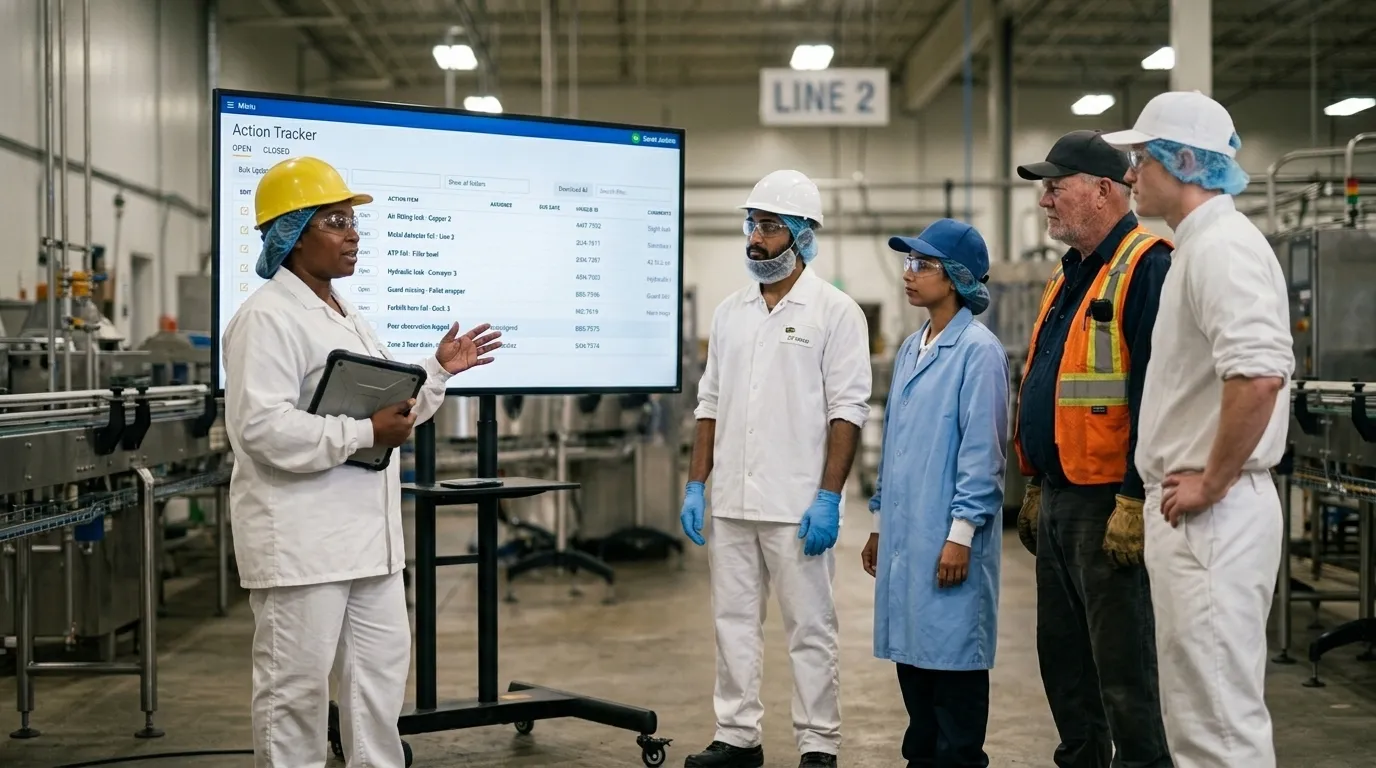
Weever doesn't replace IWS. It runs the daily work IWS asks for. CIL and centerline checks run on a schedule at the machine, readings are recorded and trended, defects are logged with photos, routed to an owner and tracked to closure, and reports by line, shift and equipment feed the daily management meeting without anyone building a spreadsheet. Data can flow into Power BI and, for failed checks, into your CMMS as work orders.
The effect is clearest in time saved. Monin, a flavoured syrup manufacturer we worked with, had operators completing equipment inspection and cleaning checks on paper before every production run, then routing them to quality by hand. Digitizing those checks saved 3 to 4 hours a day and let operators start lines faster, and Monin rolled Weever out to all its North American facilities within 5 months.
“Using Weever ensured that we did not lose documentation for compliance reporting. We could also see where issues were happening and make adjustments quickly.”
Johanna Velez, VP Quality Assurance, Monin
Read the case studyAt Royal Canin's Lebanon, Tennessee factory, where abnormality reporting is central to its WCM and TPM practice, a backlog of over 300 unresolved issues built up under its legacy system. After moving defect handling onto Weever, the factory reached a 95% close rate by late 2024.
Keep the system, lose the paperwork
An integrated work system improves efficiency by making losses visible and giving every operator ownership of their equipment. Its tools only work if the daily records are captured accurately and acted on the same day.
See your IWS routines on one system
Book a demo and bring one CIL, one centerline sheet and one defect tag. We’ll show you how they run, route and report in Weever.
Book a demo
Spend Less Time on Admin. More Time Improving Operations.
See how Weever automates data entry, reporting, and action items so you can focus on improvement not admin.