

-%20smaller.webp)
.webp)
Explore More Blogs
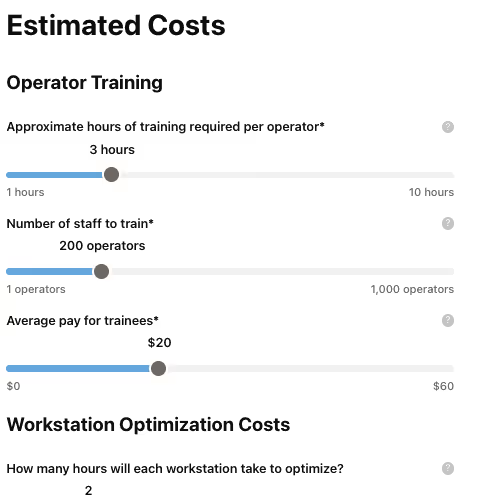
5S Implementation ROI Calculator
ROI Calculator
5S Program Implementation
How much will your 5S program cost and what hard dollar benefits will it provide?
Configure our calculator to get a sense of what return you can expect from a successful 5S program implementation.
5S Overview
5S Planning
5S Implementation
5S Auditing
5S Audit Digitization
FREE RESOURCEs
(Please note the calculator may take a moment to load)
5S Auditing Preview text
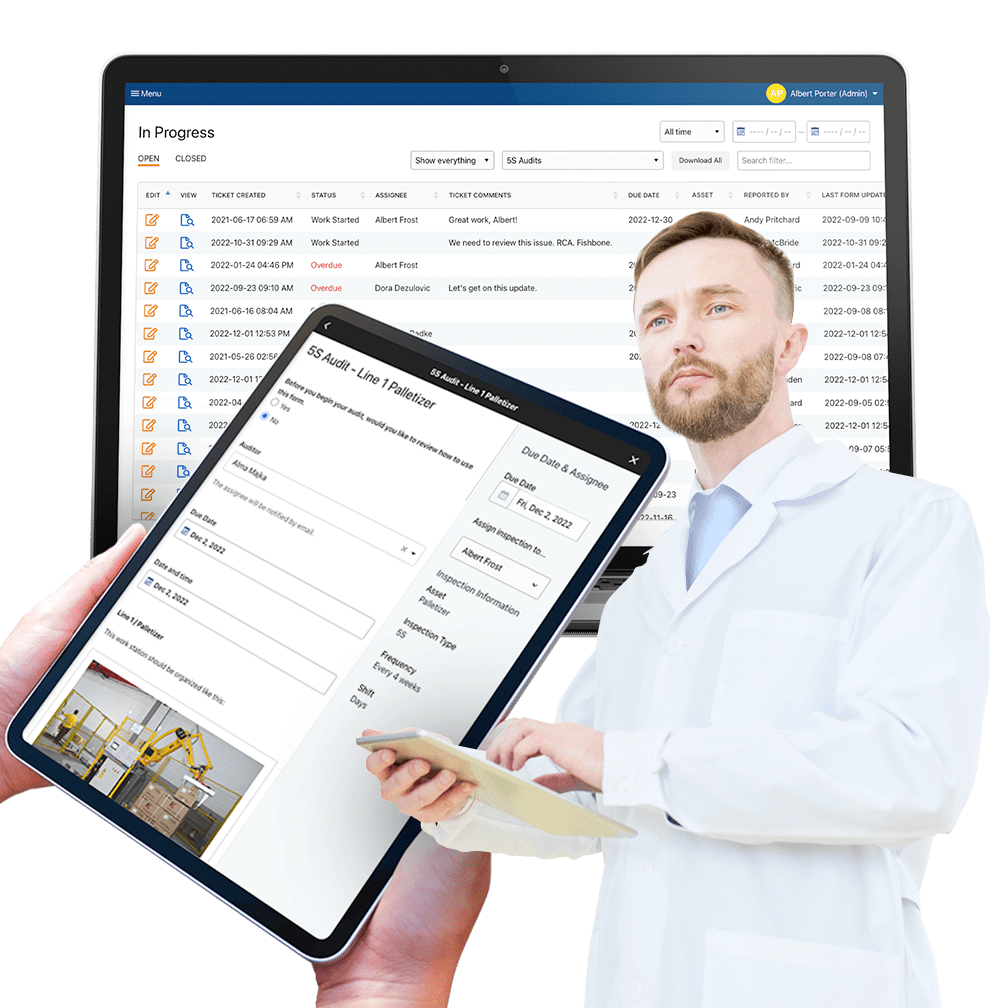
Automate 5S Auditing to ensure compliance and radically increase workstation productivity.
- Extremely simple and easy to use.
- Save time with automated reporting and administration.
- Capture richer data and manage improvement workflows.
- Automate schedules to ensure compliance.
Ultimate Guide to Success with 5S

Leveraging KPIs to Bolster Your 5S Implementation Business Case
Implementing the 5S methodology isn't just a workplace transformation; it's a strategic move toward efficiency, safety, and cost savings. To substantiate the case for 5S adoption, gathering benchmark data and evidence-backed KPIs becomes crucial. These metrics serve as a roadmap, showcasing current inefficiencies and highlighting the potential improvements that 5S can bring.
The right KPIs not only provide quantifiable data but also serve as compelling evidence to support the business case for 5S implementation.
Key Performance Indicators (KPIs) and Metrics that will support your 5S adoption business case
Workplace Organization Index
This KPI assesses the overall cleanliness, orderliness, and organization of workspaces. Gather this metric by conducting regular assessments or surveys to gauge the current state of organization within the facility.
Inventory Management Efficiency
Measure inventory turnover rates and excess inventory costs. Low turnover and excessive inventory costs demonstrates a need to be more efficient.
Safety Incident Rate
Track the number and costs associated with safety incidents. 5S will help to reduce safety incidents through decluttering and standardized processes.
Productivity Metrics
Metrics such as cycle time, lead time, and throughput provide tangible evidence of productivity challenges that can be overcome with 5S. 5S enhances workstation efficiency, which increases productive output and OEE.
Quality Metrics
Assess quality indicators like defect rates, rework percentages, and customer complaints. A decrease in defects or complaints post-5S signifies improved quality control.
Best Practices in Gathering and Utilizing KPIs
By focusing on these KPIs and metrics, supervisors can build a robust business case for implementing the 5S methodology. These quantifiable measures serve as empirical evidence, showcasing the tangible benefits and improvements brought about by adopting 5S within a manufacturing environment.
Employee Involvement
Engage employees in the KPI gathering process, fostering ownership and accountability.
Regular Monitoring
Continuously track and monitor KPIs to measure the impact of 5S implementation over time.
Baseline Establishment
Gather pre-implementation data to establish a baseline for comparison post-5S.
Align KPIs with Business Objectives
Ensure that selected KPIs directly align with the organization's strategic goals to demonstrate the impact of 5S implementation on the bottom line.
How to Build a 5S Implementation Roadmap
For manufacturing organizations eyeing an efficiency overhaul, implementing the 5S methodology stands as a transformative strategy. Crafting an implementation plan or roadmap is pivotal to ensure a smooth transition and successful adoption of 5S principles. Let's delve into a step-by-step guide on constructing an effective implementation plan that aligns with strategic goals and drives organizational excellence.
What is the 5S Methodology?
The 5S methodology embodies a structured approach to workplace organization and efficiency. It entails the systematic arrangement, cleanliness, and standardization of workspaces to optimize productivity, safety, and quality.
Interested in learning more about Weever?
Request more information
Please tell us a bit about yourself so we can tailor our response and get you the information you need.
Steps-by-Step Guide to Writing your 5S Implementation Roadmap
Building an implementation plan for 5S adoption in manufacturing isn't merely a roadmap; it's a strategic blueprint for organizational transformation.By defining phases, setting objectives, allocating resources, anticipating challenges, and adopting best practices, organizations chart a path towards enhanced efficiency, safety, and sustained excellence through the power of the 5S methodology.
1. Define Phases, Objectives and Activities
Start by delineating clear phases, mirroring the fundamental principles of 5S: Sort, Set in Order, Shine, Standardize, and Sustain.Each phase should encompass specific objectives aligned with overarching organizational goals, emphasizing productivity, safety, and cost-efficiency.Detail the activities and tasks required for each phase. Establish timelines for these tasks, ensuring clarity and specificity. Activities may include workspace assessments, training sessions, setting up visual management tools, establishing cleaning schedules, and conducting regular audits.You might consider the 3 phase approach outlined here ⇒An example of the roadmap could look like:Phase 1: PlanningObjectives:
- Develop Roadmap: Outline a detailed plan including timelines, objectives, and resource allocation for the 5S implementation.
- Training Programs: Develop comprehensive training sessions to educate staff on 5S principles and their significance in enhancing productivity, safety, and cost-effectiveness.
Timeline: 2-4 weeksPhase 2: Optimization (The "Blitz")Objectives:
- Sort: Evaluate and declutter workspaces, identifying and removing unnecessary items.
- Set in Order: Establish designated places for necessary items, optimizing workflow.
- Shine: Implement cleaning schedules and maintenance routines for enhanced safety and cleanliness.
Timeline: 2 monthsPhase 3: NormalizationObjectives:
- Standardization: Develop standardized procedures and visual management tools to maintain the improvements achieved during the Blitz phase.
- Sustain: Establish systems for regular audits, continuous improvement, and employee engagement to sustain the 5S practices.
Timeline: Ongoing, integrated into daily operations
2. Resource Estimation and Allocation
Estimate the resources-time, personnel, and budget-needed for successful execution. Consider factors like scope, workforce involvement, training needs, and material/equipment costs. Allocate resources judiciously to ensure a balanced approach.
- Personnel: Identify team members or champions responsible for leading and coordinating the 5S implementation. Consider assigning roles such as project manager, team leaders, and frontline staff involved in the process.
- Training Programs: Develop training materials and sessions on 5S principles. Allocate resources for educating employees at all levels to ensure understanding and successful implementation.
- Budget: Allocate funds for various aspects, including training, necessary equipment, materials for organizing workspaces, signage, and potential consulting or external support.
- Time Allocation: Define a timeline for the implementation plan, including milestones, deadlines, and phased rollouts for different 5S stages.
- Equipment and Materials: Identify and procure necessary equipment, storage solutions, labels, cleaning supplies, and visual management tools required for organizing workspaces and sustaining 5S practices.
3. Identify Potential Issues and Mitigation Strategies
Anticipate potential challenges such as resistance to change or resource constraints. Propose proactive strategies to mitigate these challenges effectively. Develop contingency plans to address issues promptly, fostering adaptability and resilience.
Potential IssuesMitigation StrategiesResistance to Change: Employees may resist adopting new practices due to unfamiliarity or fear of change.Engage employees early on, communicating the benefits of 5S and involving them in decision-making. Provide forums for open discussion and address concerns transparently.Resource Constraints: Limited availability of budget, time, or manpower can hinder the implementation process.Prioritize resource allocation, ensuring adequate budget, time, and personnel. Develop a phased approach if resources are limited, focusing on high-impact areas initially.Lack of Leadership Support: Inadequate buy-in or support from management may impede progress.Secure visible support and involvement from leadership. Showcase the benefits and impact of 5S to garner management buy-in and commitment.Inadequate Training: Insufficient training and education on 5S principles might result in ineffective implementation.Develop comprehensive training sessions on 5S principles for all employees. Offer continuous education to ensure understanding and implementation consistency.Sustainability Challenges: Difficulty in maintaining the momentum and adherence to 5S principles in the long term.Establish systems to sustain 5S practices. Implement recognition programs, conduct regular audits, and provide ongoing support to maintain momentum and motivation.

Pain Points Solved with 5S
In the competitive landscape of manufacturing, the quest for enhanced productivity, improved safety, streamlined operations, and cost-effectiveness is a strategic priority for organizations.
However, achieving these goals often encounters hurdles such as inefficient workflows, safety concerns, high employee turnover, lean waste, product defects, and escalating operational costs.
The 5S methodology is a proven strategy that addresses these pain points by systematically optimizing workspaces and fostering a culture of continuous improvement. Here are the top ways a successful 5S implementation can help to overcome pain points and align with your organization's strategic objectives.
Productivity & Efficiency
Increase productivity and efficiency so we can reduce costs and increase production.
Inefficient workspaces and processes can hamper productivity. Implementing 5S improves workflows, reduces bottlenecks, and streamlines operations, enhancing overall productivity. Fundamentally, 5S is about optimizing the efficiency of workstations to maximize productivity and employee engagement.
- "Sort" minimizes clutter and reduces time spent searching for tools, materials, etc.
- "Set in Order" ensures everything has a designated place, which leads to fewer errors and smoother operations, underpinning enhanced quality and reduced rework.
- "Shine" emphasizes regular cleaning and maintenance, thus reducing interruptions caused by accidents or unsafe conditions.
- "Standardize" implements consistent procedures and simplifies training, fosters clarity, and significantly contributes to streamlined workflows.
- "Sustain" nurtures a culture of continuous improvement leading to lasting efficiency gains and reduced waste.
Poor Safety Record
Reduce incidents and near misses that have resulted in massive costs, regulatory issues and issues with employee retention.
Implementing the 5S methodology significantly bolsters safety measures within manufacturing facilities. A clean and organized workspace reduces the risk of accidents and injuries by removing hazards and making potential dangers more visible. You can also limit travel through areas that contain hazardous chemicals, thus reducing exposure.
- Organizing tools, equipment, and materials in designated and easily accessible locations.
- Clear labeling and structured storage systems reduce the time spent searching for items, preventing rushed movements or reaching for tools in unsafe positions.
- Ensures that potentially hazardous materials are stored separately and clearly marked, minimizing the risk of exposure or mishandling.
- Established and consistent placements for items reduce the likelihood of incidents caused by incorrect tool usage or improper storage, contributing to a safer work environment.
Employee Retention
Reduce employee turnover which results in increased hiring costs, training, etc.
Employee retention is a challenge for manufacturers. As a result, they are constantly looking for ways to keep good employees through engagement programs. 5S can help with this.
Implementing the 5S methodology fosters a culture that actively engages employees in the improvement process.
A well-organized and clean environment fosters a positive work culture, boosts employee morale, and encourages ownership and pride in the workplace. By engaging and empowering your staff to be actively involved in 5S you give them a sense of ownership, increasing job satisfaction and reducing absenteeism.
Moreover, 5S encourages collaboration and teamwork. As employees organize work areas, establish cleaning schedules, and create standardized processes, they work together to develop and maintain these standards. This collaborative effort cultivates a sense of unity and shared responsibility for the workplace, fostering a culture where employees feel valued and integral to the success of the organization.
Reduced Lean "Waste"
Reduce all types of lean waste to increase productivity, including defects, excess processing, over production, waiting, inventory and so on.
5S helps identify and eliminate different types of waste, including unnecessary movement, overproduction, excess inventory, waiting time, defects, and underutilized talent or resources.
- Reducing inventory and the potential for overproduction
- Minimizes excessive motion and transportation waste by optimizing workspaces,
- Ensuring tools and materials are easily accessible, reducing unnecessary movement
- Clear layouts and designated storage spaces diminish the waste of waiting by ensuring tools are readily available.
- Streamlining work processes between workstations can reduce worker downtime waiting for parts or instructions, unnecessary transportation of parts and materials, or under-utilized floorspace.
- Visual controls reduces defects and rework
Reduce Product Defects
Reduce costs relating to product quality issues including customer complaints and rework.
Disorder and lack of standardization can contribute to errors, defects, and inconsistencies in products or services. Implementing the 5S methodology significantly contributes to elevating product quality within a manufacturing facility. With standardized procedures and organized workspaces, the likelihood of errors decreases, leading to improved quality control and consistency in output.
- Ensure that only necessary items remain in the workspace, minimizing clutter and reducing the chances of errors caused by misplaced tools or materials.
- Decluttering process mitigate the risk of defects or inconsistencies in the manufacturing process, setting the stage for improved product quality.
- Organizing workspaces in a manner that facilitates efficient operations.
- Clear labeling and designated locations for tools and materials minimize the potential for errors during production.
- Quicker identification and retrieval of required items, reducing assembly errors or delays due to missing parts.
- Reinforce cleanliness, standardization, and ongoing adherence to best practices
- Promote consistency and reliability in manufacturing processes
Cost Savings
Reduce time and costs spent on inefficient processes lead to increased operational costs.
5S aids in identifying and eliminating wasteful practices, reducing costs in the long run. Implementing the 5S methodology leads to substantial cost reductions and enhanced cost-saving measures within manufacturing organizations.
- Eliminates unnecessary items, optimizing inventory and reducing excess stock
- Directly cuts costs associated with storing, managing, and procuring surplus materials
- Reduce spending on replacements and repairs, contributing to significant cost savings
- Minimizing search times, and prevent misplaced items
- Reduce downtime caused by employees searching for tools or materials
- Reduce unexpected breakdowns and repair costs
5S Auditing Preview text
Automate 5S Auditing to ensure compliance and radically increase workstation productivity.
- Extremely simple and easy to use.
- Save time with automated reporting and administration.
- Capture richer data and manage improvement workflows.
- Automate schedules to ensure compliance.
Ultimate Guide to Success with 5S

How to gather data to support your 5S business case
Leveraging KPIs to Bolster Your 5S Implementation Business Case
How to gather data to support your business case for 5S adoption.
5S Overview
5S Planning
5S Implementation
5S Auditing
FREE RESOURCEs
Implementing the 5S methodology isn't just a workplace transformation; it's a strategic move toward efficiency, safety, and cost savings. To substantiate the case for 5S adoption, gathering benchmark data and evidence-backed KPIs becomes crucial. These metrics serve as a roadmap, showcasing current inefficiencies and highlighting the potential improvements that 5S can bring.
The right KPIs not only provide quantifiable data but also serve as compelling evidence to support the business case for 5S implementation.
Key Performance Indicators (KPIs) and Metrics that will support your 5S adoption business case
Workplace Organization Index
This KPI assesses the overall cleanliness, orderliness, and organization of workspaces. Gather this metric by conducting regular assessments or surveys to gauge the current state of organization within the facility.
Inventory Management Efficiency
Measure inventory turnover rates and excess inventory costs. Low turnover and excessive inventory costs demonstrates a need to be more efficient.
Safety Incident Rate
Track the number and costs associated with safety incidents. 5S will help to reduce safety incidents through decluttering and standardized processes.
Productivity Metrics
Metrics such as cycle time, lead time, and throughput provide tangible evidence of productivity challenges that can be overcome with 5S. 5S enhances workstation efficiency, which increases productive output and OEE.
Quality Metrics
Assess quality indicators like defect rates, rework percentages, and customer complaints. A decrease in defects or complaints post-5S signifies improved quality control.
Best Practices in Gathering and Utilizing KPIs
By focusing on these KPIs and metrics, supervisors can build a robust business case for implementing the 5S methodology. These quantifiable measures serve as empirical evidence, showcasing the tangible benefits and improvements brought about by adopting 5S within a manufacturing environment.
Employee Involvement
Engage employees in the KPI gathering process, fostering ownership and accountability.
Regular Monitoring
Continuously track and monitor KPIs to measure the impact of 5S implementation over time.
Baseline Establishment
Gather pre-implementation data to establish a baseline for comparison post-5S.
Align KPIs with Business Objectives
Ensure that selected KPIs directly align with the organization's strategic goals to demonstrate the impact of 5S implementation on the bottom line.
5S Auditing Preview text
Automate 5S Auditing to ensure compliance and radically increase workstation productivity.
- Extremely simple and easy to use.
- Save time with automated reporting and administration.
- Capture richer data and manage improvement workflows.
- Automate schedules to ensure compliance.
Ultimate Guide to Success with 5S

How to Shine in 5S
In the realm of workplace organization and efficiency, the 5S methodology stands as a beacon for optimal operations.
Among its five pillars—Sort, Set in Order, Shine, Standardize, and Sustain—Shine holds a crucial position in maintaining cleanliness, safety, and functionality within workstations.
Let’s delve into the specifics of this essential step and explore how it drives the 5S methodology toward excellence.
What is 5S?
5S is a methodology originating from Japan, emphasizing the principles of workplace organization and visual management. Its five steps, when executed meticulously, foster an environment of efficiency, safety, and continuous improvement.
How to Shine
Among the 5S steps, Shine (Seiso in Japanese) refers to the process of cleaning and inspecting work areas and equipment thoroughly. It's more than just tidying up—it's about ensuring that every nook and cranny is pristine, free of dust, dirt, or potential hazards. By doing so, Shine contributes significantly to a workspace's overall safety, functionality, and morale.
Step-by-Step Guide to 5S Shine
Cleaning and tidying can be completed in a multitude of different ways. The below steps outline the most efficient way to ensure the best results.
1. Preparation
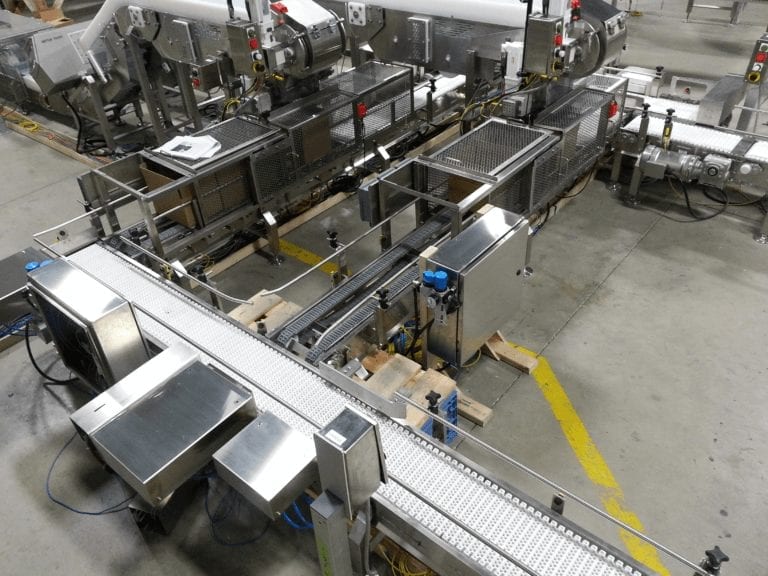
Before diving into the cleaning process, gather the necessary supplies—cleaning agents, tools, safety gear, and waste disposal materials.

2. Schedule Regular Cleaning Sessions
Establish a routine for cleaning that suits the specific needs of your workstation. Daily quick sweeps and weekly deeper cleanings can help maintain cleanliness without disrupting operations.
3. Clear the Workspace
Remove all items from the area, ensuring a clear and unobstructed cleaning path.
4. Cleaning Process
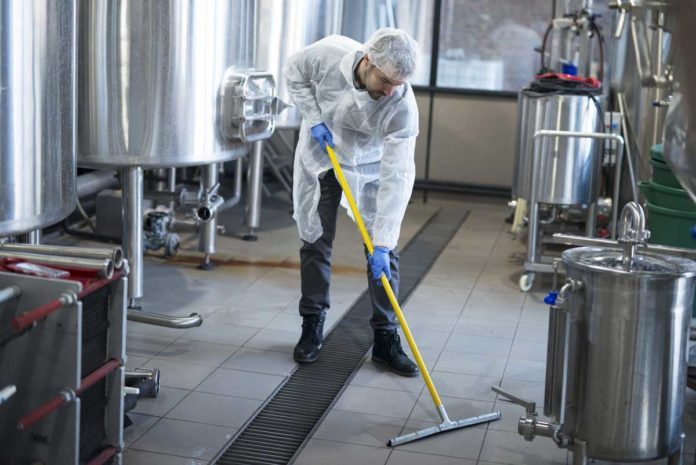
- Start from the top and work your way down to avoid re-contaminating cleaned areas.
- Use appropriate cleaning agents and tools for different surfaces and equipment.
- Pay extra attention to commonly overlooked areas such as corners, shelves, and under equipment.
- Inspect for any signs of wear, damage, or potential safety hazards during cleaning.
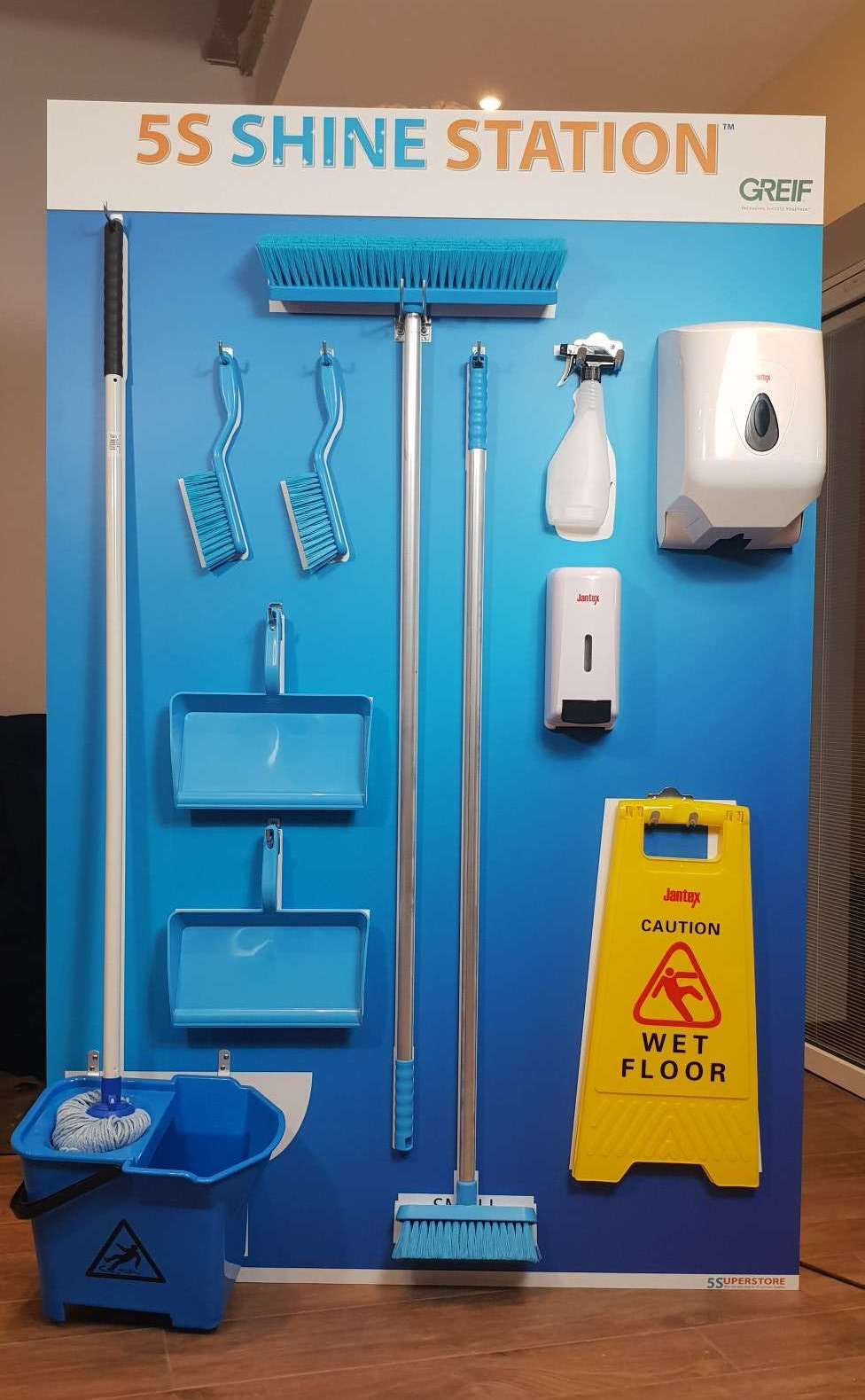
5. Organize and Return
Once the area is clean, organize tools, materials, and equipment methodically. Use visual cues like labels or color-coding for easy identification and retrieval.
Best Practices for the Shine 5S Step
Embracing the Shine step in the 5S methodology not only enhances the visual appeal of a workspace but also elevates operational efficiency and safety standards. By maintaining a clean and organized environment, organizations pave the way for sustained success and a culture of excellence.
Remember, the true essence of Shine lies not just in the gleam of a polished surface, but in the commitment to a mindset of cleanliness and continuous improvement
Ownership and Accountability
Assign responsibilities for cleaning and maintenance to individuals or teams to ensure accountability.
Continuous Improvement
Encourage feedback and suggestions from employees to refine the cleaning process continually.
Regular Inspections
Implement regular checks to ensure adherence to cleanliness standards and promptly address any issues identified.
Training and Education
Provide adequate training on proper cleaning techniques, safety procedures, and the importance of maintaining a clean workspace.
Sustainability
Instill a culture of cleanliness and continuous improvement by integrating Shine into daily routines.

The Art and Science of Scheduling 5S Audits
The 5S methodology is a powerful framework for workstation optimization and continuous improvement. At its core lies the practice of auditing—a systematic evaluation that ensures adherence to 5S principles.
Scheduling these audits strategically is a cornerstone of maintaining a thriving 5S program. Let's delve into the essence of 5S auditing and unveil the pivotal role that scheduling plays in its success.
What is 5S Auditing?
5S auditing is a systematic assessment that scrutinizes workspaces to gauge their alignment with the principles of Sort, Set in Order, Shine, Standardize, and Sustain.
These audits serve as a critical tool to evaluate the effectiveness of 5S implementation, identify areas for improvement, and reinforce a culture of cleanliness, organization, and efficiency within workplaces.

Steps-by-Step Guide to Scheduling 5S Audits
The success of 5S auditing hinges not just on the evaluation itself but also on the strategic scheduling of these assessments. Regular, well-planned audits foster a culture of continuous improvement and drive sustained excellence within organizations.
Before scheduling audits, it is recommended to:
After scheduling audits, you can move forward with:
- Conduct Audit
- Generate & Review Reports
- Implement Corrective Actions & Follow up Audits
- Celebrate Success and Recognition
1. Define Audit Frequency
- Understand Organizational Needs: Consider operational requirements and the nature of work areas to determine how frequently audits should occur.
- Set a Schedule: Establish a clear audit frequency, whether it's weekly, monthly, quarterly, or based on specific operational cycles.
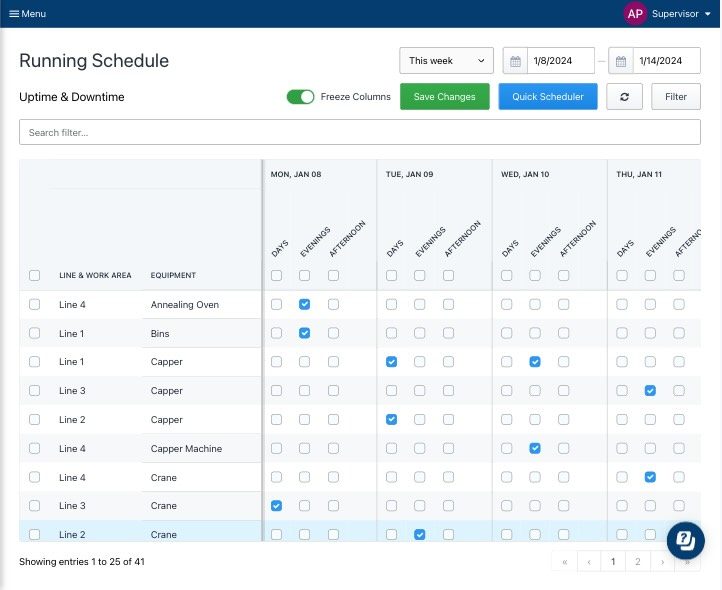
2. Identify Areas for Audits
- Prioritize Work Areas: Determine which departments, zones, or processes require immediate or regular audits based on their impact and criticality.
- Rotation Schedule: Develop a rotation schedule to ensure all areas are audited consistently over time.
3. Establish Audit Duration and Timing
- Allocate Time: Determine the estimated time required to conduct audits for each designated area.
- Choose Appropriate Timing: Schedule audits during times that least disrupt operations but allow for thorough evaluations.
4. Communicate Audit Schedule
- Allow Flexibility: Be open to adjusting audit schedules based on unforeseen circumstances or emerging priorities.
- Adapt to Changes: Modify schedules if feedback or data indicates the need for more frequent or less frequent audits in certain areas.
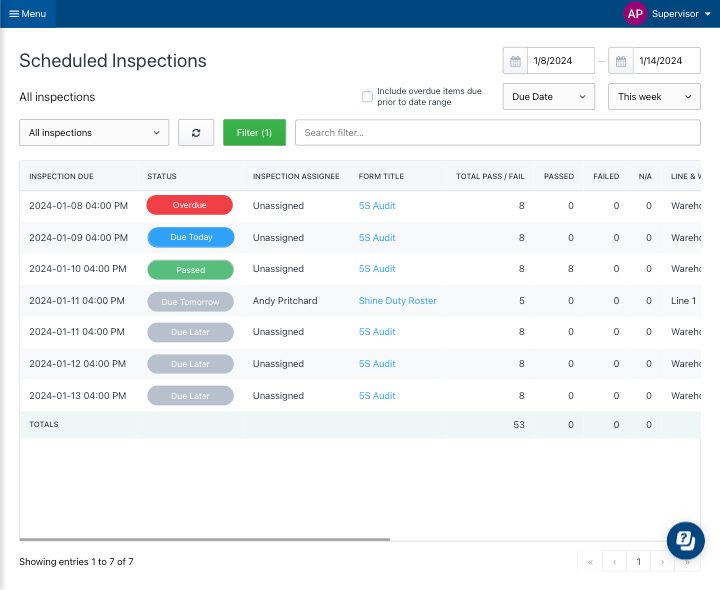
5. Utilize Technology and Tools
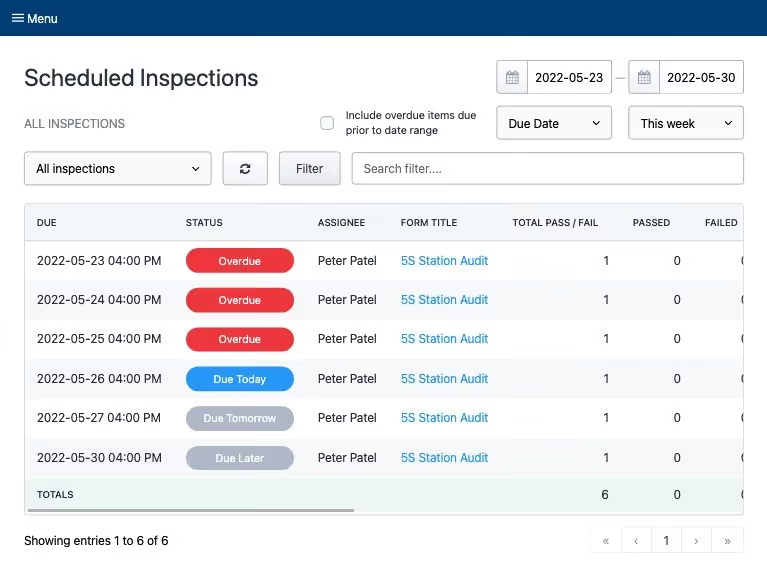
- Use Scheduling Software: Employ digital tools or software that streamline the scheduling process and allow for easy tracking and management of audit schedules.
- Set Reminders and Alerts: Utilize reminders and alerts to ensure auditors and stakeholders are informed and prepared for upcoming audits.
5S Scheduling Best Practices
The most important factor for success is to make the auditing program as accessible as possible. To maximize audit accessibility the tools and resources required should be easy to access and use. Also, the audit schedule should be consistent.
Scheduling 5S audits in a systematic and consistent manner ensures that the workspace's adherence to 5S principles is regularly assessed, providing opportunities for improvement and sustaining the desired standards over time.
Decide on the frequency of audits based on the nature of the workspace, its size, complexity, and the organization's needs. Audits can occur daily, weekly, monthly, quarterly, or even semi-annually.
Some best practices for setting up 5S audit schedules include:
Set a Consistent and Clear Schedule
Establish a clear schedule detailing when audits will occur and which areas or departments will be audited at each session. Regular audits maintain a continuous focus on maintaining standards and identifying areas for improvement. This schedule should be communicated and adhered to by audit teams.
Flexibility and Adaptability
Be open to adjusting the audit schedule if necessary due to unforeseen circumstances, changes in priorities, or emerging needs within the organization.
Feedback and Improvement
Gather feedback from auditors and stakeholders regarding the audit schedule's effectiveness. Use this feedback to refine and improve the scheduling process for future audits.
Continuous Review
Periodically review the effectiveness of the audit schedule. Ensure it aligns with the organization's goals, and make adjustments as needed to enhance its efficiency and relevance.
Documentation and Records
Keep records of scheduled audits, including dates, areas audited, auditors involved, and findings. Documentation aids in tracking progress over time and identifying trends.
Rotating Audit Teams
Consider rotating audit teams or assigning different auditors for each session. This helps gain fresh perspectives and prevents bias in assessments.

Recognition: Celebrating Achievements in 5S
Fire Protection Equipment Inspection
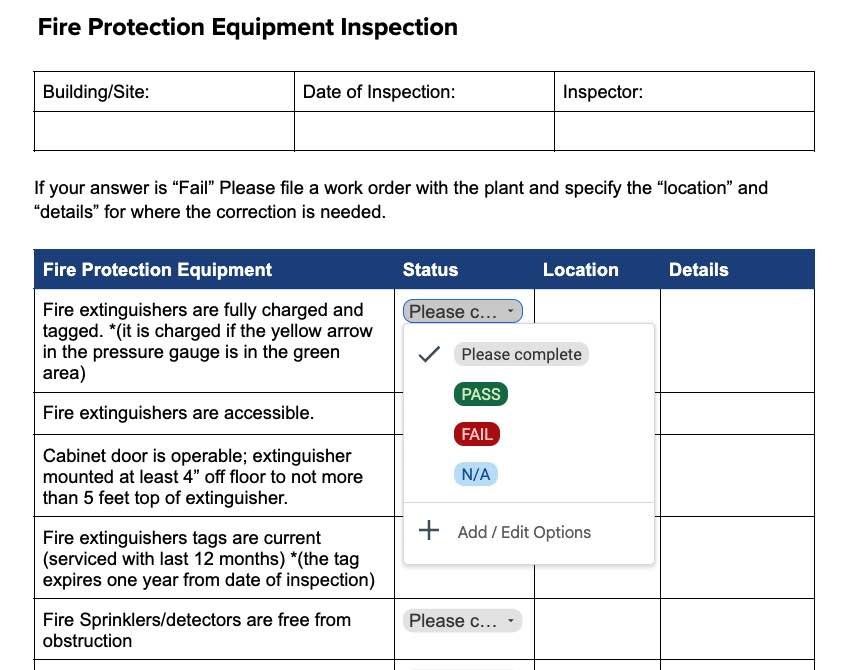
Entirely free and customizable Google Docs, MS Word, and PDF files sent to your email inbox.

Solve Warehouse Fire Inspections with Weever
- Configurable Templates.
- Enhance Real-time Visibility.
- Guide inspections with on-demand resources.
- Automate failure workflows.
- Customizable KPI Reporting.
- Manage Schedules.
Millions of jobs completed worldwide. View Testimonials

Take a Guided Tour.
How to Standardize in 5S
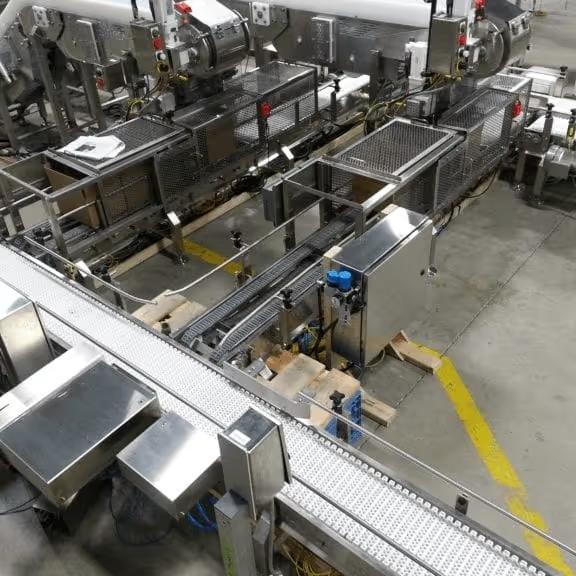
For manufacturing facilities, precision, consistency, and efficiency reign supreme. The 5S methodology stands as a beacon, guiding industries toward optimized operations. Among its fundamental steps, standardization holds a pivotal role in ensuring uniformity, reliability, and continuous improvement. Let's explore how standardization fuels the essence of 5S within manufacturing environments.
What role does Standardize play in 5S?
5S is a methodology deeply rooted in Japanese practices, emphasizing the principles of workplace organization and visual management. The five steps—Sort, Set in Order, Shine, Standardize, and Sustain—form a comprehensive system to enhance productivity, safety, and quality.
Standardization, the fourth step, plays a crucial role by establishing and maintaining uniformity in the application of the 5S methodology across workstations. It ensures that processes, procedures, and practices adhere to a defined standard, facilitating consistency and predictability.
How to Standardize Workstations in Manufacturing
Standardizing workstations within manufacturing necessitates a meticulous approach.
Initiating standardization involves defining clear, comprehensive standards for each step of the 5S methodology. These standards are translated into detailed procedures accompanied by robust training programs.
Visual management, integrating color coding, labeling, and signage, aids in establishing and reinforcing standardized practices.
Regular audits and assessments ensure ongoing compliance and provide insights for improvement.
Documentation and effective communication are pivotal, ensuring all stakeholders are informed and equipped to uphold the established standards.
Follow these steps to standardize the implementation of 5S within a workstation:
Standardization Step-by-Step Guide
The success of standardization lies in its integration into the organizational DNA, where it becomes second nature to all involved—a true testament to the power of the 5S methodology in manufacturing. Follow these steps to standardize the 5S methodology:
1. Define Clear Standards
- Establish comprehensive guidelines detailing how each 5S step should be executed.
- Specify expectations for organization, cleanliness, safety protocols, and visual cues.
2. Develop Standardization Procedures
- Create step-by-step procedures for implementing each 5S step.
- Provide training and resources to ensure everyone understands and follows these procedures.
3. Implement Visual Management
- Use visual cues such as color coding, labels, and signage for clear identification of tools, materials, and designated areas.
- Visual aids should convey standardized processes and expectations.
4. Regular Audits and Assessments
- Conduct frequent audits to assess adherence to standardized practices.
- Gather feedback and data to identify areas for improvement and adjust standards as necessary.
5. Documentation and Communication
- Document standardized procedures and guidelines for easy reference.
- Communicate changes or updates in standards promptly and effectively to all stakeholders.
Standardization Best Practices
Standardization within the 5S methodology is more than just enforcing rules; it’s about creating an environment that thrives on consistency, efficiency, and continual enhancement. By standardizing practices, organizations pave the way for sustained improvement and operational excellence.
Standardization best practices encompass engaging stakeholders at all levels, fostering a culture of continuous improvement, prioritizing comprehensive training, securing support from leadership, and celebrating achievements.
Engage Stakeholders
Involve employees in the standardization process to gather insights and increase buy-in.
Continuous Improvement
Regularly review and refine standards based on feedback, performance data, and changing needs.
Training and Education
Ensure all team members are adequately trained and informed about standardized practices.
Leadership Support
Gain support from management to prioritize and maintain standards across the organization.
Celebrate Success
Acknowledge and celebrate achievements in adherence to standards to foster a culture of excellence.

How to Build a Business Case for 5S Implementation
Building a compelling business case for implementing a 5S program is critical in garnering support, securing resources, and laying the foundation for a successful initiative. Let's explore the essence of the 5S methodology and unveil the significance of strategic planning in the success of a 5S program.
What is the 5S Methodology?
The 5S methodology embodies a structured approach to workplace organization and efficiency. It entails the systematic arrangement, cleanliness, and standardization of workspaces to optimize productivity, safety, and quality.
Planning within the 5S context plays a pivotal role, setting the stage for successful implementation, adherence to principles, and continuous improvement.
Steps-by-Step Guide to Building a 5S Business Case
Building a business case for a 5S program requires meticulous planning, data-driven insights, and a compelling presentation to demonstrate its potential impact on efficiency, safety, and the bottom line.
A well-structured business case lays the groundwork for successful implementation and sustained improvement within the organization. Follow these steps to build and internally "sell" your plan successfully.
1. Understand Organizational Needs
5S is not just about continuously improving operations, it can be used to addresses and fixes major organizational issues.
To properly understand how your organization will benefit from 5S you need to first understand the challenges that are unique to your organization that can be addressed by 5S.
Start by understanding your organization's existing annual strategic objectives. Usually senior leadership will provide annual goals that are the focus of strategic endeavours. These goals highlight what they care about.
Aligning your 5S program to solve the challenges they have identified is a sure fire way to gain leadership support and budget allocation.
To add to your analysis, identify pain points by evaluating existing workplace conditions, inefficiencies and safety concerns.
Learn more about how 5S can solve your organization's strategic challenges ⇒
2. Define Objectives and Benefits
The next step is to outline the goals and objectives of the 5S program that align perfectly with your organization's strategic goals.
Your 5S benefits will then also answer to the pain points you identified in the prior step.
View a comprehensive list of 5S benefits ⇒
3. Gather Benchmark Data and Evidence
To prove the Return on Investment (ROI) for your 5S program, you will need to show improvement in quantifiable KPIs that affect bottomline organizational performance.
- Collect Metrics: Gather data to support the business case, such as incident rates, productivity levels, and waste reduction potential.
- Use Case Studies: Leverage successful 5S implementations in similar industries as case studies.
Leveraging KPIs to Bolster Your 5S Implementation Business Case ⇒
4. Outline Implementation Plan
The next step is to outline an implementation plan for your 5S program.
Create a detailed plan outlining the step-by-step implementation process. The roadmap should identify phases, steps, objectives, activities and resource requirements.
Estimate required resources—time, personnel, and budget—for successful execution.
Anticipate potential issues and their impact and propose strategies that will mitigate and overcome challenges effectively.
Learn how to Build a 5S Implementation Roadmap ⇒
5. Calculate Return on Investment (ROI)
Estimate your cost and quantify your benefit to provide an estimate positive ROI for your 5S program. Calculate implementation costs, including training, tools, and downtime. Forecast the expected benefits against the costs to demonstrate the potential returns.
Use our ROI Calculator to estimate costs, benefits and return on investment ⇒
6. Develop a Compelling Presentation
Compile and distill your business case into a presentation that outlines all of the above information. Emphasize the program benefits, ROI and how the program aligns with current corporate goals.
5S Planning Best Practices
To successfully champion your 5S plan, you should consider these best practices:
Alignment with Organizational Goals
Ensure that the 5S program aligns with broader company objectives.
Stakeholder Engagement
Involve key stakeholders and decision-makers throughout the planning process to gain buy-in.
Realistic Expectations
Set achievable goals and expectations based on the organization's current state.
Flexibility and Adaptability
Plan for contingencies and remain open to adjustments based on feedback and evolving needs.
Measurable Success Criteria
Establish clear metrics to track progress and measure the success of the 5S program.
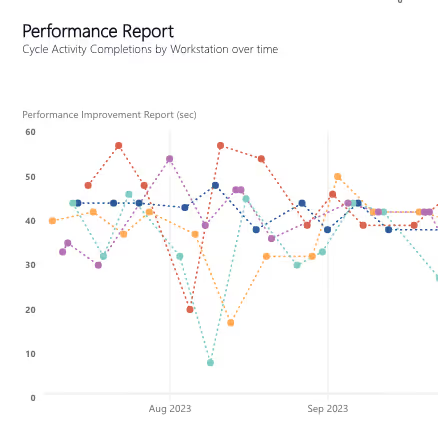
Comprehensive Guide to 5S Audit Reporting
In the pursuit of operational excellence and continual improvement, the 5S methodology stands as a guiding principle. At its core lies the practice of auditing—a systematic evaluation ensuring adherence to 5S principles.
Generating and reviewing audit reports are pivotal steps within this process, playing a crucial role in identifying strengths, areas for improvement, and driving organizational progress. Let's delve into the essence of 5S auditing and unveil the significance of robust reporting in the success of 5S programs.
What is 5S Audit Reporting?
5S auditing is a structured assessment process aimed at evaluating workspaces' compliance with the principles of Sort, Set in Order, Shine, Standardize, and Sustain.
Reporting within this context entails the compilation and analysis of audit findings to provide actionable insights and drive continuous improvement efforts.
Steps-by-Step Guide to 5S Audit Reporting
5S audit reports are not mere documents; they are powerful tools driving organizational change and improvement. Robust reporting mechanisms empower organizations to identify areas of excellence, address shortcomings, and foster a culture of continuous improvement and operational excellence.
Before generating reports, you will need to:
- Establish Audit Criteria and Checklists
- Train Auditors
- Schedule Audits
- Conduct Audits
After generating reports, you can move forward with:
- Implement Corrective Actions & Follow up Audits
- Celebrate Success and Recognition
1. Collect and Compile Data
Ensure you have a system in place to manage the efficient collection of audit data.
- Gather Audit Findings: Accumulate observations, notes, and collected data from audits conducted across various work areas.
- Organize Information: Systematically arrange data to ensure clarity and ease of understanding.
2. Analyze Audit Results
KPI analysis can help to identify patterns and trends that provide insights into what is working and what is not. Use the insights to create action plans for additional training or updates to audit SOPs, checklists and schedules.
- Identify Patterns and Trends: Look for recurring themes or issues across different areas or departments.
- Compare Against Standards: Evaluate findings against predefined criteria and benchmarks.
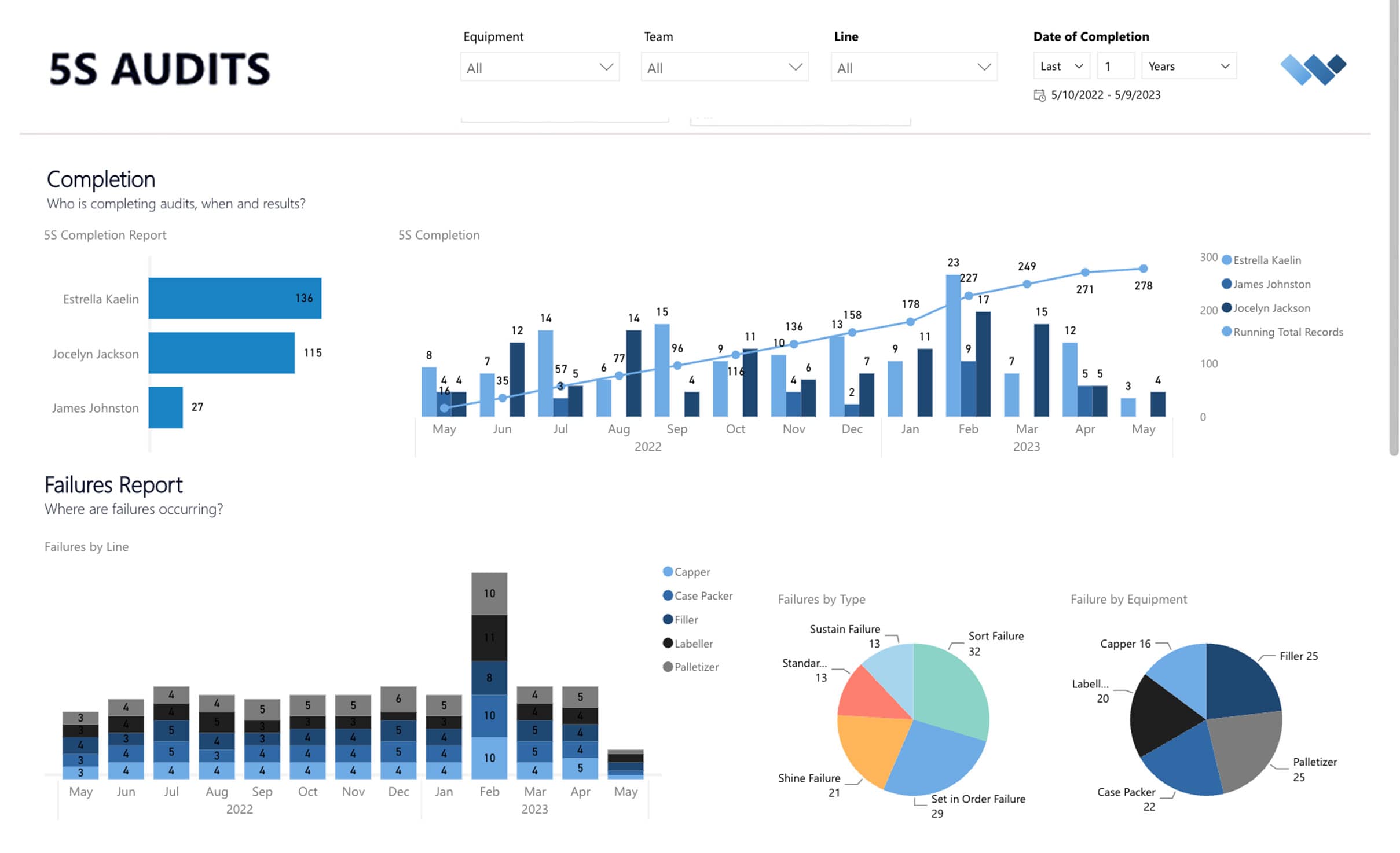
3. Generate Dashboards
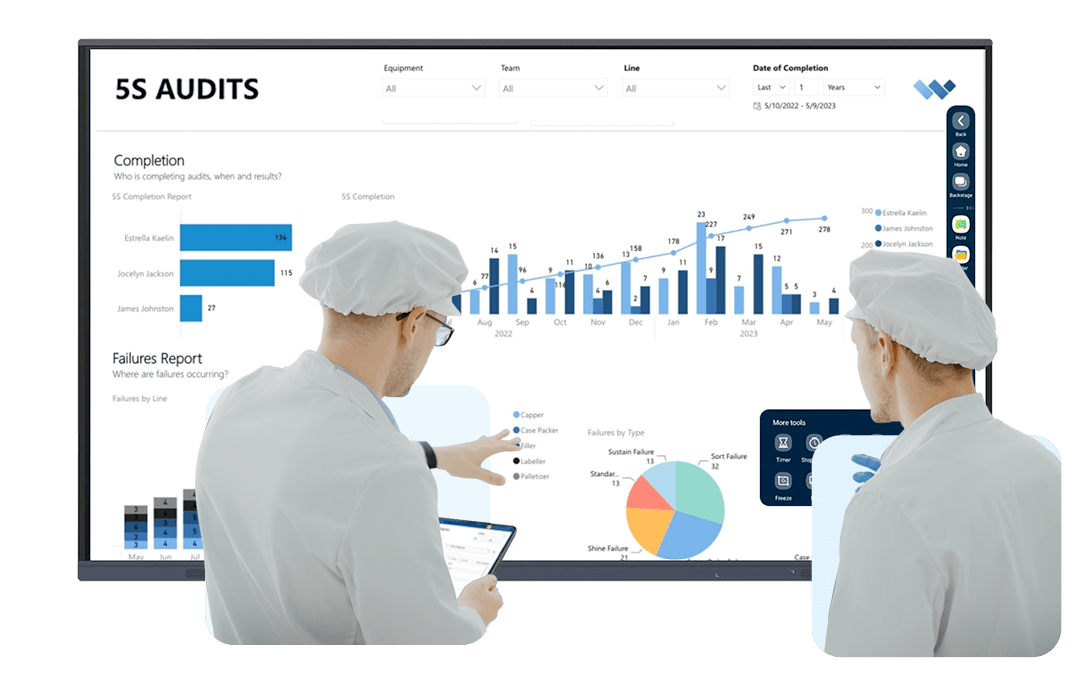
Create a single source of truth dashboard that highlights insights, improvement opportunities and the status of your action plans.
- Summarize Observations: Create detailed reports outlining both compliance and non-compliance areas.
- Include Data Insights: Present quantitative and qualitative data to support audit findings.
- Recommend Actions: Provide actionable suggestions and improvement strategies for non-compliance areas.
- Prioritize Suggestions: Outline steps to address critical issues first for immediate impact.
4. Review Reports with Stakeholders
Ensure stakeholders have the information they need and can provide feedback to update the reports. Consider creating a report that is shared publicly with frontline staff to showcase wins and improvement opportunities.
- Share Findings: Present audit reports to relevant stakeholders, including department heads, managers, and employees.
- Seek Input and Feedback: Encourage discussions and gather perspectives on findings and proposed actions.
5S Reports Best Practices
5S audit reports are not mere documents; they are powerful tools driving organizational change and improvement. Robust reporting mechanisms empower organizations to identify areas of excellence, address shortcomings, and foster a culture of continuous improvement and operational excellence.
Accuracy and Objectivity
Ensure reports accurately reflect audit findings without bias.
Clarity and Conciseness
Present information in a clear and easily understandable format.
Actionable Recommendations
Provide practical and feasible suggestions for improvement.
Engage Stakeholders
Involve relevant parties in discussions and decision-making based on reports.
Scheduling 5S Audits: Implementation Guide
From Compliance Burden to Competitive Advantage: How Audit Software Can Transform your Manufacturing Operations
Audits. We know they are necessary, but they are one of those activities in manufacturing that few (if any) of us look forward to doing. Audits keep our businesses compliant, improve product quality, and uncover areas for continuous improvement, but ask any plant manager or quality leader, and they'll likely admit that traditional audits can feel like a burden.
So, how do you turn auditing from a reactive headache into a proactive tool for growth? The answer is simple: manufacturing audit management software.
The Challenge of Traditional Audit Processes
Audits, when thorough, require inspections, verification of compliance with regulatory standards, and tracking of corrective actions. Traditionally, this involves manual paperwork, spreadsheets, and gathering information from disconnected systems. This approach often leads to:
- Redundant data entry and lost documents.
- Inconsistent follow-ups on corrective actions.
- Sluggish responses to regulatory changes.
As regulatory expectations grow around the world, manufacturers face more pressure to keep meticulous, up-to-date records about everything from the materials they're bringing into their facilities, to their maintenance logs, to safety outcomes, and even the safeguards they use to protect the privacy and financial data of their customers. A single missed audit deadline or incomplete report can bring costly consequences. In fact, research highlights that the cost of noncompliance averages out to $14.82 million annually per company in penalties, lost productivity, and reputational damage. That's a heavy price to pay for outdated processes.
Level Up with Audit Management Software
Do you use your current audit management system to support reactive problem-solving, or does it assist you in building your strengths and setting you up for success in the future?
Audits should serve as a structured way for companies to check whether their processes, products, and systems meet internal standards and external regulatory requirements. In simple terms, they answer the question: "Are we doing what we said we would and are we delivering the right level of quality?"
Manufacturing audit management software like Weever is designed to cut through inefficiencies. Weever software helps manufacturers plan and execute audits and analyze results with precision and ease. Let's break down what that looks like in practice.
- Simplify complex workflows - One common frustration in traditional auditing is the complexity of audit templates. Departments often have their own versions of audit templates and customizing them requires technical know-how. Weever addresses this challenge by offering intuitive, customizable templates that can be tailored to any type of audit. Whether it's a 5S inspection, autonomous maintenance check, or regulatory compliance review, by giving teams a clear structure and easy-to-use interface, the software helps reduce human error and ensures consistency across every audit.
- Automate what slows you down - Here's a question for you: What happens when your audit reveals a safety hazard? In a manual system, the answer usually involves completing a lot of paperwork, launching email chains, and feverishly hoping that corrective actions don't slip through the cracks, resulting in an injury, shutdown, or worse. With Weever audit management software, automation steps in, generating corrective action plans, assigning tasks to the right people, and setting deadlines. Issues are resolved faster and with greater accountability. Scheduling, task assignments, and reminders are all handled by the system, freeing up your staff for more strategic initiatives.
- Unlock the power of real-time data - Another critical question: How do you know whether your audits are truly driving improvement? If your current audit program does nothing more than uncover existing problems that are already impacting your business, then it is not delivering the value proposition it should. Weever challenges this outdated dynamic by providing real-time reporting. Managers can instantly see the status of audits, track non-compliance issues, and generate detailed reports for internal or external use. These insights allow leaders to move from reacting to problems to preventing them, fueling continuous improvement across operations.
- Integrate new software without disruption - We're not going to sugarcoat it: Disruption can be a concern when introducing new technology. That's why Weever is designed for easy onboarding, with guided implementation, pre-built templates, and comprehensive training. Its flexible configuration means it adapts to existing systems and workflows rather than forcing your business to overhaul how you operate. The result is faster adoption, minimal downtime, and a quicker return on investment.
Audits: From Pain in the Neck to Strategic Advantage
Auditing isn't just about compliance; it's about building trust and protecting your organization from unnecessary risk. Effective audit programs provide assurance your operations are functioning at a high level, and risks are being managed effectively.
By moving to a digital, automated audit system, manufacturers gain more than efficiency. They gain a competitive edge. Consistent, accurate audits mean stronger quality assurance, safer workplaces, and better compliance records. Your investment in manufacturing audit management software helps attract customers and builds your reputation as a reliable partner.
Audit management software like Weever transforms audits from a frustrating necessity into a powerful driver of compliance, efficiency, and improvement. By simplifying workflows, automating corrective actions, and delivering real-time insights, it ensures that audits are not just completed, but that they create meaningful value.
So, the question isn't "Do we need audit management software?" but rather "Can we afford not to have it?" In today's environment of tightening regulations and rising competition, the answer is clear.
Ready to see how streamlined audits can transform your operations? Reach out to Weever today to schedule a demo and take the first step toward making audits a competitive advantage.
Ready to Digitize 5S In Your Operations?
Discover how the Smart Connected Worker Platform can revolutionize your manufacturing operations. Our team of experts is ready to help you implement intelligent solutions that drive safety, efficiency, and operational excellence. Download the 5S Audit Digitization Implementation Guide Demo 5S Today
How to Conduct Successful 5S Audits
In the quest for operational efficiency and workplace optimization, the 5S methodology stands as a cornerstone. At the heart of 5S lies the practice of auditing-an instrumental process ensuring adherence to its principles. Let's explore the essence of 5S auditing and unveil the essential steps to conduct audits that drive continuous improvement and organizational excellence.
What is 5S Auditing?
5S auditing is a systematic assessment that scrutinizes workspaces to gauge their alignment with the principles of Sort, Set in Order, Shine, Standardize, and Sustain.
These audits serve as a critical tool to evaluate the effectiveness of 5S implementation, identify areas for improvement, and reinforce a culture of cleanliness, organization, and efficiency within workplaces.

Steps-by-Step Guide to Conducting Successful Audits
Successful 5S audits transcend mere assessments; they catalyze a culture of excellence, fostering continual improvement and reinforcing the principles of organization and efficiency within the workspace.Conducting audits is a pivotal stage within the 5S methodology. This step involves a comprehensive evaluation of work areas to determine compliance with established criteria and ensure adherence to 5S principles.Before conducting audits, it is recommended to:
After completing audits, it is recommended to:
- Generate & Review Reports
- Implement Corrective Actions & Follow up Audits
- Celebrate Success and Recognition
Conducting thorough audits is not just about evaluating compliance; it's an opportunity to engage employees, gather valuable insights, and lay the groundwork for continuous improvement within the organization.
1. Preparation
Provide auditors with materials for them to efficiently understand the standards set for a give workstation.
- Gather Audit Materials: Ensure auditors have the necessary tools, checklists, and resources required for the assessment.
- Review Audit Scope: Familiarize auditors with the specific areas, processes, or departments to be audited.
2. Workstation Examination
Walk through the workstation with the operator and pay attention to the details.
- Objective Evaluation: Conduct evaluations in a structured manner, adhering strictly to the predefined criteria and checklists.
- Engage with Employees: Encourage auditors to interact with employees in the workspace, seeking their input and observations.
- Attention to Detail: Assess all aspects of the work area, from physical cleanliness to the organization of tools and materials.
3. Document Findings
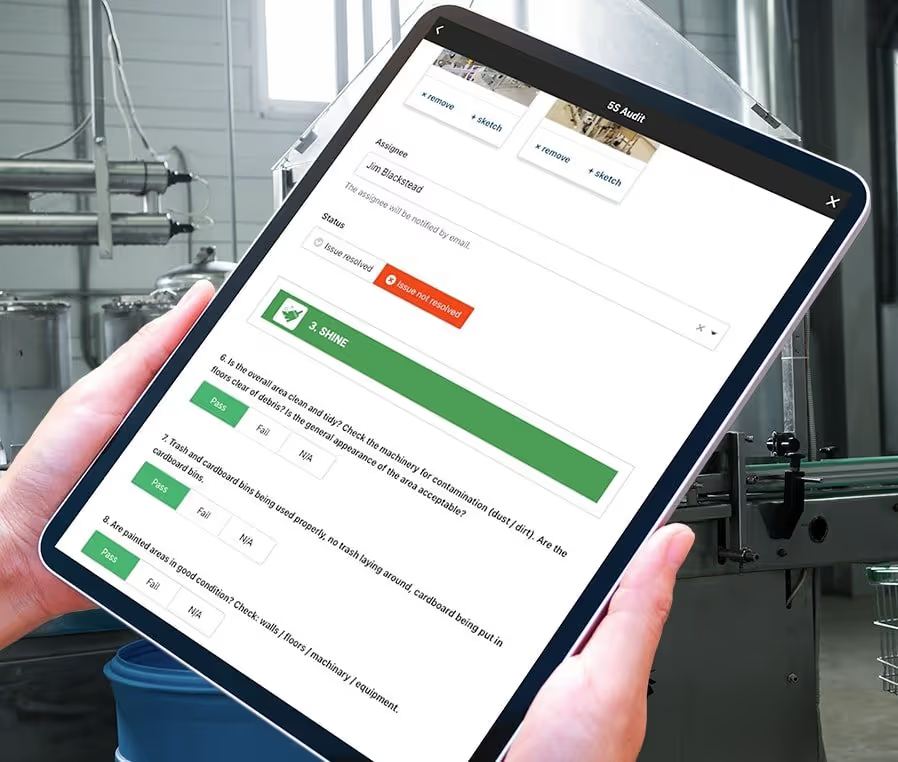
Document observations. Add additional information for "failures", including photos and action item assignments if appropriate.
- Data Collection: Gather quantitative and qualitative data to support audit findings.
- Record Observations: Document both compliance and non-compliance observations accurately and objectively.
- Take Notes: Record any additional comments, suggestions, or noteworthy observations made during the audit.
4. Verify & Summarize
Include the operator in the audit. Discuss and verify audit results and consult on next steps. Summarize your observations and recommendations.
- Debriefing: Hold discussions with auditors to consolidate findings and ensure consistency in assessments.
- Employee Feedback: Share preliminary findings with employees to gather their insights and feedback.
- Double-check Observations: Review audit findings to ensure accuracy and validity.
- Cross-reference Data: Validate collected data with multiple sources if possible for accuracy.
- Summarize Findings: Consolidate audit observations and data into a comprehensive report.
- Include Recommendations: Offer suggestions for improvement and actions to address non-compliance areas
5. Communicate Results
Share insights and suggested action plans with shift supervisor and other stakeholders.
- Feedback Loop: Share audit reports and findings with relevant stakeholders, including employees and management.
- Transparent Communication: Ensure open communication about both strengths and areas needing improvement.
5S Audit Reporting: Comprehensive Guide
In the pursuit of operational excellence and continual improvement, the 5S methodology stands as a guiding principle. At its core lies the practice of auditing-a systematic evaluation ensuring adherence to 5S principles.
Generating and reviewing audit reports are pivotal steps within this process, playing a crucial role in identifying strengths, areas for improvement, and driving organizational progress. Let's delve into the essence of 5S auditing and unveil the significance of robust reporting in the success of 5S programs.
What is 5S Audit Reporting?
5S auditing is a structured assessment process aimed at evaluating workspaces' compliance with the principles of Sort, Set in Order, Shine, Standardize, and Sustain.
Reporting within this context entails the compilation and analysis of audit findings to provide actionable insights and drive continuous improvement efforts.
Steps-by-Step Guide to 5S Audit Reporting
5S audit reports are not mere documents; they are powerful tools driving organizational change and improvement. Robust reporting mechanisms empower organizations to identify areas of excellence, address shortcomings, and foster a culture of continuous improvement and operational excellence.Before generating reports, you will need to:
After generating reports, you can move forward with:
- Implement Corrective Actions & Follow up Audits
- Celebrate Success and Recognition
1. Collect and Compile Data
Ensure you have a system in place to manage the efficient collection of audit data.
- Gather Audit Findings: Accumulate observations, notes, and collected data from audits conducted across various work areas.
- Organize Information: Systematically arrange data to ensure clarity and ease of understanding.
2. Analyze Audit Results
KPI analysis can help to identify patterns and trends that provide insights into what is working and what is not. Use the insights to create action plans for additional training or updates to audit SOPs, checklists and schedules.
- Identify Patterns and Trends: Look for recurring themes or issues across different areas or departments.
- Compare Against Standards: Evaluate findings against predefined criteria and benchmarks.
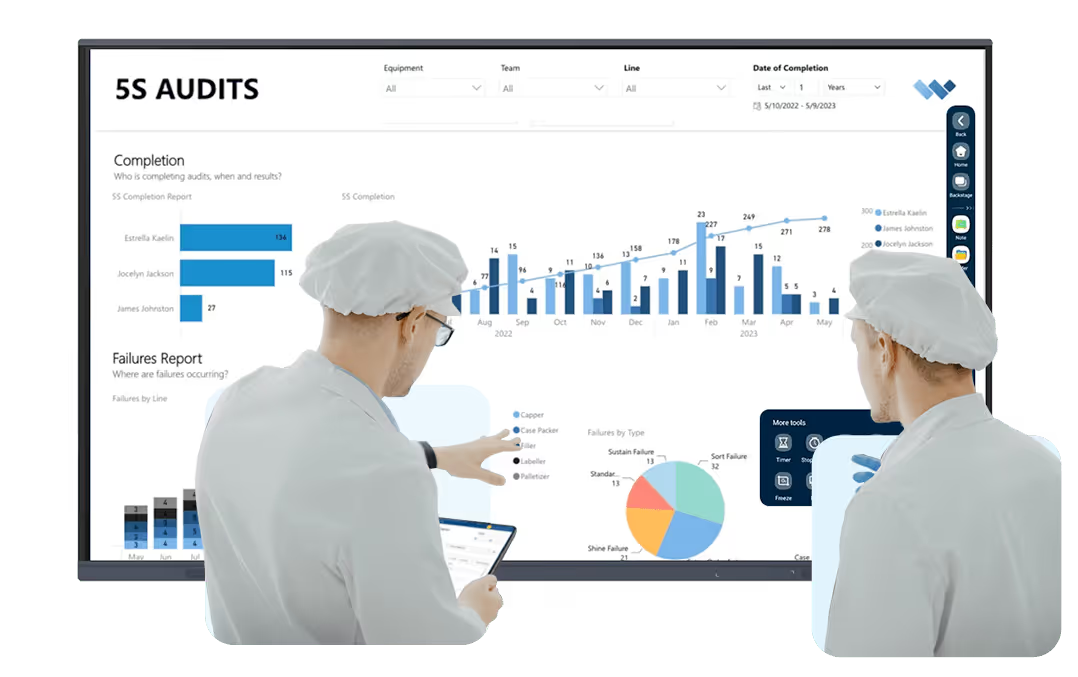
3. Generate Dashboards
Create a single source of truth dashboard that highlights insights, improvement opportunities and the status of your action plans.
- Summarize Observations: Create detailed reports outlining both compliance and non-compliance areas.
- Include Data Insights: Present quantitative and qualitative data to support audit findings.
- Recommend Actions: Provide actionable suggestions and improvement strategies for non-compliance areas.
- Prioritize Suggestions: Outline steps to address critical issues first for immediate impact.
4. Review Reports with Stakeholders
Ensure stakeholders have the information they need and can provide feedback to update the reports. Consider creating a report that is shared publicly with frontline staff to showcase wins and improvement opportunities.
- Share Findings: Present audit reports to relevant stakeholders, including department heads, managers, and employees.
- Seek Input and Feedback: Encourage discussions and gather perspectives on findings and proposed actions.
5S Reports Best Practices
5S audit reports are not mere documents; they are powerful tools driving organizational change and improvement. Robust reporting mechanisms empower organizations to identify areas of excellence, address shortcomings, and foster a culture of continuous improvement and operational excellence.
Accuracy and Objectivity
Ensure reports accurately reflect audit findings without bias.
Clarity and Conciseness
Present information in a clear and easily understandable format.
Actionable Recommendations
Provide practical and feasible suggestions for improvement.
Engage Stakeholders
Involve relevant parties in discussions and decision-making based on reports.

5S Recognition: Celebrating Achievements
Within the sphere of workplace optimization and continuous improvement, the 5S methodology stands as a beacon, fostering efficiency and excellence. At the core of this practice lies 5S auditing-an assessment process ensuring adherence to principles. Celebrating success and recognition are integral to this process, serving as catalysts for motivation, fostering a culture of excellence, and reinforcing positive behaviors. Let's explore the essence of 5S auditing and unveil the significance of celebrating success in the success of 5S programs.
What is 5S Auditing?
5S auditing is a systematic assessment that scrutinizes workspaces to gauge their alignment with the principles of Sort, Set in Order, Shine, Standardize, and Sustain.
These audits serve as a critical tool to evaluate the effectiveness of 5S implementation, identify areas for improvement, and reinforce a culture of cleanliness, organization, and efficiency within workplaces.
Celebrating success within this framework is more than acknowledgment; it's a tool to reinforce desired behaviors, motivate employees, and sustain momentum in the pursuit of excellence.

Steps-by-Step Guide to Recognizing Contributions and Celebrating Success in 5S
Celebrating success and recognition isn't just about acknowledging accomplishments; it's a pivotal element in nurturing a culture of excellence, motivation, and continuous improvement within 5S programs. These celebrations serve as milestones, reinforcing positive behaviors and propelling organizations toward sustained success.Before recognizing contributions and celebrating successes, it is recommended to:
- Establish Audit Criteria and Checklists
- Train Auditors
- Schedule Audits
- Conduct Audits
- Generate & Review Reports
- Implement Corrective Actions & Follow up Audits
1. Set Clear Goals and Benchmarks
Ensure all employees clearly understand expectations.
- Define Achievements: Establish clear objectives and criteria for success aligned with 5S principles.
- Communicate Expectations: Ensure everyone understands the goals and benchmarks set.
2. Regular Recognition Efforts
Be consistent and transparent.
- Continuous Acknowledgment: Recognize achievements consistently, whether big or small.
- Public Acknowledgment: Celebrate successes publicly to reinforce positive behaviors.
3. Engage Employees in Recognition
Ensure employees are involved in the process.
- Employee Involvement: Involve employees in identifying and acknowledging success stories.
- Peer Recognition: Encourage peer-to-peer recognition to foster a culture of appreciation.
4. Reward and Incentivize
Provide rewards for outstanding achievements.
- Incentives for Excellence: Offer rewards or incentives for outstanding adherence to 5S principles.
- Non-Monetary Rewards: Recognize achievements with non-monetary incentives like certificates, badges, or accolades.

5. Showcase Achievements
Celebrate and broadcast positive results with the team.
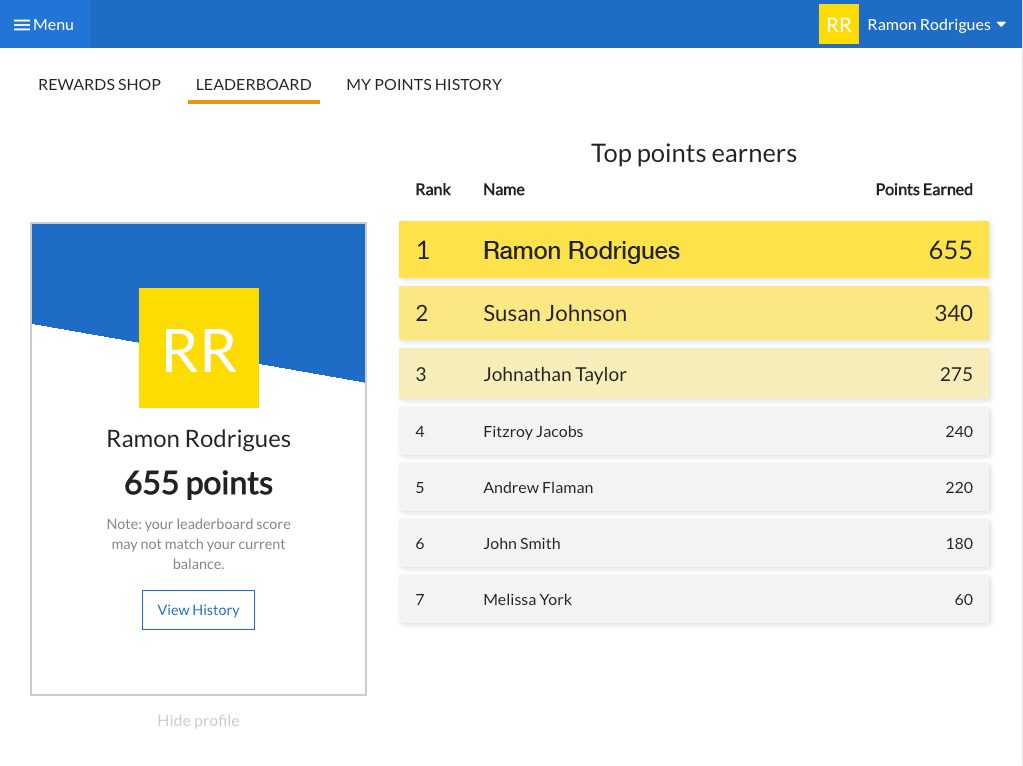
- Visual Displays: Create visual displays showcasing successful implementations and improvements.
- Share Success Stories: Share success stories through newsletters, bulletin boards, or internal communications.
6. Feedback and Improvement
Review the program with frontline staff and stakeholders regularly to ensure continuous improvement.
- Encourage Feedback: Solicit feedback on recognition efforts to refine and enhance future celebrations.
- Continuous Improvement: Use feedback to continually evolve recognition strategies.
5S Recognition and Celebrating Wins Best Practices
Now that you understand the steps involved in the process, it is important to understand best practices that pertain to each step. Some best practices for recognizing achievements and celebrating wins include:
Consistency is Key
Maintain regularity in recognition efforts to sustain motivation and engagement.
Transparency and Fairness
Ensure fairness in recognition and rewards to motivate everyone equally.
Personalization
Recognize individuals or teams based on their unique contributions.
Leadership Support
Garner support from leadership to reinforce the importance of recognition in the organizational culture.
Celebrating Team Achievements
Acknowledge collective successes to foster teamwork and collaboration.
5S Standardize Implementation
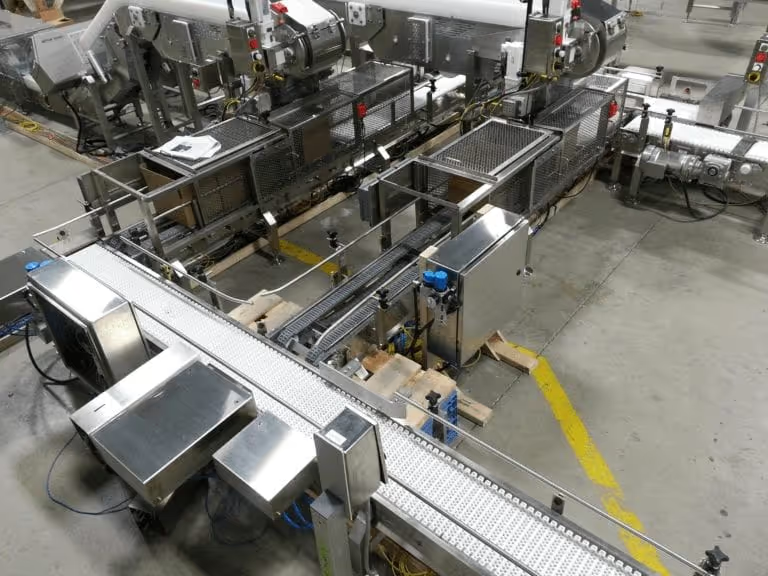
For manufacturing facilities, precision, consistency, and efficiency reign supreme. The 5S methodology stands as a beacon, guiding industries toward optimized operations. Among its fundamental steps, standardization holds a pivotal role in ensuring uniformity, reliability, and continuous improvement. Let's explore how standardization fuels the essence of 5S within manufacturing environments.
What role does Standardize play in 5S?
5S is a methodology deeply rooted in Japanese practices, emphasizing the principles of workplace organization and visual management. The five steps-Sort, Set in Order, Shine, Standardize, and Sustain-form a comprehensive system to enhance productivity, safety, and quality.
Standardization, the fourth step, plays a crucial role by establishing and maintaining uniformity in the application of the 5S methodology across workstations. It ensures that processes, procedures, and practices adhere to a defined standard, facilitating consistency and predictability.
How to Standardize Workstations in Manufacturing
Standardizing workstations within manufacturing necessitates a meticulous approach. Initiating standardization involves defining clear, comprehensive standards for each step of the 5S methodology. These standards are translated into detailed procedures accompanied by robust training programs.
Visual management, integrating color coding, labeling, and signage, aids in establishing and reinforcing standardized practices. Regular audits and assessments ensure ongoing compliance and provide insights for improvement. Documentation and effective communication are pivotal, ensuring all stakeholders are informed and equipped to uphold the established standards. Follow these steps to standardize the implementation of 5S within a workstation:
Standardization Step-by-Step Guide
The success of standardization lies in its integration into the organizational DNA, where it becomes second nature to all involved-a true testament to the power of the 5S methodology in manufacturing. Follow these steps to standardize the 5S methodology:
1. Define Clear Standards
- Establish comprehensive guidelines detailing how each 5S step should be executed.
- Specify expectations for organization, cleanliness, safety protocols, and visual cues.
2. Develop Standardization Procedures
- Create step-by-step procedures for implementing each 5S step.
- Provide training and resources to ensure everyone understands and follows these procedures.
3. Implement Visual Management
- Use visual cues such as color coding, labels, and signage for clear identification of tools, materials, and designated areas.
- Visual aids should convey standardized processes and expectations.
4. Regular Audits and Assessments
- Conduct frequent audits to assess adherence to standardized practices.
- Gather feedback and data to identify areas for improvement and adjust standards as necessary.
5. Documentation and Communication
- Document standardized procedures and guidelines for easy reference.
- Communicate changes or updates in standards promptly and effectively to all stakeholders.
Standardization Best Practices
Standardization within the 5S methodology is more than just enforcing rules; it's about creating an environment that thrives on consistency, efficiency, and continual enhancement. By standardizing practices, organizations pave the way for sustained improvement and operational excellence.
Standardization best practices encompass engaging stakeholders at all levels, fostering a culture of continuous improvement, prioritizing comprehensive training, securing support from leadership, and celebrating achievements.
- Engage Stakeholders - Involve employees in the standardization process to gather insights and increase buy-in.
- Continuous Improvement - Regularly review and refine standards based on feedback, performance data, and changing needs.
- Training and Education - Ensure all team members are adequately trained and informed about standardized practices.
- Leadership Support - Gain support from management to prioritize and maintain standards across the organization.
- Celebrate Success - Acknowledge and celebrate achievements in adherence to standards to foster a culture of excellence.

5S Shine Implementation
In the realm of workplace organization and efficiency, the 5S methodology stands as a beacon for optimal operations.
Among its five pillars-Sort, Set in Order, Shine, Standardize, and Sustain-Shine holds a crucial position in maintaining cleanliness, safety, and functionality within workstations.
Let's delve into the specifics of this essential step and explore how it drives the 5S methodology toward excellence.
What is 5S?
5S is a methodology originating from Japan, emphasizing the principles of workplace organization and visual management. Its five steps, when executed meticulously, foster an environment of efficiency, safety, and continuous improvement.
How to Shine
Among the 5S steps, Shine (Seiso in Japanese) refers to the process of cleaning and inspecting work areas and equipment thoroughly. It's more than just tidying up-it's about ensuring that every nook and cranny is pristine, free of dust, dirt, or potential hazards. By doing so, Shine contributes significantly to a workspace's overall safety, functionality, and morale.
Step-by-Step Guide to 5S Shine
Cleaning and tidying can be completed in a multitude of different ways. The below steps outline the most efficient way to ensure the best results.
1. Preparation
Before diving into the cleaning process, gather the necessary supplies-cleaning agents, tools, safety gear, and waste disposal materials.
2. Schedule Regular Cleaning Sessions
Establish a routine for cleaning that suits the specific needs of your workstation. Daily quick sweeps and weekly deeper cleanings can help maintain cleanliness without disrupting operations.
3. Clear the Workspace
Remove all items from the area, ensuring a clear and unobstructed cleaning path.
4. Cleaning Process
- Start from the top and work your way down to avoid re-contaminating cleaned areas.
- Use appropriate cleaning agents and tools for different surfaces and equipment.
- Pay extra attention to commonly overlooked areas such as corners, shelves, and under equipment.
- Inspect for any signs of wear, damage, or potential safety hazards during cleaning.
5. Organize and Return
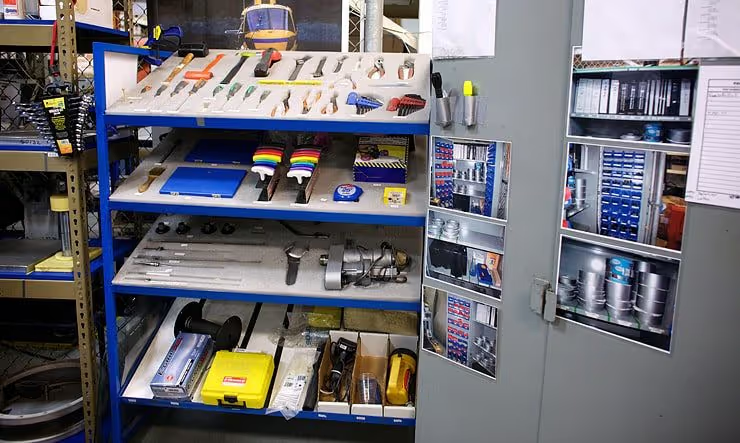
Once the area is clean, organize tools, materials, and equipment methodically. Use visual cues like labels or color-coding for easy identification and retrieval.
Best Practices for the Shine 5S Step
Embracing the Shine step in the 5S methodology not only enhances the visual appeal of a workspace but also elevates operational efficiency and safety standards. By maintaining a clean and organized environment, organizations pave the way for sustained success and a culture of excellence. Remember, the true essence of Shine lies not just in the gleam of a polished surface, but in the commitment to a mindset of cleanliness and continuous improvement.
- Ownership and Accountability - Assign responsibilities for cleaning and maintenance to individuals or teams to ensure accountability.
- Continuous Improvement - Encourage feedback and suggestions from employees to refine the cleaning process continually.
- Regular Inspections - Implement regular checks to ensure adherence to cleanliness standards and promptly address any issues identified.
- Training and Education - Provide adequate training on proper cleaning techniques, safety procedures, and the importance of maintaining a clean workspace.
- Sustainability - Instill a culture of cleanliness and continuous improvement by integrating Shine into daily routines.
5S Sorting Implementation
As your manufacturing facility gears up for a transformative "Optimization Blitz," the initial step of the 5S methodology, Sort, sets the stage for an efficient and organized workspace.
On the first day of the "blitz", Frontline staff, working hand-in-hand with 5S leadership, will embark on the crucial task of sorting their workstations.
In this article we discuss an overview of the Sort step, the process involved, key considerations, and best practices to make this phase impactful.
But first, let's review what 5S is and why it is important.
What is 5S?
The 5S methodology is a systematic approach aimed at organizing a workspace for efficiency and effectiveness. It consists of five steps, each starting with the letter "S":
- Sort: Eliminate unnecessary items from the workspace, keeping only the essentials.
- Set in Order: Organize and arrange necessary items in a logical and accessible manner for easy retrieval and use.
- Shine: Clean the workspace regularly to maintain cleanliness and identify any issues or abnormalities.
- Standardize: Establish and maintain standardized work procedures to sustain the improvements made in the first three steps.
- Sustain: Develop a habit of maintaining the established standards and continuously improving the workspace.
This methodology is often applied in manufacturing, service industries, and various workplaces to streamline processes, reduce waste, and enhance productivity.
The Sort Step
Now that we understand the 5S methodology a bit better, let's dig into understanding how to sort a workstation to maximize its productivity.
The Sort step aims to declutter workspaces by identifying and removing unnecessary items.
It's about distinguishing between what's needed (the essentials) and what's not (the clutter). By reducing unnecessary items, teams create streamlined, organized, and efficient work areas, laying the groundwork for improved productivity.
How to Sort a Workstation
The Sort step in the 5S methodology kickstarts the Optimization Blitz, fostering a workspace conducive to efficiency and productivity. Through collaborative efforts, clear guidelines, and a purposeful approach to sorting, frontline staff and 5S leaders can lay a strong foundation for subsequent steps, ensuring a streamlined and organized workspace for enhanced operations.Here are the steps involved in completing an efficient sorting step.
Gather the Team
Assemble a team comprising frontline staff and 5S leaders to collaborate on the sorting process. Sorting is most effective when a team can work together to identify items, define criteria, separate and relocate.

Set Criteria
Define clear criteria for identifying non-essential items, considering factors like frequency of use, relevance to current processes, and condition. Some factors to consider include:
- Necessity: Determine what items are necessary for daily operations. Ask whether an item is essential for the work being done in that area. If not, consider removing it.
- Frequency of Use: Evaluate how often items are used. Items used regularly should be easily accessible, while those used infrequently can be stored in less accessible areas.
- Redundancy: Identify duplicate items and assess if they are all necessary. Redundant items can clutter the workspace and should be minimized.
- Purpose: Clarify the purpose of each item. If an item's purpose isn't evident or it serves no clear function, it might be a candidate for removal.
- Safety and Compliance: Ensure that items necessary for safety or regulatory compliance are readily available and properly stored. Anything related to safety or regulations should not be compromised.
- Future Needs: Consider potential future needs, but be cautious not to hoard items based solely on speculative future requirements. Balance current necessities with potential future use.
- Team Input: Involve the team working in the area during the sorting process. They likely have insights into what is necessary for their tasks and can contribute valuable perspectives.
Identify and Separate Items
Assess every item in the workspace, categorizing them into essential (needed for daily tasks) and non-essential (obsolete, rarely used).Segregate items into "Keep," "Discard," or "Reallocate" categories based on the established criteria.
Dispose or Relocate
Discard obsolete items responsibly or relocate them to designated storage areas outside the immediate workspace. Items categorized for relocation should be transferred to designated storage areas, keeping them away from the immediate workspace but still easily accessible if needed. Ensure these storage areas are organized, labeled, and easily navigable. This prevents clutter and supports efficient retrieval when required.Ensure responsible disposal methods, which might include recycling, donation, or proper waste disposal as per company policies and environmental regulations. Maintain records of items being discarded, noting reasons for disposal. This documentation aids in tracking progress and making informed decisions in the future.
Best Practices for an Effective Sort
For best results during the sorting process ensure you encourage and open dialogue, set clear criteria and document what was removed and why. Here are some additional best practices that you might consider:
Collaborative Approach
Encourage open communication and collaboration among team members during sorting.
Clear Guidelines
Provide clear criteria and guidelines to facilitate decision-making during item sorting.
Purposeful Sorting
Focus on functionality and necessity rather than sentimental value when assessing items.
Continuous Improvement Mindset
Instill a culture of ongoing sorting to prevent re-accumulation of unnecessary items. Use 5S audits to capture improvement insights.
Documentation
Keep records of discarded items and reasons for removal to track progress and inform future decisions. It is helpful to include before and after photos for each section in the workstation. These can be used to build Standardization SOPs and Audit checklists later in the 5S process.
5S Set in Order Step Implementation
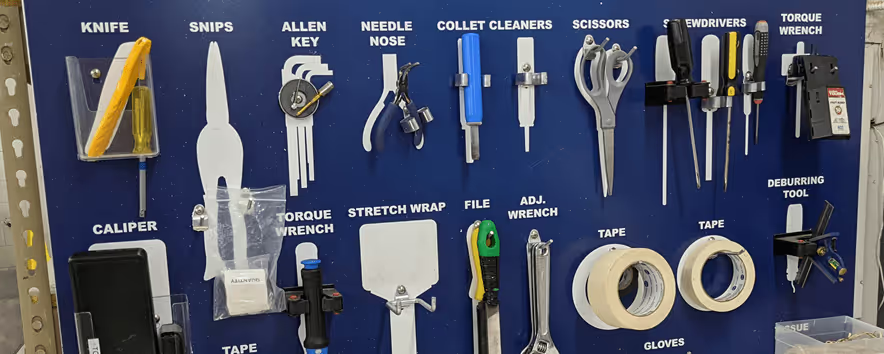
Set in Order focuses on arranging essential items in a logical and efficient manner, optimizing the workspace layout for improved accessibility, safety, and workflow.
This step ensures that everything has its designated place, streamlining processes and reducing waste.
We recommend using the "Optimization Blitz" approach to 5S implementation, where you work with small teams and execute each of the first 3 steps one per day. This approach allows for you to get the best results in the shortest amount of time.
But before we get into the Set in Order step, let's review the 5S methodology and the first "Sort" step that will need to be completed before you begin to set workstations in order.
What is 5S and how does it work?
The 5S methodology is a systematic approach aimed at organizing a workspace for efficiency and effectiveness. It consists of five steps, each starting with the letter "S":
- Sort: Eliminate unnecessary items from the workspace, keeping only the essentials.
- Set in Order: Organize and arrange necessary items in a logical and accessible manner for easy retrieval and use.
- Shine: Clean the workspace regularly to maintain cleanliness and identify any issues or abnormalities.
- Standardize: Establish and maintain standardized work procedures to sustain the improvements made in the first three steps.
- Sustain: Develop a habit of maintaining the established standards and continuously improving the workspace.
The Sort step aims to declutter workspaces by identifying and removing unnecessary items. It's about distinguishing between what's needed (the essentials) and what's not (the clutter). By reducing unnecessary items, teams create streamlined, organized, and efficient work areas, laying the groundwork for improved productivity.
When you have completed sorting, the next step is to Set the workstation in Order.
The Set in Order Step
The Set in Order is the "magical" step in the 5S process and it can be viewed as more of an art than a science. As a result, you may want to consider hiring the services of a lean practitioner to help you execute this crucial step.
Here is a detailed overview of the steps involved.
How to Set in Order a Workstation
The Set in Order step within the Optimization Blitz is pivotal in reorganizing workspaces for enhanced efficiency and safety. By collaboratively assessing, redesigning, and implementing optimized layouts, frontline staff and 5S leaders create a more organized and streamlined workspace, facilitating smoother operations and improving overall productivity. This sets the stage for the subsequent steps in the 5S methodology, emphasizing sustained orderliness and optimization within the manufacturing environment.
1. Evaluate Current Layout
Begin by evaluating the current layout and organization of the workspace. Assess how items are currently arranged and identify any inefficiencies or safety hazards.
2. Determine Optimal Layout
Collaborate with frontline staff to determine an optimal layout. Consider factors like workflow patterns, frequency of item use, ergonomic considerations, and safety protocols.
3. Establish Item Placement Guidelines
Develop clear guidelines for item placement based on their frequency of use, workflow sequence, and ergonomic considerations. Designate specific areas for different categories of items.What to Consider and Look For:
- Accessibility: Ensure items are easily reachable and accessible, reducing unnecessary movement or bending.
- Safety Measures: Arrange items to minimize safety hazards, keeping heavy or hazardous items stored securely and appropriately.
- Optimal Space Utilization: Maximize space utilization by organizing items efficiently, avoiding clutter and obstructions.
4. Redesign Workspace Layout
Based on the determined guidelines, rearrange the workspace layout. Ensure commonly used items are easily accessible, frequently accessed tools are within arm's reach, and less used items are stored further away.
5. Implement Visual Controls
Utilize visual cues such as color-coded labels, signs, or floor markings to signify item placement, storage locations, or workflow paths. This aids in maintaining order and guiding efficient movement within the workspace.
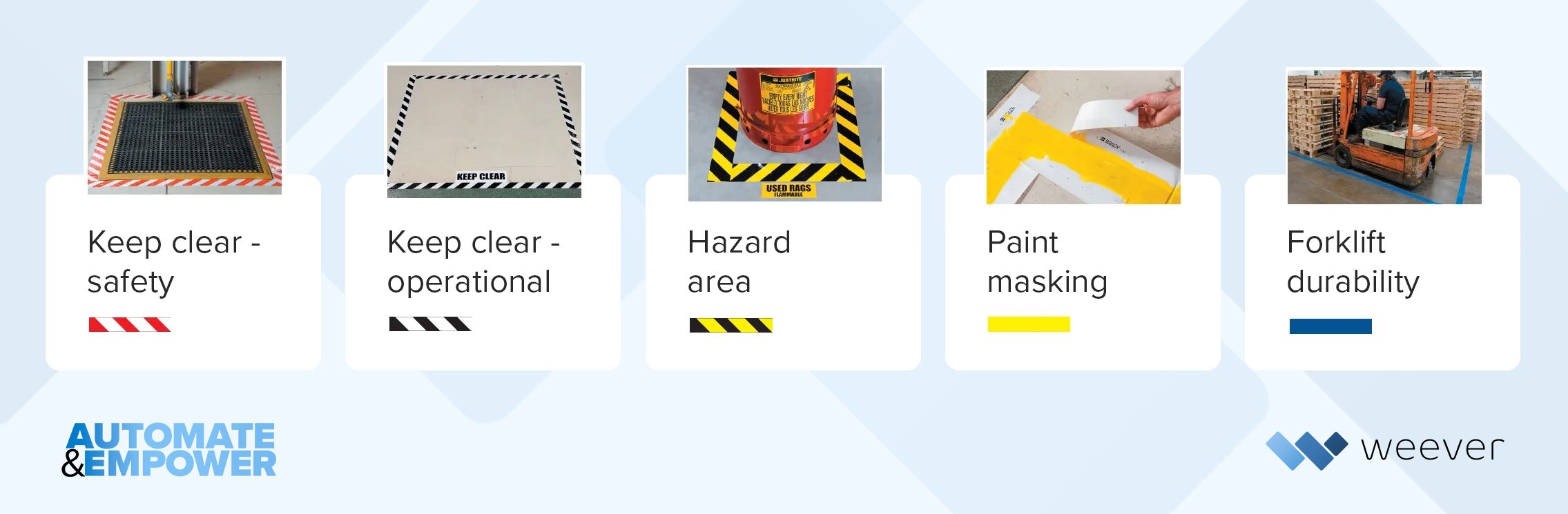
Best Practices for Setting in Order
For best results during the Set in Order process encourage team collaboration, use clear labelling and set yourself up for continuous improvement. Here are some best practices for the Set in Order stage:
Team Collaboration
Engage frontline staff in decision-making for layout redesign, considering their insights and preferences.
Labeling and Signage
Use clear and standardized labeling and signage for item placement to facilitate easy identification.
Periodic Reviews
Conduct regular reviews of the workspace layout to ensure it aligns with operational needs and make adjustments as required.
Continuous Improvement
Foster a culture of continuous improvement, encouraging feedback and suggestions for further workspace optimization.
Documentation
Keep records of the decisions you made during the Set in Order step. It is helpful to include before and after photos for each section in the workstation. These can be used to build Standardization SOPs and Audit checklists later in the 5S process.
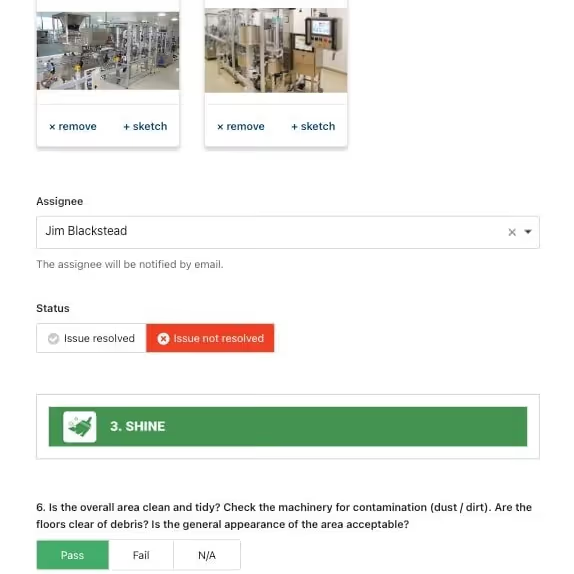
How to create a 5S Audit Checklist
If you are reading this guide, you have probably completed the workstation “Optimization” phase of 5S and you are looking for a way to “Normalize” your efficiency gains through 5S audits.
Creating efficient and rich checklists is crucial to the success of your program.
It is important to balance your need for comprehensive information to drive better strategic decisions with the need to make the audit as productive as possible.
What is a 5S Audit Checklist?
A 5S audit checklist is a structured tool used to evaluate and assess a workspace's adherence to the principles of 5S: Sort, Set in Order, Shine, Standardize, and Sustain. It serves as a comprehensive guide for auditors to systematically inspect various areas, processes, or departments within an organization to ensure they align with 5S standards and practices.
The checklist is typically organized into sections corresponding to each of the 5S principles, with specific items or criteria listed under each section. These items detail observable standards or behaviors that demonstrate compliance or non-compliance with the respective 5S principle.
- Sort - Assess the presence of unnecessary items or clear identification of essential tools
- Set in Order - Evaluate the logical arrangement of items and whether there are designated places for everything
- Shine - Criteria for workspace cleanliness and adherence to regular cleaning schedules
- Standardize - Assess whether standardized procedures are in place for maintaining organization and cleanliness.
- Sustain - Indicators of a culture that promotes continuous improvement and adherence to established 5S practices over time.
The checklist acts as a roadmap for auditors during assessments, guiding them through specific criteria to evaluate, document findings, and identify areas for improvement or commendation. It aids in ensuring consistency, objectivity, and thoroughness in evaluating the workspace against 5S principles.
How to Establish Audit Criteria
For checklists to be effective, it is important to understand your audit criteria, which serves as the guidelines or standards against which the workspace will be evaluated during the audit process.
During the Optimization phase of your 5S journey, you should have taken comprehensive notes, and photos, that illustrate how each workstation needs to be organized to optimize productivity. This information will inform the audit criteria on which your checklists will be based.
The audit criteria defines standards for each 5S principle. For instance, under "Sort," define what constitutes necessary versus unnecessary items.
The criteria should be tailored to fit the unique needs and functions of different work areas or departments. What may be essential in one area might differ in another based on the nature of the work conducted.
Ensure that the criteria are clear, objective, and easily understood by auditors. Avoid ambiguity to prevent differing interpretations during audits.
Incorporate both quantitative and qualitative measures into the criteria. Quantitative measures might include specific counts (e.g., number of items in a workspace), while qualitative measures could involve visual inspections for cleanliness or organization.
Learn more about how to create audit criteria for each workstation ⇒
How to create your 5S audit checklists
Once your 5S audit criteria for each workstation, you can move forward and build your checklists. Audit checklist forms can be constructed in many different ways. Some find value in a grading system, whereas others want to assess more “binary” information, i.e. pass/fail. The grading system provides more context and the binary “pass/fail” system is easier to understand and more efficient to review.
In our experience, the best practice is to ask simple “pass/fail” questions, where only “failures” request additional information. The result of this is a highly efficient experience where rich data is captured when required.
Checklists should provide clear instructions to the auditor, especially when asking qualitative questions. What does “pass” mean in this case? What does “fail” mean?
Here is a comprehensive list of best practices you can use to create your 5S Audit Checklists:
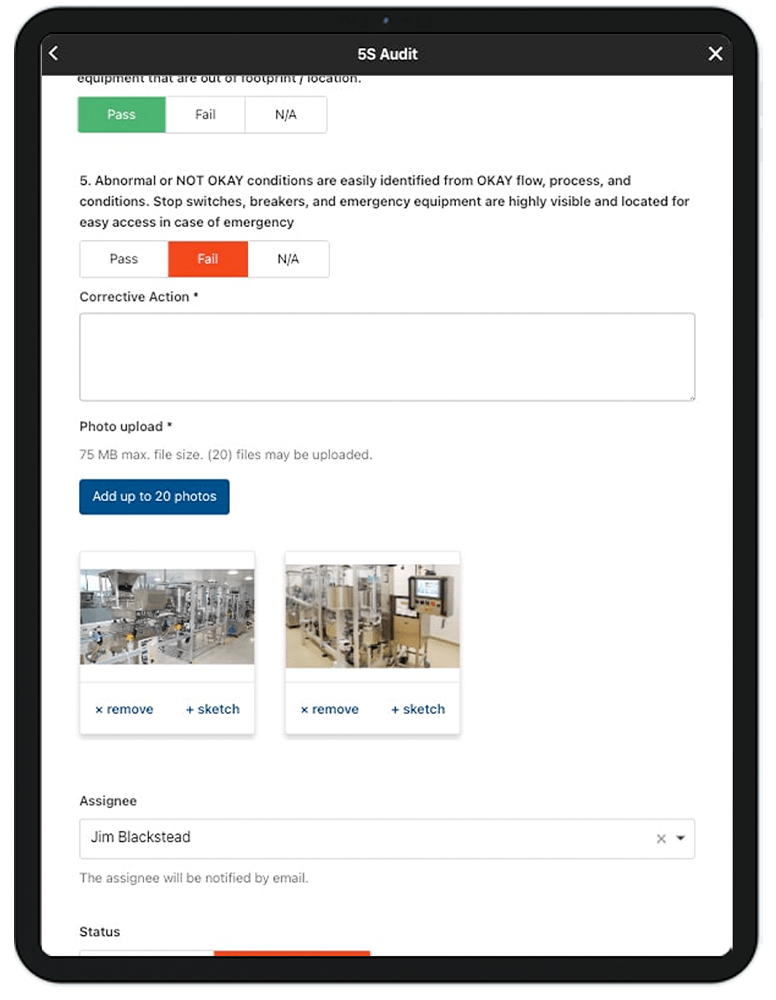
Be Specific and Objective
Ensure that the checklist items are specific, measurable, and objective. Avoid vague or ambiguous criteria that may lead to differing interpretations during audits.
Tailor to Each Unique Workspace
Customize the checklist to suit the unique needs and functions of different work areas or departments. What may be essential in one area might differ in another based on the nature of the work conducted.
Include Visual Aids or References
Incorporate visual aids, photographs, or reference materials where applicable to illustrate the expected standards. Visual references help auditors better understand and assess criteria.
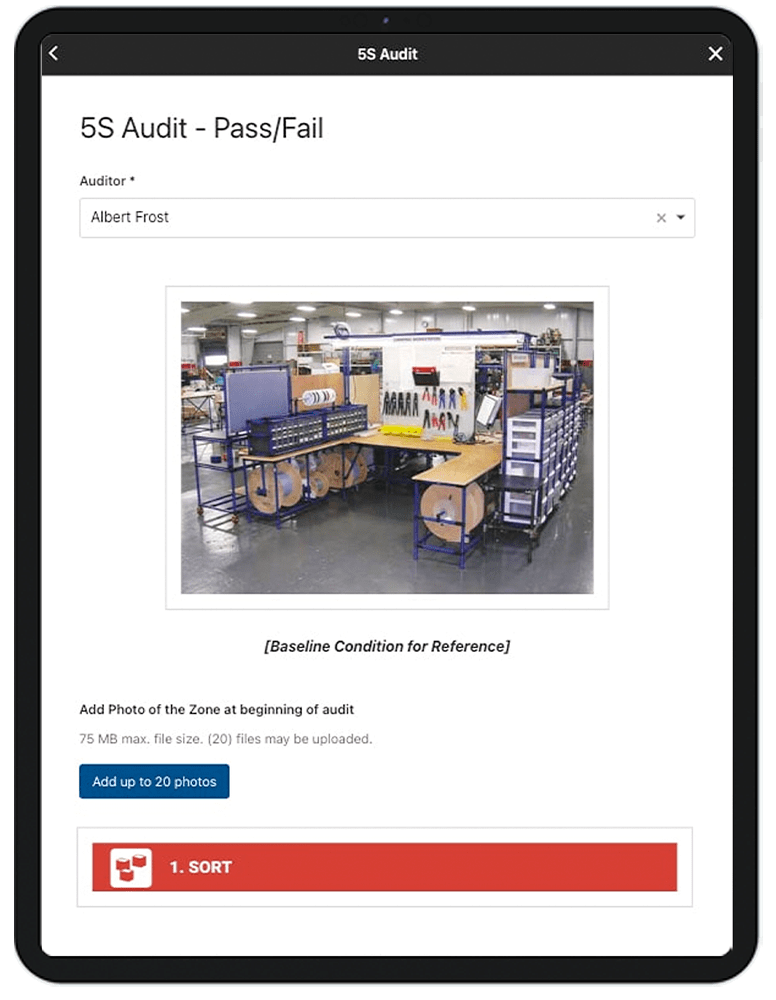
Provide Clear Instructions
Include clear instructions or guidelines for auditors on how to conduct assessments, what to look for, and how to document findings. This ensures consistency in audit execution.
Consider Compliance Requirements
If there are specific compliance standards or regulations relevant to the workspace, ensure that the checklist incorporates these requirements for comprehensive assessments.
Quantitative and Qualitative Measures
Incorporate both quantitative and qualitative measures into the criteria. Quantitative measures might include specific counts (e.g., number of items in a workspace), while qualitative measures could involve visual inspections for cleanliness or organization.
Review and Validation
Review the checklist for completeness and accuracy. Validate the checklist by testing it in a real workspace environment to ensure its effectiveness before formal implementation.
Update and Refine as you go
Regularly update and refine the checklist based on feedback, changing organizational needs, or improvements identified during audits. The checklist should evolve to remain relevant and effective.
Creating a well-structured and detailed audit checklist ensures that audits are conducted consistently, thoroughly, and effectively, enabling comprehensive evaluations of workspace adherence to 5S principles.
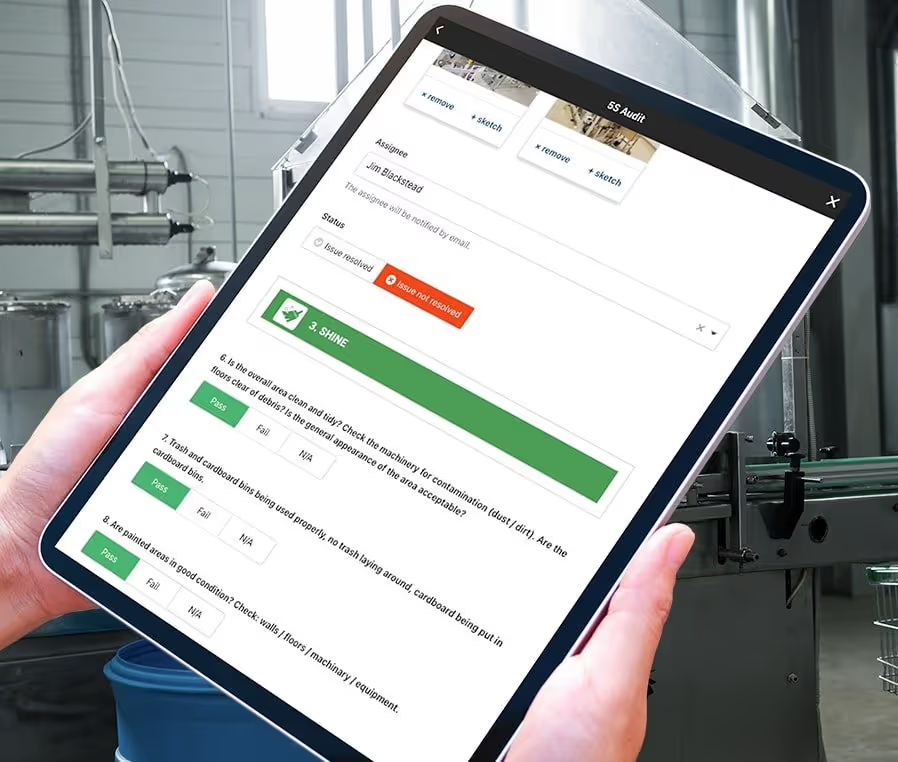
5S Auditors: How to Train Them Efficiently
As with most things in life, you get what you put in. As a result, if your 5S auditors aren’t proficient, the audits won’t be conducted properly and your program may be at risk of failure.
Training 5S auditors is pivotal to ensure consistent, effective, and unbiased assessments aligned with the principles of Sort, Set in Order, Shine, Standardize, and Sustain.
Involve relevant stakeholders, experienced auditors, or 5S experts in training sessions to share insights, experiences, and best practices.
By following these best practices and ensuring comprehensive training, organizations can equip their 5S auditors with the necessary skills, knowledge, and tools to conduct effective audits, drive continuous improvement, and maintain high standards of workplace organization and efficiency.
Before we get into how to train a 5S auditor, let’s quickly review what 5S audits are and why they are important.
What are 5S Audits?
5S audits are systematic evaluations conducted to assess how well workstations adhere to the principles of the 5S methodology, which is used to maximize productivity and efficiency.
5S audits involve structured assessments of workstations, processes, or departments to gauge their alignment with 5S standards, aiming to identify areas for improvement, maintain high organizational standards, and drive continuous improvement.
How to Train a 5S Auditor Efficiently
5S auditors need to be trained first and foremost on the principles of 5S. They should also receive some training on how to conduct effective audits as well as how to use the 5s auditing software. Here is an overview of how you might consider structuring your 5S Auditor training.
A functional understanding of 5S Principles
Training auditors on the 5S principles ensures they have the knowledge and skills required to effectively evaluate and promote adherence to the 5S methodology during audits, driving continuous improvement and maintaining high standards within the workspace.
Auditors should be trained on the following:
Sort (Seiri)
- Identify unnecessary items in the workspace, distinguishing between essential and non-essential items.
- Methods for categorizing, organizing, and disposing of unnecessary items effectively.
- Emphasize the importance of maintaining an organized and clutter-free workspace to enhance efficiency and productivity.
Set in Order (Seiton)
- Principles of efficient workplace organization and layout design.
- Techniques for logically arranging tools, equipment, and materials for easy access and retrieval.
- Clearly designated storage locations and labeling systems to minimize waste and streamline workflows.
Shine (Seiso)
- Cleanliness standards and practices within the workspace.
- Importance of regular cleaning schedules, procedures, and maintaining a hygienic and safe work environment.
- Roles and responsibilities of employees in maintaining cleanliness and orderliness.
Standardize (Seiketsu)
- Establishing and maintaining standardized work practices and procedures.
- Creating and adhering to uniform processes for sustainability and consistency.
- Clear guidelines, protocols, and visual controls to sustain standardized practices.
Sustain (Shitsuke)
- Fostering a culture of continuous improvement and sustainability within the organization.
- Emphasize the significance of employee engagement, ownership, and accountability in sustaining 5S practices.
- Focus on methods to encourage ongoing adherence to 5S principles through regular training, reinforcement, and recognition of achievements.
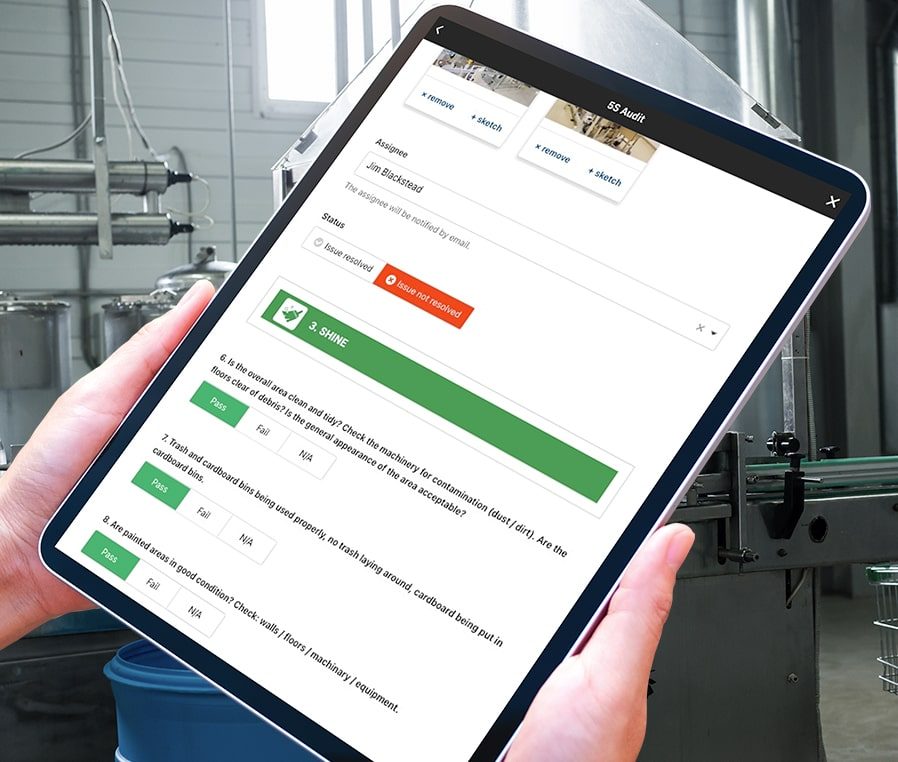
How to Conduct an Audit
To ensure the best results, 5S auditors should receive some training on how to properly conduct an audit. You can take auditors through audit procedures and techniques, communication skills, and how to handle non-compliance events. Some of the training can be knowledge transfer using a presentation, but you may want to consider role playing to round out the experience.
Here are some best practices to consider when training 5S auditors on how to conduct audits:
- Audit Procedures and Techniques: Provide guidance on the systematic approach to conducting audits, emphasizing the use of standardized checklists or criteria, proper documentation methods, and strategies for engaging with employees during assessments.
- Workspace Familiarization: Ensuring auditors have a comprehensive understanding of the workspace being audited. This involves learning about specific processes, workflows, and the layout of different areas to effectively evaluate compliance with 5S principles.
- Communication and Interview Skills: Training auditors in effective communication techniques to engage with employees and gather information during audits. This includes active listening, asking relevant questions, and providing clear explanations about the audit process.
- Objectivity and Consistency: Emphasizing the importance of maintaining objectivity and consistency throughout the auditing process. Auditors should evaluate workspaces uniformly based on established criteria without biases or personal interpretations.
- Handling Non-compliance: Providing guidance on handling instances of non-compliance diplomatically. Auditors should offer constructive feedback and suggestions for improvement, fostering a positive approach to change.
- Continual Improvement Mindset: Encouraging a mindset of continual improvement among auditors, emphasizing the significance of their role in driving positive changes within the workspace.
- Practical Exercises and Simulations: Conducting practical exercises or simulations where auditors can apply their knowledge and skills in simulated audit scenarios to enhance their proficiency.

How to Use the Auditing Software
To ensure an efficient audit experience, your auditors will benefit from software training. Provide a general orientation and show them how to conduct an audit. By employing these best practices in training, organizations can effectively equip their 5S auditors with the skills and knowledge necessary to leverage auditing software efficiently, enhancing the effectiveness of 5S audits and contributing to workspace improvements.
- Comprehensive Orientation: Initiate training with an overview of the auditing software, its functionalities, and the benefits it offers in conducting 5S audits. Provide a detailed walkthrough of the software interface, explaining key features, navigation, and data entry methods.
- Hands-On Practice Sessions: Offer practical training sessions where auditors can interact with the software in a simulated environment. Provide guided exercises that allow them to practice using the software to conduct mock audits, enter data, generate reports, and interpret results.
- Integration with 5S Principles: Highlight how the auditing software aligns with 5S principles and aids in conducting thorough assessments. Emphasize the software's role in maintaining records, identifying improvement areas, and fostering a culture of continuous improvement.

How to Train Frontline Staff on the Essentials of 5S Principles
In any manufacturing facility, the frontline staff plays a crucial role in upholding efficiency, safety, and productivity. One effective way to empower these teams and enhance workplace standards is through comprehensive training on the foundational 5S principles: Sort, Set in Order, Shine, Standardize, and Sustain. Here's a guide on how to conduct impactful training sessions that equip frontline staff with the knowledge and tools to implement and sustain 5S practices effectively.
What is 5S?
The 5S methodology is a systematic approach aimed at organizing a workspace for efficiency and effectiveness. It consists of five steps, each starting with the letter "S":
- Sort: Eliminate unnecessary items from the workspace, keeping only the essentials.
- Set in Order: Organize and arrange necessary items in a logical and accessible manner for easy retrieval and use.
- Shine: Clean the workspace regularly to maintain cleanliness and identify any issues or abnormalities.
- Standardize: Establish and maintain standardized work procedures to sustain the improvements made in the first three steps.
- Sustain: Develop a habit of maintaining the established standards and continuously improving the workspace.
This methodology is often applied in manufacturing, service industries, and various workplaces to streamline processes, reduce waste, and enhance productivity. The 5S methodology can have a significant positive impact on many success factors for your business, including:
- Efficiency
- Safety
- Quality
- Employee Morale
- Cost Savings
- Continuous Improvement
Overall, 5S isn't just about tidying up; it's a systematic approach that contributes to operational excellence, safety, and a culture of continuous improvement within organizations.
How to Train Frontline Staff on 5S Principles
The below is a list of best practices for training frontline staff on general 5S principles. If you are looking for more details on training auditors, feel free to review this link: How to train 5S Auditors ⇒
Focused Training Objectives
Begin by establishing clear training objectives focused on each 5S principle.Break down the training into concise modules, highlighting the significance of:
- Decluttering workspaces (Sort)
- Optimizing organization (Set in Order)
- Maintaining cleanliness (Shine)
- Standardizing procedures (Standardize)
- Fostering a culture of continuous improvement (Sustain).
Tailor the content to resonate with the manufacturing environment, showcasing how these principles directly impact operational efficiency and safety.
Length of Engagement
While the length of training may vary, consider a structured approach with multiple sessions spanning several days or weeks.
- Engage staff in interactive workshops, combining theory sessions with practical exercises.
- Short, focused sessions of 30 to 60 minutes might work well to maintain attention and retention of key concepts.
- Follow up with regular refresher sessions or workshops to reinforce learning and track progress in implementing 5S principles.
Hands-On Application
Encourage hands-on learning by integrating real-life examples from the manufacturing floor. This practical application not only reinforces learning but also instills a sense of ownership and empowerment among the frontline teams.
- Engage participants in activities where they apply 5S principles directly to their workstations or areas of operation.
Continuous Support and Feedback
Empowering frontline staff with a robust understanding of 5S principles cultivates a culture of efficiency, safety, and continuous improvement within the manufacturing facility. By focusing on engaging, practical, and ongoing training, organizations can elevate their frontline teams to champion 5S practices, driving positive changes in the workplace.
- Offer continuous support post-training.
- Establish a feedback loop where staff can share challenges or successes encountered while implementing 5S principles.
- Provide avenues for ongoing learning, such as mentorship programs or access to additional resources, fostering a culture of continual improvement.
Training frontline staff on 5S principles is an investment that yields long-term benefits, enhancing productivity, workplace safety, and overall operational excellence.
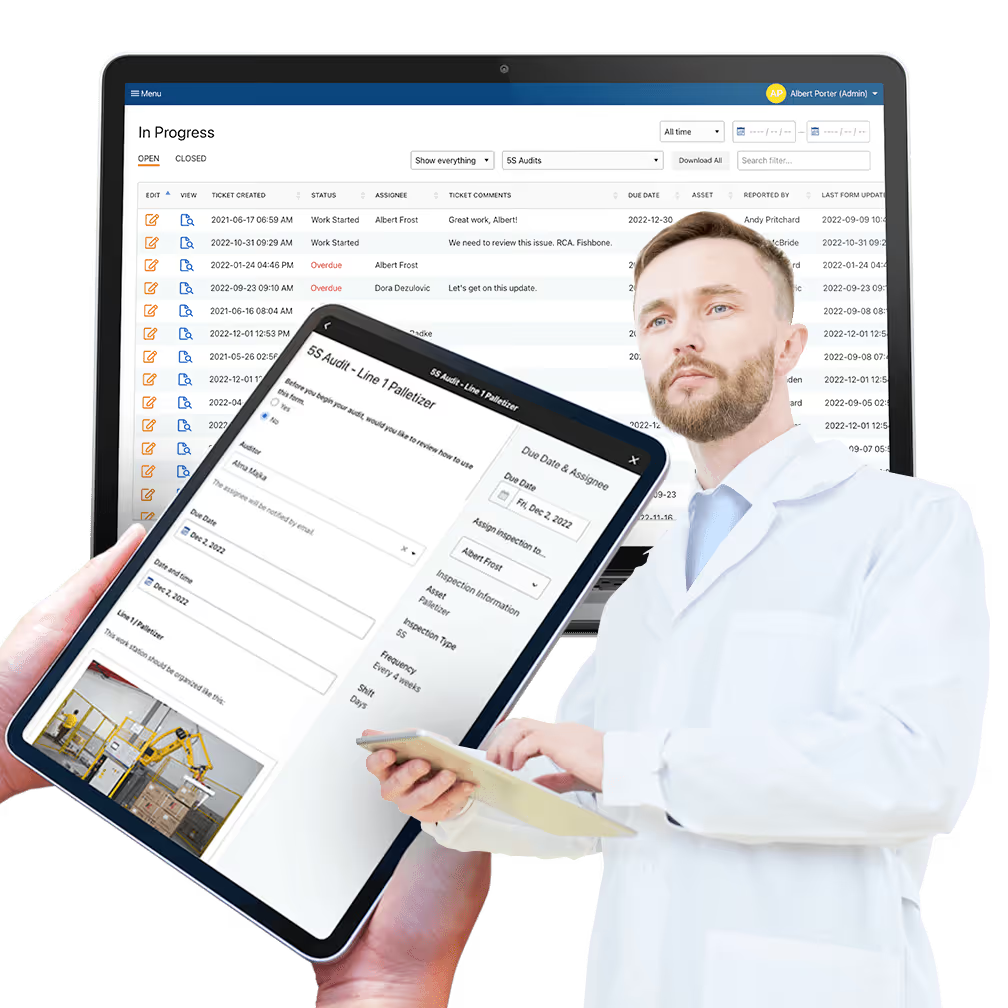
5S Sustain Implementation
Although Sustain is only one of the 5 principles of the 5S methodology, it encompasses 90% of the work. Sustain is the long-tail of 5S. And it is where the real results lie. It is also, conversely, the stage in which most 5S programs fail.
In order to realize the benefits of 5S, you must ensure principles are sustained using an efficient and effective 5S auditing program. This article outlines what sustain means, the benefits of an efficient auditing program and a simple and practical way to ensure success.
What does "5S" & "Sustain" mean?
The 5S methodology is a system for organizing a workspace to improve efficiency, safety, and productivity. It consists of five principles, each starting with the letter "S": Sort, Set in Order, Shine, Standardize, and Sustain.
"Sustain" in the context of the 5S methodology refers to the fifth principle, emphasizing the need to maintain and continuously reinforce the standards established through the first four principles (Sort, Set in Order, Shine, Standardize). It involves developing a culture of discipline, adherence, and ongoing commitment to the 5S principles to ensure that improvements made in organizing the workspace are sustained over the long term.
"Normalizing" 5S with Audits
In another post, we overview the 3 phases of 5S implementation, including Planning, Optimizing and Normalizing.
The Normalizing phase is comprised of the "Sustain" and "Standardize" steps because they are interconnected steps ensuring standards are met and improvement opportunities are captured and implemented.
Once you have planned your 5S program and optimized the workstations, you will build materials that help you standardize the process.
- Standardization creates uniformity and consistency in work practices, processes, and visual controls across the organization, leading to increased efficiency, safety, and sustained improvements.
- Sustain is how you put your standardization work into action.
Sustain entails creating habits, routines, and practices that uphold the established standards of cleanliness, organization, and efficiency. It involves fostering a mindset among employees to consistently follow the 5S principles, making it a part of the organizational culture. Sustaining the 5S principles requires regular reinforcement, training, monitoring, and continuous improvement efforts to prevent regression and ensure lasting positive changes within the workspace.
By far, the most crucial factor in sustaining 5S is scheduled audits.
5S Auditing
5S audits are critical because they are the vehicle through which standards are maintained. 5S audits also provide a means for frontline staff to provide feedback that drive continuous improvement and productivity gains. The benefits of 5S audits are vast, including:
Maintenance of Standards
Ensure established 5S standards are maintained. Prevent regression into disorganization. Provide a structured way to measure how effectively the 5S principles are being applied.
Identify Improvements
Capture issues in the 5S implementation as well as other challenges affecting productivity in general and create an action plan to overcome them.
Employee Engagement
Foster a sense of ownership and responsibility and encourage team members to take an active role in maintaining the workspace's cleanliness and organization.
Data-Driven Decision Making
Audit results provide rich data and insights to drive strategic decisions around resource allocation, OEE, employee engagement and so forth.
5S auditing is valuable because it serves as a tool for ongoing assessment, improvement, and maintenance of an organized and efficient workspace, contributing to enhanced productivity, safety, and employee satisfaction.
5S Auditing: A step-by-step guide
If you have completed the first 4 steps in 5S, the auditing program is essentially about normalizing that work on an ongoing basis. Implementing a 5S auditing program involves several practical steps to ensure a comprehensive assessment of the workspace.
1. Establish Audit Criteria and Checklists
Establishing audit criteria is a crucial step in conducting effective 5S audits. These criteria serve as the guidelines or standards against which the workspace will be evaluated during the audit process. Use the criteria to develop a checklist outlining specific items or areas to be evaluated under each of the 5S categories. This checklist helps auditors systematically assess the workspace.Learn more about creating audit checklists ⇒
2. Train Auditors
Ensure that the individuals conducting the audit are trained in the 5S principles, the audit process, and using the audit checklist effectively. Communicate the established audit criteria clearly and ensure they understand how to apply the criteria consistently during audits. They should understand what to look for and how to assess compliance.Also, train auditors on how to use the checklists effectively and communicate its purpose and importance to all involved stakeholders. If you have digitized your 5S audit process using digital forms, you will need to train your auditors on how to access and use the system.Learn more about best practice for training auditors ⇒
3. Schedule Audits
Establish a regular schedule for conducting audits. Scheduling audits in a systematic and consistent manner ensures that the workspace's adherence to 5S principles is regularly assessed, providing opportunities for improvement and sustaining the desired standards over time.Decide on the frequency of audits based on the nature of the workspace, its size, complexity, and the organization's needs. Audits can occur daily, weekly, monthly, quarterly, or even semi-annually.Learn how to set up 5S Audit Schedules ⇒
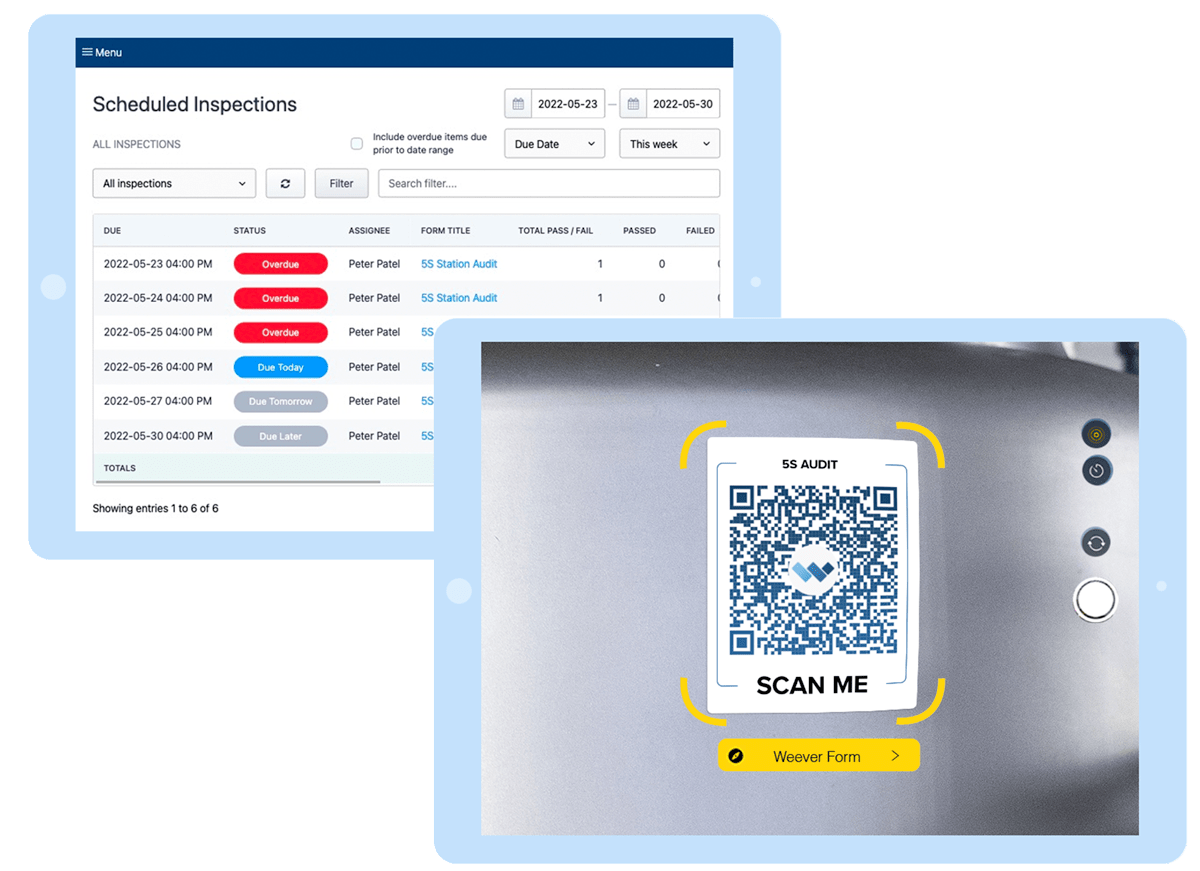
4. Conduct Audits
Perform the audits using the established checklist. Evaluate each area against the defined criteria for Sort, Set in Order, Shine, Standardize, and Sustain. Document findings, noting areas of compliance and areas needing improvement.
5. Generate & Review Reports
Compile audit findings into comprehensive reports. These reports should include observations, areas of non-compliance, improvement recommendations, and any notable successes.Review the audit reports with relevant stakeholders, including employees working in the audited areas. Discuss findings, celebrate successes, and identify action items for improvement.
6. Implement Corrective Actions & Follow up Audits
Develop action plans to address areas identified for improvement. Assign responsibilities, set deadlines, and track progress on implementing necessary changes.Conduct follow-up audits to assess the effectiveness of implemented changes and to track progress. Continuous monitoring ensures sustained adherence to 5S principles.
7. Celebrate Success and Recognition
Recognize and celebrate achievements and improvements resulting from the auditing process. Acknowledge the efforts of individuals and teams in maintaining an organized and efficient workspace.

How to implement a proactive safety program into your facility
Reacting to safety incidents when they occur is a great way to ensure they don't happen again. But how can we prevent incidents before they happen? Incident prevention can save your organization hundreds of thousands in direct and indirect costs, not to mention the time and energy required to investigate and deal with regulatory concerns.
Modern technology has enabled proactive safety methods, providing managers with the ability to recognize unsafe patterns, provide frontline staff with real-time risk assessment feedback, and react to issues more quickly to prevent disaster. So, what is involved in implementing a proactive (aka preventive safety) program at your facility? Let's dig in …
A bit about Weever.
Weever is cloud-based operations and productivity software that makes it easy to involve frontline staff in on-going improvement initiatives. With one site license and a highly intuitive interface everyone can participate. Use Weever to capture meaningful and rich data effortlessly from frontline staff, create schedules and provide real-time access to information so they can be more effective at their job. Create action plans from inspection failures and track improvements to completion and automate reporting so you can spend your time doing the "real work" instead of battling with spreadsheets.
Create a Business Case
Proactive Safety is a methodology that uses data captured from employees to recognize unsafe policies, behaviors and conditions, even if the event resulted in safe outcomes, and to create action plans, including training, signage, mitigation strategies, to prevent these issues from becoming incidents.
The Proactive Safety methodology can be a big undertaking requiring a budget and buy-in from senior management.
The best way to get anything to happen at a manufacturing facility is to get the buy-in from senior leadership. In order to do this, you need to create a business case that outlines some key details they need to understand before "green lighting" a project.
- Project Goals
- Scope of the project
- Expected costs to implement and manage
- Expected benefits and ROI
You will be more likely to succeed with your pitch if you get alignment and support from other department managers and frontline staff. You can talk to them about how you want to prevent incidents and the benefit you see, invite them to a meeting to discuss the plan and get them to endorse the project.

Make your safety program more proactive today
A great way to get buy-in is to show senior leadership the ROI of a proactive safety approach without shelling out a big investment of time and money. To do this, consider trialing some simple projects.
There are some "quick wins" that you can do today to get the ball rolling on making your safety program more proactive. Behaviour-based safety observations, risk assessments and monthly safety quizzes are examples of easy ways to elevate safety awareness and capture data from frontline employees. Learn more about these "quick wins" here: https://weeversoftware.com/blog/be-more-proactive-with-safety
Make sure you take account of some key performance indicators before you start your trial so you can compare with your results after 3 months or so. Number of incidents and near misses are a good thing to track. You can also track number of proactive safety data points before and after and number of preventive measures created during the trial.
If you are interested in creating a project plan, you can download this guide that takes you through each step, including goals, implementation plans, costs and ROI.
If you are interested in creating a project plan, you can download this guide that takes you through each step, including goals, implementation plans, costs and ROI.
Feel free to learn more about our software and get in touch with us if you have any questions.
Spend Less Time on Admin. Get More Insights by Email.
Subscribe to receive practical tips, updates, and ideas to improve operations without the extra admin work.