
-%20smaller.webp)
.webp)
Explore More Blogs

Your Autonomous Maintenance Checklist: Empower Operators, Cut Downtime,Drive Reliability
Your Autonomous Maintenance Checklist: Empower Operators, Cut Downtime,
Drive Reliability
In most manufacturing environments, the condition of equipment has a direct impact on
reliability, output and cost.
Your Autonomous Maintenance Checklist: Empower Operators, Cut Downtime, Drive Reliability
In most manufacturing environments, the condition of equipment has a direct impact on reliability, output and cost. That's why the concept of autonomous maintenance, a core pillar of Total Productive Maintenance (TPM), is so valuable. With autonomous maintenance, machine operators assume responsibility for the routine upkeep of their equipment: cleaning, inspecting, lubricating, and spotting early signs of trouble. By giving operators this role, you allow specialist maintenance technicians to focus on more complex, value-added tasks, while improving overall equipment effectiveness (OEE), reducing unplanned downtime, and fostering a stronger culture of ownership among operators.
Autonomous maintenance only succeeds when it's structured, repeatable, and measurable, and that's exactly what this checklist provides. For you and your teams, this isn't just a task list; it's a roadmap for building a culture of reliability from the ground up.
Each checkpoint defines who does what, when, and how, making it easier to train operators, audit progress, and ensure consistency across shifts and lines. It also turns what can feel like a broad and nearly overwhelming improvement initiative into a series of manageable, trackable actions. By following the checklist:
· Operators learn to recognize and prevent early signs of equipment failure, taking ownership of their assets.
· Supervisors and maintenance managers gain visibility into daily maintenance activities, helping them allocate resources more strategically.
· Plant and operations managers can use checklist completion data to measure engagement, identify bottlenecks, and drive continuous improvement initiatives.
In short, this checklist helps translate the principles of autonomous maintenance into everyday practice, so your facility can build reliability and not just react to failures.
Step 1: Initial Cleaning
- Confirm that the equipment has been thoroughly cleaned: Remove built-up dust, oil, grime, debris, and contaminants to restore it to as close to "new" condition as possible.
- Ensure that operators become familiar with their machines via the cleaning process, so they recognize normal vs abnormal conditions.
- Identify any hidden issues exposed during cleaning, such as loose components, leaks, wear marks, etc.
- As a leader, schedule this activity, ensure operator involvement, and track completion.
Step 2: Eliminate Sources of Contamination or Abnormalities
- After cleaning, walk through the equipment and work area with operators and maintenance to identify ongoing contamination sources: open seals, leaks, ingress of dust/oil, faulty guarding, vibration-related loosening, etc.
- Take corrective actions to fix leaks, replace worn seals, improve housekeeping, and ensure access for cleaning/inspection.
- Confirm that the aim is to reduce the re-introduction of contaminants and slow equipment deterioration
- As a leader, ensure this is documented, assign ownership, and set a review date for effectiveness.
Step 3: Establish CIL Standards (Cleaning, Inspecting, Lubrication)
- Define standards for how often cleaning, inspecting, and lubrication should occur, what tasks are included, and what tools or materials are needed.
- Develop checklists or standard work instructions for CIL tasks. Operators should be trained on these standards.
- Ensure that the tools and materials required are readily available and standardized across teams/shifts.
- As a leader, review and approve the standards, ensure clarity, and encourage buy-in from operators and maintenance.
Step 4: General Inspections
- Operators should perform regular, simple inspections of their equipment, such as visual checks, listening for abnormal sounds, monitoring temperature, checking key fasteners, checking lubrication points, and removing contamination.
- Confirm that inspection activities are scheduled (daily, per shift, or per operator) and documented.
- Establish escalation criteria when inspections reveal anomalies (e.g., maintenance involvement, engineering review).
- As a leader, verify through audits that inspections are being done, logged, and acted on.
Step 5: Autonomous Inspection (Operator-Led, More Detailed)
- Train operators to advance from simple checks to more detailed inspections. They should be able to recognize wear patterns, alignment issues, vibration, and bearing play, as well as make minor adjustments and identify potential failures before they occur.
- Ensure proper tools or sensors are made available and operators know how to use them.
- Confirm operators have ownership of the inspection process and feel accountable for their machine's condition.
- As a leader, measure uptake, review findings, and ensure they trigger corrective or improvement tasks.
Step 6: Standardization
- Document all successful practices. These include cleaning procedures, inspection checklists, lubrication schedules, training modules, and escalation paths.
- Make standard work available to all shifts and teams so practices are consistent across the plant.
- Ensure that the tools, visual management aids (labels, tags, signage) and digital work instructions (if used) are applied uniformly.
- As a leader, monitor compliance, conduct regular audits, and intervene when variance appears.
Step 7: Continuous Improvement
- Review performance data such as equipment uptime, inspection/maintenance completion rates, number of anomalies found by operators, changes in OEE, cost ,and safety metrics.
- Hold feedback sessions with operators, maintenance technicians, and supervisors. You need to know what's working, what's not, and where is friction. Use this information to capture improvement ideas.
- Update standards, checklists, training, and tools accordingly. Reflect new learnings, and adopt new technologies or methods where beneficial.
- As a leader, you set a cadence for review (monthly/quarterly), drive the culture of ownership, and ask: "How can we get better next cycle?"
Tips for Implementation
- Assign a pilot area or line to apply the checklist and track results. Starting with a defined scope helps focus resources and demonstrate value early.
- Ensure operator training and involvement. Without operator buy-in and knowledge, autonomous maintenance will not take hold.
Clarify roles between operations and maintenance. Operators own the routine tasks, while maintenance supports and focuses on complex or corrective tasks. - Leverage digital tools or software. Real-time task tracking, dashboards of inspections completed, and analytics on maintenance outcomes all help drive accountability.
- Measure the right metrics. Track reductions in unplanned downtime, follow improvement in OEE, acknowledge fewer minor failures, track operator observations, and note increased maintenance staff availability for high-value work.
By working through this checklist, you provide your operations and maintenance teams with a structured, practical roadmap to implementing autonomous maintenance. You help create a sustainable system where operators take ownership, maintenance becomes more strategic, and equipment reliability improves. Use this checklist as a living tool: review it, adapt it, iterate, and you'll see the benefits compound.
The Autonomous Maintenance Checklist
- Step 1: Initial Cleaning
- Step 2: Eliminate Sources of Contamination or Abnormalities
- Step 3: Establish CIL Standards (Cleaning, Inspecting, Lubrication)
- Step 4: General Inspections
- Step 5: Autonomous Inspection (Operator-Led, More Detailed)
- Step 6: Standardization
- Step 7: Continuous Improvement
Ready to Transform Your Operations?
Discover how the Smart Connected Worker Platform can revolutionize your manufacturing operations. Our team of experts is ready to help you implement intelligent solutions that drive safety, efficiency, and operational excellence. Demo Autonomous Maintenance Download the Autonomous Maintenance Guide

5S Audits That Work: Real-World Tips for Production Managers Who Want Results
5S Audits That Work: Real-World Tips for Production Managers Who Want Results
5S is the workplace organization method from Japan. Seiri (Sort), Seiton (Set in Order), Seiso (Shine), Seiketsu (Standardize), and Shitsuke (Sustain) describe steps to eliminate waste, improve efficiency, and maintain a clean and organized workspace to boost productivity.
If you've already invested time and energy into building a solid 5S program, you know the real challenge isn't just getting started, it's sustaining it. That's where regular 5S audits come in.
By establishing clear standards for organization and cleanliness, 5S audits reduce waste, minimize errors and hazards, streamline workflows, and lower operational costs. Ultimately they improve profitability and ensure accountability for maintaining a well-organized, efficient, and safe environment. A good audit doesn't just tick boxes. Think of it as a quick "health check" for your work areas: it's a way to make sure the gains you've made through Sort, Set in Order, and Shine don't slip away.
Structure Your S5 Audits for Consistency
Consistency is the key to making audits meaningful. When every auditor uses the same criteria, your teams know exactly what's expected, and results can be compared over time.
Start with a standardized audit form, ideally one that lays out clear scoring criteria for each of the 5S categories. This structure helps your auditors focus on what matters most and gives your staff a clear picture of what "good" looks like.
Get a jump start, on the process with Weever's free spreadsheet and Word templates that can be customized to your plant's specific needs.
And remember, consistency isn't just about forms; it's about timing. Audits should be scheduled at regular intervals and each one should build on the last. Make sure you include detailed notes and photos where possible so that if your 5S auditors change, you don't lose continuity in your continuous improvement process.
Use Audits to Drive Collaboration, Not Compliance Anxiety
The most effective 5S audits aren't about "catching" problems. This isn't a gotcha moment. The goal of S5 audits is to create collaboration. Walk the floor Gemba-style with your 5S committee or management team, but make sure the tone stays positive and open.
Talk to line employees and invite them to share their insights. After all, no one knows a workstation better than the employees using it every day. Their perspective often leads to the practical, innovative, and lasting improvements.
Remember: we're not going for "gotcha." If unsafe or inefficient behavior is spotted, take notes and follow up privately rather than calling it out in the moment. When staff feel safe to contribute ideas without fear of blame or punishment, engagement and audit quality skyrockets.
Measure Progress and Celebrate Wins
Audits are only useful if you act on what you learn: Record findings, follow up on issues from previous rounds, and look for measurable trends. Keep track of your scores over time; it helps your employees see the impact of their efforts. If an issue keeps resurfacing, dig deeper with a root cause analysis to eliminate it for good.
It's just as important to recognize areas that have improved. When employees see their hard work reflected in better audit scores and in cleaner, more efficient workspaces, they feel ownership of the results. Remember, ownership and engagement drive momentum.
Make Feedback Constructive and Continuous
A successful 5S program is built on trust and two-way communication. The feedback you give should be constructive and conversational.
Instead of pointing out issues, ask for input:
- "What do you think would make this station more efficient?"
- "Is there a way to store this tool that saves motion or time?"
There might be underlying issues you know nothing about and by requesting input, you might discover other issues and even potential solutions. As part of your feedback, always acknowledge what's working well. Reinforcing progress helps your team see that 5S isn't just about neatness, it's about making everyone's day safer and more productive.
Over time, these discussions build a culture where employees make 5S part of how they do their jobs, not as another management initiative.
A backbone of the Sustain phase of 5S, regular audits, when done well, maintain standards, surface new ideas, and strengthen teamwork. That's what long-term success looks like: a plant floor that's orderly, productive, and ready for whatever challenges come next.
Don't forget: If you're looking for a practical way to start or improve your 5S audits, Weever's free 5S Audit Template can help you standardize, track, and sustain your results.
Ready to Transform Your Operations?
Discover how the Smart Connected Worker Platform can revolutionize your manufacturing operations. Our team of experts is ready to help you implement intelligent solutions that drive safety, efficiency, and operational excellence. Demo 5S Auditing with Weever Today Download the 5s Ultimate Guide
A Master Class in Clean: Why Every Facility Needs a Master Sanitation Schedule
A Master Class in Clean: Why Every Facility Needs a Master Sanitation Schedule
Imagine walking through a spotless food production plant at 5 a.m. before the day's shift begins. The floors are dry and clean, every metal surface gleams, the equipment is sanitized, and the air smells faintly of disinfectant. Now imagine the same plant on a day when a cleaning shift was missed: the floors are sticky, metal surfaces are smudged and dirty, residue has built up on machinery, and the air, frankly, stinks of missed opportunities. As a result, cross-contamination risks rise, visitors would be horrified, and any auditors walking in would spot inconsistencies in your cleaning logs.
The difference between these two realities often comes down to one thing: a master sanitation schedule (MSS ).
A master cleaning schedule isn't just a checklist, it's the backbone of consistent hygiene, safety, and compliance at your plant. Done well, it ensures that cleaning tasks aren't left to chance, accountability is crystal clear, and your operation stands up to both regulators and customers. If done poorly (or not at all), it leaves dangerous gaps that can be filled with bacteria, dirt, and regrets.
Let's dive into the essential elements every MSS must contain and why they matter. Along the way, we'll explore how digital tools like Weever software make creating and managing these schedules not only easier but smarter.
- Detailed Cleaning Tasks
At the heart of any MSS are the tasks themselves. Each one should be described with precision in your MSS :
- What needs to be cleaned (e.g., conveyor belts, mixing tanks, high-touch surfaces).
- How it should be cleaned (the methods and procedures).
- What tools or chemicals are required.
This level of detail removes ambiguity. Without it, you risk two people performing the "same" task in very different ways: one thorough while the other one is rushed. In industries like food manufacturing, where cleanliness is tied directly to safety and compliance, inconsistency is not an option.
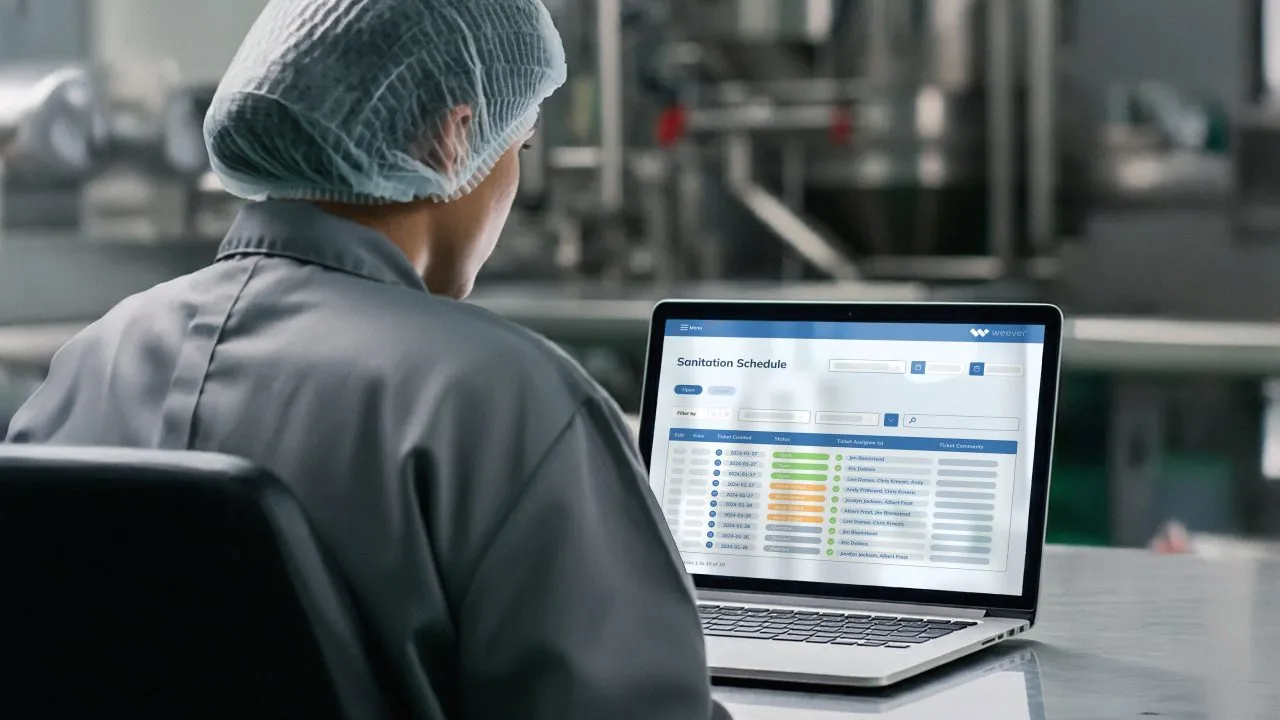
Weever helps standardize these tasks by allowing teams to build clear, step-by-step cleaning protocols directly into the platform. Instructions, images, and even short videos can be embedded so there's no confusion about management's expectations.
- Frequency of Cleaning
It's not enough to say what to clean, you must also specify when to clean it. Some tasks are daily (sanitize food contact surfaces), while others are weekly (deep clean of drains) and some are monthly or even quarterly (HVAC duct cleaning).
The frequency ensures two critical outcomes:
- Cleanliness is maintained consistently rather than sporadically.
- You have documented evidence of compliance. Auditors expect documented evidence that tasks are being performed at the correct intervals.
Traditional paper schedules and spreadsheets often fail here. A misplaced log sheet or a skipped update can leave glaring holes. Weever's automation eliminates this risk by generating recurring tasks, scheduling reminders, and sending real-time alerts to responsible team members. Nothing slips through the cracks.
- Assigned Responsibilities
Accountability is where many cleaning programs falter. When responsibility is vague ("someone from maintenance should do this"), tasks are more likely to be overlooked. A strong MSS removes that ambiguity by assigning each task to a specific individual or team.
Accountability is key when it comes to maintaining a clean environment. Clarity reduces overlap, avoids confusion, and creates ownership. It also makes it easier to follow up if something isn't done correctly.
Weever takes accountability to the next level with digital task assignment. Managers can see who is responsible, track progress in real time, and quickly reassign tasks if needed. This visibility keeps everyone aligned and prevents excuses.
- Verification and Documentation
Finally, even the most carefully designed cleaning program won't pass muster without proof. Verification and documentation are non-negotiable in regulated industries. Inspectors, auditors, and certification bodies all want to see evidence that tasks were performed as scheduled. This involves two layers:
Verification: Confirming that the cleaning was completed correctly, often through a supervisor's sign-off or digital check.
Documentation: Recording completion details, creating a permanent, time-stamped record.
With paper systems, these records are vulnerable to loss, damage, or errors. In contrast, Weever captures every task digitally, stores it securely, and makes it instantly retrievable during audits. Instead of scrambling to find paperwork, teams can present a clear, accurate digital trail that proves compliance.
How Weever Brings It All Together
Creating an MSS is only the first step in your journey to supreme clean. Managing it can be overwhelming, especially in complex facilities. Challenges can include tracking dozens (or hundreds) of tasks across departments, ensuring deadlines are met, maintaining spotless records for audits, and quickly spotting inefficiencies or missed tasks. Left unchecked, these challenges lead to inconsistent cleaning, wasted labor, and even compliance violations. That's why many organizations turn to digital platforms like Weever to remove the friction.
Weever can become the engine that powers your MSS . Instead of fighting with clipboards and spreadsheets, your teams benefit from:
- Pre-built templates and an intuitive interface that makes setup fast.
- Automated task generation that eliminates the need for manual updates.
- Real-time reporting so that managers see what's done, what's overdue, and where risks lie.
- Actionable data insights that uncover inefficiencies, helping optimize labor and resources.
- Guided onboarding and support that minimizes disruption and allows for smooth implementation.
The result is a program that's not only compliant, but efficient.
A Master Cleaning Schedule Matters More Than Ever
In today's manufacturing and food production environments, cleanliness isn't a "nice to have." It's a regulatory requirement, a brand safeguard, and a customer expectation.
A Boar's Head Provision Company's deli meat plant in Jarratt, Virginia was linked to a listeriosis outbreak that began in May 2024. Of the 61 reported cases, 60 people were hospitalized and 10 died. Over 7 million pounds of deli meat products were recalled that had been produced at that facility.
Inspectors had uncovered 69 incidents of "non-compliance" in the year leading up to the outbreak, and federal inspection reports told the tale of a massive breakdown in sanitation that included discolored meat buildup and meat overspray on walls and large pieces of meat on the floor, flies in pickle vats, black mold, puddles of blood on the floors, and rancid smells in the coolers.
While this is an extreme example of what can happen when sanitation and cleaning schedules break down, a master cleaning schedule ensures nothing is left to chance.
By combining clear task definitions, proper frequency, assigned accountability, and airtight documentation, you create a reliable framework that keeps your operations compliant and your customers safe. Tools like Weever help you streamline and automate thee tasks on your master cleaning schedule, providing you with the data and compliance information you need to satisfy auditors, inspectors, and your customers.
Spotless facilities don't happen by accident. It takes hard work, attention to detail, and a master cleaning schedule.
See Master Sanitation Scheduling in Action
Discover how the Smart Connected Worker Platform can revolutionize your manufacturing operations. Our team of experts is ready to help you implement intelligent solutions that drive safety, efficiency, and operational excellence. Schedule a Master Sanitation Scheduling Demo Read the Food Manufacturing Sanitation Industry Report

Proactive Safety: Saving Lives and Saving Money
Proactive Safety: Saving Lives and Saving Money
On January 13, 2022, employees reported for work at Eastway Tank, Pump and Meter Ltd., a tank truck manufacturing facility in Ottawa, Ontario, like any other day, not knowing their lives would change forever.
An explosion, described as one of the deadliest workplace incidents in Ottawa’s history, killed six employees and seriously injured a seventh worker that day. More than three and a half years later, on September 11, 2025, Ottawa police charged the company’s owner, Neil Greene, with six counts of criminal negligence causing death and one count of criminal negligence causing bodily harm. He and the company had already pled guilty in April 2024 to regulatory provincial offenses brought by the Ministry of Labour.
Investigations, accusations, and court cases have perhaps outweighed the real story here: safety failures cause employee injuries and deaths, impact production, cause reputational damage, and cost companies billions of dollars every year.
The Human and Financial Cost of Safety Failures
An additional 987 workers died of workplace injuries in 2022 in Canada. In 2023, 1,057 workers died from workplace injuries and illnesses in Canada, according to the Association of Workers' Compensation Boards of Canada (AWCBC). According to the U.S. Bureau of Labor Statistics (BLS), in private-industry manufacturing in the U.S. in 2023, there were approximately 355,800 injury and illness cases at a rate of 2.8 cases per 100 full-time equivalent (FTE) workers. In 2023, the BLS reported 391 fatal work injuries in manufacturing, a rate of 2.5 per 100,000 FTE workers in that sector. Overall in the U.S., there were 5,486 fatal work injuries in 2022 (the last fully published year) and 5,283 in 2023.
In the manufacturing sector, workplace fatalities, injuries, and illnesses continue to pose significant risks. Every one of those numbers represents a person whose life has ended or been permanently changed by a workplace incident, it represents a family that has suffered because of the loss or injury to a loved one.
With such significant incidents taking place, relying solely on reactive responses such as investigating after an injury or doing audits only when required leaves your facility exposed in both human and financial terms.
For these and many other reasons, this is why proactive safety matters in manufacturing. A proactive stance that includes regular risk assessments, robust training, encouraging hazard-reporting, and consistently monitoring behavior and systems sets you up to prevent workplace injuries and fatalities rather than respond to their consequences after the fact.
The Hidden Costs of Waiting to be Proactive
It’s easy to quantify medical bills, workers’ compensation and lost productivity when an injury occurs, but the hidden costs often dwarf them. The prevention of even one major incident could save your organization between $100K - $250K or more in direct and indirect costs. In a recent study on safety return on investment (ROI) in Ontario, Canada, The Institute for Work & Health determined workplace injury- and illness-causing incidents include an average direct cost of between $39k - $78k and indirect costs of $78k - $156k, easily double the direct costs.
According to the National Safety Council (NSC), in 2023 the cost of work-related injuries in the U.S. was about $176.5 billion, or roughly $1,080 per worker, with medically consulted injuries averaging $43,000 per claim. Indirect costs related to lost production, retraining replacement staff, downtime, and the administrative burden of managing workers’ compensation claims can multiply direct costs many times over. From the regulatory perspective, the U.S. Occupational Safety and Health Administration (OSHA) states employers pay “almost $1 billion per week” in direct workers’-compensation costs alone.
In sum: the cost per serious injury in a manufacturing facility can easily exceed six figures, and the aggregate cost to industry runs into tens of billions of dollars annually. These numbers make it clear: proactive safety isn’t a luxury; it’s a strategic cost-control and value-creation lever.
Proactive vs. Reactive: What Works
When we talk about proactive measures in manufacturing safety, what we’re really talking about seems like common sense:
- Regular safety inspections and audits of machines, guardrails, ergonomics, and work processes
- Continuous performance monitoring (incident trends, near misses, hazard reports)
- Behavioral safety programs (observations, coaching, restorative training)
- Procedure reviews and sampling to ensure safe work methods
- Training and skill development that focuses on hazard recognition and mitigation
These efforts create a safety culture where every worker feels empowered to notice and report risk. The result is engaged workers who take ownership in safety, fewer surprises, fewer unplanned shutdowns, and fewer catastrophic events.
On the other hand, reactive measures, such as reporting injuries after they have occurred, investigating injury-causing incidents after the fact, and trend-reviewing, are essential but inherently costly and disruptive. They address the aftermath rather than the cause.
Finance-wise, the math is compelling: investing in tools to prevent even one major incident (which might cost $100,000-$250,000 or more in combined direct and indirect costs) is far cheaper than trying to “make up” the total expense of an injury after the fact. Applying such logic in a manufacturing facility makes proactive investment a smart business decision.
Building a Proactive Safety Culture in Manufacturing
Getting started in a manufacturing facility begins with leadership commitment: what management prioritizes inevitably becomes a company priority. Safety must be declared a production imperative, not merely a regulatory checkbox. Building that culture starts with a clear-eyed risk assessment to identify high-hazard processes, machine interactions, material handling challenges, and ergonomic risks. From there, data-driven monitoring systems such as near-miss and hazard reporting help spot trends and intervene early.
Worker engagement is equally essential: when frontline employees are trained in hazard recognition, empowered with stop-work authority, and involved in continuous improvement, safety becomes everyone’s responsibility. An integrated audit and review program, including regular safety sampling, procedural reviews, and behavioral observations, keeps standards high and performance transparent.
Finally, the best programs balance reactive and proactive approaches, which results in using every incident investigation as a learning opportunity that strengthens prevention and reinforces the organization’s overall safety maturity. In manufacturing especially, where heavy machinery, high-speed lines, chemical exposures and physical handling abound, the stakes are high. Every injury avoided means steadier production, fewer delays, and lower insurance premiums. Every fatality avoided means everything to your employees and their families.
The Bottom Line
Investing in proactive safety within your manufacturing facility is more than meeting compliance. It’s about protecting people, ensuring uptime, improving morale, and safeguarding the bottom line. With a rate of 2.8 cases per 100 FTE workers in U.S. manufacturing and nearly 400 fatalities in the sector in 2023 alone, the data are clear. Coupled with the fact that the U.S. economy absorbs upwards of $170 billion annually in injury-related costs, the business case is compelling.
The story is no different in Canada, where the annual cost of workplace injuries and fatalities is estimated to be over $26 billion, a cost absorbed by the economy (ie., employers). In 2023, employers paid over $11.5 billion in total workers' compensation premiums across Canada.
Failure to proactively manage safety is expensive. But when you treat safety as a strategic capability by anticipating hazards instead of simply reacting, you build resilience, enhance productivity, and create long-term value. Don’t wait for the incident to happen to your employee. Proactively manage safety and turn it into your competitive advantage.

Food for Thought: Compliance with U.S. Food Safety Laws
Food for Thought: Compliance with U.S. Food Safety Laws
In a modern manufacturing enterprise, compliance with U.S. food laws isn’t just about what you make, it’s about how you make it, where, and under what controls. For manufacturing organizations, compliance encompasses technical, legal, and corporate requirements, in other words, the rules and practices you must obey simply to be allowed to operate and market your goods.
These can impact you directly or indirectly through U.S. rules related to:
- Product safety
- Health, safety, and environmental (HSE) impact
- Data protection
- Export controls
- Anti-corruption
- IT safety and security
- Fair competition
- Employment law
In order to be strategic, manufacturers must compete, grow, and innovate, and they must embed compliance into their operations. Failing on that front can be catastrophic.
Risks of Non-Compliance
When compliance is neglected through poor documentation or not enforced, several dangers arise, including:
· Regulatory penalties: fines, shutdowns, and product recalls
· Legal liability: lawsuits from harmed customers or workers
· Reputational damage: loss of brand trust, especially in food and health sectors
· Operational disruption: production halts, and remediation costs
In a globalized environment, non-compliance in one jurisdiction often ripples across others. Thus, companies increasingly treat compliance as a core capability, not an afterthought. Employees must own their roles in compliance and management must design systems and documentation to prove that compliance is real, consistent, and enforceable.
Let’s drill into key compliance requirements for food and related manufacturers and analyze how recent compliance failures underscore how serious these risks are.
FDA Regulations: 21 CFR Part 11, Part 820, and GMP Controls
Food, dietary supplements, and medical devices often fall under the U.S. Food and Drug Administration (FDA) oversight involving Good Manufacturing Practices (GMPs) and electronic record rules (Part 11). Originally, Part 11 and Part 820 were central prescriptions for software systems, audit trails, validations, and electronic signatures.
Recent regulatory updates include:
The FDA has refined guidance on data integrity and software validation, emphasizing “unintended bypasses, legacy systems, and cybersecurity risks” in more recent years.
Enforcement priorities at the FDA appear to have shifted to stricter scrutiny of audit trails, access control, and system validation.
On the drug side, 21 CFR Part 211 (current GMP for finished pharmaceuticals) was last amended as recently as August 22, 2025, per the eCFR docket.
In practice, manufacturers using MES (Manufacturing Execution Systems), EBR (Electronic Batch Records), or other digital control systems must ensure system validation, consistent audit trails, and locked-down controls; documentation of all changes, testing, and user roles; and traceability and ability for FDA to review both electronic and paper backup records. Any gaps in these areas can lead to non-compliance findings or, in the worst case, product holds or recalls.
HACCP/Preventive Controls (FSMA, SFCA, etc.)
Hazard Analysis and Critical Control Points (HACCP) remains a foundational approach for food safety. In the U.S., HACCP principles are built into the Food Safety Modernization Act (FSMA) preventive controls rules, which require food facilities to develop a written food safety plan that identifies and minimizes hazards through a hazard analysis, implements process, allergen, sanitation, and supply chain controls, conducts monitoring and corrective actions, and includes verification procedures and a recall plan. A qualified individual must oversee the plan, and facilities must also comply with updated GMPs. Manufacturers must analyze biological, chemical, and physical hazards, then put in place preventive controls to reduce or eliminate those risks. Key expectations include:
- Identification of CCPs (Critical Control Points)
- Monitoring and corrective actions
- Verification and oversight
- Recordkeeping and validation
- Failing to enforce HACCP or to document it properly is a recurring cause of FDA or USDA enforcement actions.
Examples of companies cited for failing to enforce HACCP often involve seafood and juice processors, industries where HACCP is federally mandated by the U.S. Food and Drug Administration (FDA). Violations are frequently detailed in FDA Warning Letters, which are publicly available enforcement actions. A prominent example is the seafood processor, which the FDA cited in a December 2024 warning letter following an inspection. The company's products were deemed "adulterated" due to serious violations of seafood HACCP regulations, including:
· Inadequate hazard analysis - The company failed to properly control for histamine formation in canned tuna and sardines, which can cause scombrotoxin poisoning.
· Inadequate critical limits - Issues were identified with temperature monitoring and time controls at multiple processing points.
· Deficient corrective actions - The company's corrective action plans for addressing histamine issues were inadequate.
U.S. OSHA (Occupational Safety & Health Administration)
In the U.S., OSHA enforces worker health and safety. For manufacturing, compliance often requires regular hazard identification (machinery, chemicals, ergonomics), training workers on safe practices, keeping records of injuries or illnesses (OSHA logs), and providing appropriate PPE, ventilation, machine guards, etc. Violations can lead to fines, citations, or enforced shutdowns.
In July 2025, U.S. Department of Labor safety inspectors cited Keystone Foods, a distributor for Tyson Foods, for allegedly failing to protect employees against fire and explosion hazards at its Camilla, Georgia, poultry plant. OSHA determined that on Dec. 26, 2024, two workers at the plant, which is a wholly owned subsidiary of Tyson Foods Inc., were seriously burned when a hose filled with oil ruptured, igniting the oil mist and causing a fire and explosion in the boiler room. Inspectors concluded Keystone Foods did not ensure workers followed proper internal procedures nor the manufacturer’s guidelines when conducting maintenance on its boiler pump.
OSHA issued a citation to Keystone Foods for a serious violation under the OSH Act’s general duty clause and proposed penalties of $16,550.
U.S. EPA (Environmental Protection Agency)
Food manufacturers also must be concerned about environmental compliance with standards related to emissions, waste, chemical storage, pollutant discharge, and more. The U.S. EPA expects manufacturers to monitor pollutant levels, including in water or air. They must properly store, label, and dispose of chemicals, and report spills or environmental releases. In addition, food manufacturers must follow U.S. energy and emissions standards.
Failure to comply can lead to substantial fines, remediation orders, or injunctions. HP Hood LLC, a national ice cream manufacturer, agreed to pay a penalty of $115,849 in November 2023 to settle claims by the U.S. EPA that it violated federal laws regulating the handling and storage of ammonia at its facility in Suffield, Conn. As part of the settlement, the company agreed to complete system safety audits of its six facilities nationwide that have requirements under the risk management program (RMP) regulation.
At the time, the EPA commented, “When a company falls short in meeting its safety obligations, it puts workers, local communities, and the environment at risk. With the company operating facilities across the country, we have a duty to call out a lack of accountability when we see it.”
International Standards (ISO, IEC, etc.)
To sell globally, manufacturers adopt standards such as ISO 9001 (quality management), ISO 13485 (for medical devices), IEC 61215 / 61646 (photovoltaic module standards), and Conformity to EMC (electromagnetic compatibility) or CE directives (in Europe). These standards impose requirements for consistency, documentation, risk management, and continuous improvement.
Lessons Learned & Best Practices
These recent examples highlight the real consequences of non-compliance. To protect operations, reputation, and public health, manufacturers should:
Embed compliance culture: Not as a checkbox exercise, but as a daily mindset shared by workers and managers.
Document rigorously: Audit trails, change controls, software validation, and inspection logs must be accessible and defendable.
Automate and digitize: Use tools that enforce validation, traceability, and accountability.
Use a workflow platform: Tools like Weever Process enable you to configure regulatory workflows while ensuring traceability, data integrity, and oversight.
Audit and review frequently: Internal audits, mock inspections, and continuous review of compliance metrics prevent surprises.
Stay current on guidance: Monitor regulatory changes, such as evolving FDA data integrity expectations or environmental rules.
In an era where a single food illness-related outbreak can shutter a plant or decimate consumer trust, compliance is not optional. Compliance with the many laws related to food and drug manufacturing is your responsibility. By understanding each compliance domain, learning from recent failures, and deploying modern tools to enforce controls, manufacturers can their people, their customers, and their business.

Anticipating Tomorrow: Autonomous Maintenance & Automation Is Redefining Competitive Advantage

Anticipating Tomorrow: Autonomous Maintenance & Automation Is Redefining Competitive Advantage
On a Tuesday morning in an automotive plant, a conveyor belt suddenly ground to a halt. The stoppage rippled across the facility, idling workers and threatening to delay a shipment destined for a major customer. All activity stopped as workers waited for technicians to find, assess, and fix the problem.
When technicians arrived, they discovered the culprit: a worn bearing that had been showing subtle warning signs for weeks. The signs were there, such as unusual vibrations and a faint, "not-normal" noise, but no one had all the information necessary to connect the dots by identifying the issue and putting in a maintenance request. By the time it failed, the cost was more than a bearing. It was hours of lost production, missed delivery targets, and an avoidable blow to customer trust.
With Weever, a very different scenario is possible. Sensors detect those vibrations early. An automated system creates a work order, assigns it to the right operator, and schedules the repair during routine downtime. The part is swapped out quickly, production never stops, and the customer receives their shipment on time.
That predictive response is at the heart of autonomous maintenance powered by automation, and it's how the most competitive companies are staying ahead.
From Breakdowns to Predictions
We've all heard it: "If it ain't broke, don't fix it." And for decades, that was the manufacturing mantra: fix it when it breaks. That concept no longer applies to today's world of global supply chains, razor-thin margins, and demanding customers. Even scheduled preventive maintenance, while better than waiting until something breaks down, often leads to wasted time and unnecessary part replacements. The real shift is happening in predictive and proactive maintenance, where data-driven insights anticipate problems and resolve them before they occur.
Adoption of predictive maintenance is accelerating quickly. WorkTrek conducted a global survey on the state of industrial maintenance involving 1,165 MRO professionals and noted that nearly a third actively utilized predictive maintenance and that those companies using it said it lowered costs by as much as 25%.
The market for predictive maintenance solutions, probably the best gauge of their use, is projected to skyrocket from $12.7 billion in 2024 to $80.6 billion by 2033, growing at nearly 23% annually. The appeal is clear: organizations that use predictive strategies report up to 30% less unplanned downtime and a 25% drop in maintenance costs.
For your frontline operators, that translates into a smoother, safer workday. Instead of spending their days firefighting, they can trust that machines will run reliably. When intervention is needed, it happens on their schedule, when it's convenient. This shift from reacting to predicting is the first big step in future-proofing industrial operations.
Powerful and Practical
Prediction is a powerful tool, but automation is what makes it practical. Knowing a bearing may fail in two weeks is useful; automatically scheduling the repair, assigning it to the right team, and ensuring the part is available is transformative.
Historically, maintenance management was a tangle of paper checklists, spreadsheets, and manual follow-ups. Errors crept in: missed inspections, delayed lubrication, forgotten compliance tasks. Automation eliminates those errors. Platforms like Weever take predictive signals and automatically translates them into action. Tasks are generated, assigned, and tracked without manual intervention, ensuring nothing falls through the cracks.
This consistency builds reliability. Every inspection is done on time, every checklist completed, every action documented. The result is fewer surprises, more compliance with industry standards, and more time for maintenance teams to focus on higher-value work like performance optimization.
Making Data Your Competitive Edge
Every hum, vibration, and temperature fluctuation from a machine is a clue about its health. The companies that know how to collect, analyze, and act on this data are positioning themselves for long-term advantage.
Predictive maintenance can significantly extend a machine's lifespan, with studies from organizations like McKinsey & Company indicating potential increases from 20% to 40%. It achieves this by preventing minor issues from escalating into major failures, reducing wear and tear, and optimizing maintenance schedules to ensure equipment operates reliably for longer periods.
This is where software like Weever becomes essential. It transforms raw machine data into actionable insights, displayed through intuitive dashboards and real-time reports. Operators see what's happening at the machine level, managers see performance across the facility, and executives see opportunities for cost savings and efficiency gains. With this level of visibility, decisions become strategic, not reactionary.
Staying Ahead of your Competition
The story of the failed conveyor belt illustrates what's at stake. Companies that cling to reactive approaches will continue fighting fires and losing time, money, and ground in the process. Those that adopt autonomous maintenance, powered by automation and data, will prevent problems before they occur and focus on continuous improvement instead.
Weever plays a critical role in helping organizations make this leap. Its user-friendly platform minimizes the learning curve, so operators can adopt new practices without disruption. Its automation capabilities standardize and streamline workflows, ensuring consistency, while its analytics turn data into foresight. A structured rollout approach helps entire organizations transition smoothly.
In an environment where uptime is everything and customers demand reliability, the ability to anticipate needs is no longer optional: it's the foundation of competitive advantage. The winners in tomorrow's industrial landscape will be those who act today: embracing automation, harnessing data, and embedding autonomous maintenance into their operations.
Because in the end, the real goal isn't just keeping machines running. It's keeping your business running … a step ahead of your competition.
Download the Autonomous Maintenance Guide Demo Autonomous Maintenance
Ready To Learn More About Autonomous Maintenance?
Discover how the Smart Connected Worker Platform can revolutionize your manufacturing operations. Our team of experts is ready to help you implement intelligent solutions that drive safety, efficiency, and operational excellence.
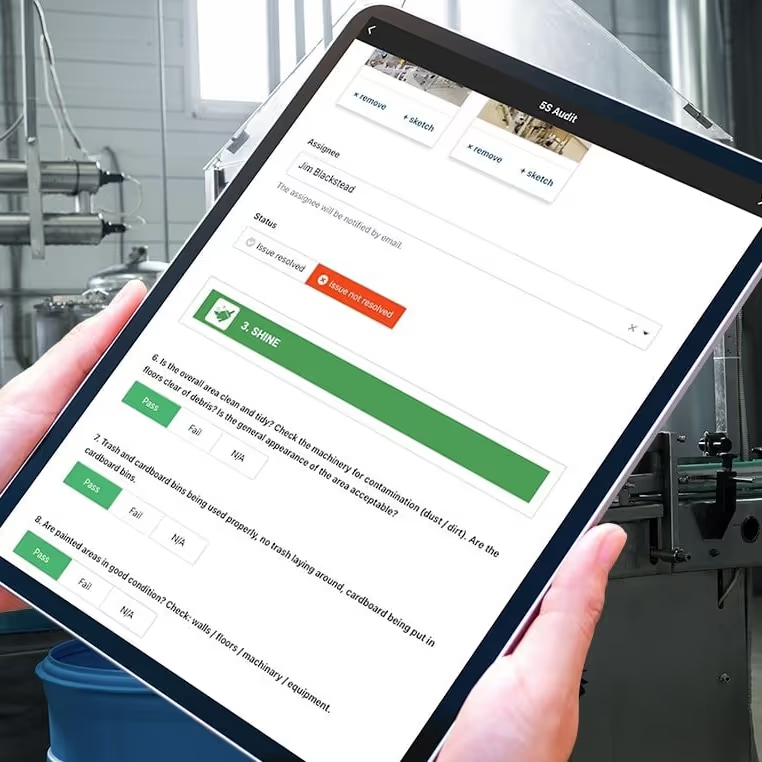
What Are Emerging Trends in Autonomous Maintenance, and How Can Weever Enhance Efficiency Across Industries?
Autonomous maintenance is rapidly evolving as industries seek ways to optimize operations, reduce downtime, and maintain a competitive edge. But what is autonomous maintenance? Autonomous maintenance refers to the process where operators are trained to perform basic maintenance tasks, such as cleaning, lubrication, and inspection, without the need for dedicated maintenance personnel. This approach not only empowers operators but also enhances overall equipment efficiency. As the landscape of autonomous maintenance advances, companies must stay attuned to emerging trends to sustain their efficiency and productivity. Weever, a leading productivity software tool, is positioned to help businesses navigate these changes by enhancing their maintenance processes across various industries. This article explores emerging trends in autonomous maintenance and illustrates how Weever can boost efficiency through its intuitive design, automation capabilities, analytics tools, real-time reporting, and seamless rollout methodology.
Simplifying Autonomous Maintenance Implementation
The trend towards autonomous maintenance is driven by the need for more efficient, reliable, and cost-effective maintenance processes. However, the successful implementation of these practices hinges on the ability to adopt new technologies quickly and effectively. This is where Weever excels, offering a user-friendly interface that simplifies the adoption of autonomous maintenance practices across industries.
Minimal Training, Maximum Impact
One of the key challenges in adopting autonomous maintenance is understanding its fundamental steps and overcoming the learning curve associated with new systems and technologies. Weever addresses this by providing an intuitive interface that requires minimal training. Designed with the end-user in mind, Weever's platform allows maintenance teams to quickly understand and use the software, thereby reducing the time and resources typically needed for extensive training programs.
Adaptation to New Trends
As autonomous maintenance continues to evolve, industries are witnessing a shift towards more sophisticated technologies, such as AI-driven diagnostics and predictive maintenance tools. Weever's ease of use ensures that companies can swiftly adapt to these trends without the usual friction associated with adopting new technologies. By simplifying the implementation process, Weever helps businesses stay agile and responsive to the latest developments in autonomous maintenance, ensuring they remain at the forefront of industry trends.
Streamlining Maintenance Processes
Automation is at the heart of autonomous maintenance, and one of the most significant emerging trends is the shift towards more automated workflows. Weever is at the cutting edge of this trend, offering robust automation features that streamline maintenance tasks and action items, ultimately enhancing operational efficiency.
Reducing Manual Effort
Traditional maintenance processes often involve a significant amount of manual effort, from routine inspections to documenting and tracking maintenance activities. Weever automates these routine tasks, freeing up valuable time and resources that can be better spent on strategic initiatives. By reducing manual effort, Weever enables maintenance teams to focus on more critical tasks, such as optimizing machine performance and analyzing data to prevent future breakdowns.
Consistency in Best Practices
As industries adopt new autonomous maintenance trends, consistency in executing these practices becomes crucial. Weever ensures this consistency by automating the creation and assignment of action items based on predefined maintenance protocols. This automation not only reduces the risk of human error but also ensures that maintenance tasks are performed consistently and in line with the latest industry standards.
Staying Ahead with Automation
In an environment where maintenance trends are rapidly evolving, the ability to stay ahead of the curve is a significant competitive advantage. Weever's automation capabilities allow businesses to integrate emerging best practices into their workflows seamlessly. Whether it's automating the scheduling of predictive maintenance tasks or ensuring compliance with new regulations, Weever provides the tools needed to stay ahead in a constantly changing landscape.
Leveraging Analytics for Predictive Maintenance
The rise of data-driven maintenance strategies is another emerging trend in autonomous maintenance. As more industries recognize the value of leveraging data to predict and prevent equipment failures, the demand for advanced analytics tools is growing. Weever's powerful analytics features enable businesses to harness the full potential of their maintenance data, providing actionable insights that drive smarter decision-making.
Anticipating Future Needs
Weever's analytics tools allow businesses to monitor and analyze maintenance data in real-time, providing insights into equipment performance, failure patterns, and overall maintenance efficiency. By identifying trends and patterns in this data, businesses can anticipate future maintenance needs and take proactive measures to prevent unplanned downtime. This predictive approach not only enhances equipment reliability but also extends the lifespan of assets, reducing overall maintenance costs.
Adjusting Strategies to Remain Competitive
In a competitive market, the ability to adapt maintenance strategies in response to new trends is crucial. Weever's analytics tools provide the insights needed to make informed decisions about when and how to adjust maintenance strategies. Whether it's optimizing maintenance schedules based on equipment usage patterns or identifying opportunities for cost savings, Weever empowers businesses to stay competitive by continually refining their maintenance processes.
Data-Driven Maintenance Optimization
As industries continue to adopt more advanced autonomous maintenance practices, the role of data in driving maintenance decisions will only increase. Weever's analytics tools are designed to support this trend by offering comprehensive data visualization and reporting capabilities. By making it easier to interpret and act on maintenance data, Weever helps businesses optimize their maintenance processes and achieve greater efficiency across their operations.
Keeping Teams Informed and Responsive
Real-time reporting is another critical trend in autonomous maintenance, enabling businesses to monitor the current state of their maintenance activities and respond quickly to emerging issues. Weever's real-time reporting capabilities ensure that maintenance teams are always informed, allowing for swift adjustments in response to new industry developments.
Immediate Access to Information
Weever's real-time reporting tools provide immediate access to critical maintenance information, from equipment status updates to the progress of ongoing maintenance tasks. This real-time visibility allows maintenance teams to respond quickly to any issues that arise, minimizing downtime and ensuring that maintenance activities remain on track.
Responding to Industry Developments
As new trends in autonomous maintenance emerge, the ability to quickly adapt to these changes becomes increasingly important. Weever's real-time reporting capabilities enable businesses to stay agile by providing the information needed to make informed decisions in response to new developments. Whether it's adjusting maintenance schedules to accommodate new equipment or responding to regulatory changes, Weever ensures that businesses can remain responsive to the latest industry trends.
Enhancing Communication and Collaboration
Effective communication and collaboration are essential for successful maintenance operations, especially in industries with complex workflows and multiple stakeholders. Weever's real-time reporting tools enhance communication by providing a centralized platform where all relevant information is easily accessible. This transparency not only improves collaboration among maintenance teams but also ensures that all stakeholders are kept informed about the current state of maintenance activities.
Seamlessly Integrating New Trends
The final piece of the puzzle in achieving efficient autonomous maintenance is the seamless integration of new trends into existing workflows. Weever's proven rollout methodology is designed to minimize disruption and maximize efficiency, ensuring that businesses can quickly and effectively adopt new autonomous maintenance practices.
Minimizing Disruption
Implementing new maintenance practices can often be disruptive, particularly in industries with established workflows and complex operations. Weever's rollout methodology is designed to minimize this disruption by providing a structured approach to integrating new trends. From initial planning to full implementation, Weever ensures that the transition to new maintenance practices is smooth and efficient, with minimal impact on day-to-day operations.
Maximizing Efficiency
Efficiency is at the core of autonomous maintenance, and Weever's rollout methodology is designed to maximize this efficiency by ensuring that new practices are seamlessly integrated into existing workflows. By providing step-by-step guidance and support throughout the rollout process, Weever helps businesses achieve the full benefits of emerging maintenance trends without the usual teething problems associated with change.
Cross-Industry Applicability
One of the key strengths of Weever's rollout methodology is its applicability across various industries. Whether it's manufacturing, food processing, or logistics, Weever's approach can be tailored to meet the specific needs of different sectors. This versatility ensures that businesses in any industry can benefit from the latest trends in autonomous maintenance, regardless of the unique challenges they may face.
Driving Efficiency with Weever
As industries continue to evolve, the importance of staying ahead of emerging trends in autonomous maintenance cannot be overstated. Weever provides the tools and support needed to navigate these changes, offering a comprehensive solution that enhances efficiency across all aspects of maintenance operations. From simplifying the adoption of new practices to providing real-time insights and ensuring a smooth rollout of new trends, Weever is the ideal partner for businesses looking to optimize their maintenance processes and maintain a competitive edge.
In a world where efficiency is paramount, Weever stands out as a leader in autonomous maintenance, helping businesses not only keep pace with emerging trends but also set the standard for maintenance excellence across industries.
Ready to elevate your maintenance practices? Connect with us today to discover how Weever can help you stay ahead of emerging trends and maximize efficiency across your operations.

5 Reasons Digital Work Permits Keep Workers Safer and Operations Smarter
It was a routine maintenance job until it wasn't. In July 2025, a worker for an environmental and hazardous waste management service provider entered a confined space at a customer's facility. The space, which contained organic chemical residue, was not properly vented. On a beautiful summer workday that should have been routine, tragedy struck and the worker died.
The U.S. Occupational Safety and Health Administration (OSHA) alleged that the employer failed to implement legally mandated permit-required confined space entry requirements. Specifically, OSHA found that the employer failed to ventilate, test the environment, and use non-entry rescue equipment, including a tripod, mechanical winch, and full-body retrieval harness. OSHA cited the employer for violations including three willful and proposed $602,938 in penalties.
This is why Permit to Work (PTW) systems exist: to ensure hazardous tasks are authorized, coordinated, and carried out safely. That didn't happen in the case of that worker entering a confined space. And when those systems rely on paper, they can leave too much room for error. Misplaced forms, time delays, and incomplete records all increase the risk of potentially fatal accidents and miscommunication.
Software-based work permits close those gaps. By digitizing the process, organizations gain real-time visibility, experience fewer errors, and achieve stronger compliance, all while keeping workers safe.
Make the Smarter, Safer Choice
Here are five reasons why digital work permit management is acknowledged as the smarter, safer choice:
Enhanced Risk Identification and Safety
The primary role of a work permit is to protect workers by making risks visible before a job starts. Digital systems take this a step further. With dynamic fields and built-in guidance, software helps uncover hazards that a paper form might miss and quickly can be updated as hazards evolve. Worst case scenario when risks are ignored and not included in permitting systems: As was the case with the worker mentioned earlier, risks can be overlooked, leading to deadly consequences.
For example, if a worker selects "confined space entry," the system can automatically trigger additional checks for ventilation, atmospheric testing, and rescue planning. That tailored approach ensures risks are addressed thoroughly and consistently.
As the International Labour Organization warns, "Every 15 seconds, a worker dies from a work-related accident or disease. Every 15 seconds, 151 workers have a work-related accident." Effective risk identification isn't optional in the workplace. It's essential to save workers' lives. Software strengthens this foundation by embedding safety into every permit request.
Fewer Errors and Omissions
Paper permits are vulnerable to human error: missing signatures, skipped steps, illegible handwriting. In high-risk environments, even small mistakes can snowball into major safety incidents. Worst case scenario with paper permits: They can be virtually useless to workers who are trying to do the right thing.
Digital permits reduce this risk by design. Required fields, drop-down menus, time stamps, and automated workflows ensure that no detail is overlooked. Some platforms even embed video instructions so workers can see what safe procedures look like in practice.
Regulatory agencies around the world have documented numerous industrial accidents where poor permit management was a contributing factor. By minimizing omissions, software ensures accuracy becomes the norm, not the exception.
Greater Efficiency and Cost Savings
Safety is the number one goal, but efficiency matters too. Paper permits often mean delays as forms move from one person to another, sometimes across different sites or shifts. When it takes hours or even days for permits to work their way through the system, projects are slowed down and frustration mounts. Worst case scenario: Work starts without the proper permits in place, which means employees essentially are working "blind" to potential hazards.
With software, approvals and updates happen instantly. Documentation is stored securely and accessible at the click of a button. For organizations managing multiple locations, that efficiency adds up to significant time and cost savings.
Real-Time Awareness
Work permits aren't just about authorization; they're also about communication. Everyone needs to know when risky work is happening and under what conditions. Permits exist not only to manage risk for the employees doing the work, but for those working nearby. Worst case scenario: Paper-based systems create delays, and in fast-moving environments, delays equal danger.
Digital permits solve this with real-time notifications and shared dashboards. If conditions change, maybe the result of a sudden weather event or equipment failure, all stakeholders are alerted immediately. Whether in the control room or the field, everyone stays aligned and understands what's going on.
This immediate visibility reduces the chance of overlapping work or missed hazards. In industries like construction, oil and gas, or manufacturing, that awareness saves lives.
Stronger Compliance and Recordkeeping
Finally, compliance and recordkeeping are where digital permits take center stage. Regulators and insurers often request detailed documentation of permits and associated safety measures. Paper trails are slow to compile, easy to lose, and as mentioned before, don't always keep up with changing work processes. Worst case scenario: A regulator shows up and asks to see permits, which don't match the scope of the work, resulting in a citation and fine.
Software, on the other hand, automatically generates audit-ready reports. Multi-site organizations can consolidate records across regions with ease. What once took weeks of manual digging can now be completed in minutes. When an inspector asks for three years of permit data, software makes it a two-minute task instead of a two-week scramble.
The Bottom Line
Work permits protect lives, but only if they're managed effectively. Moving from paper to software transforms permits from a box-ticking exercise into a living, dynamic safety system with clear benefits: better risk identification, fewer errors, greater efficiency, real-time awareness, and stronger compliance. Most importantly, digital permits give workers confidence that safety is built into the way work is managed. At the end of the day, better permits mean safer people.
Ready to Elevate Safety at Your Manufacturing Operations?
Discover how the Smart Connected Worker Platform can revolutionize your manufacturing operations and elevate safety. Our team of experts is ready to help you implement intelligent solutions that drive safety, efficiency, and operational excellence.
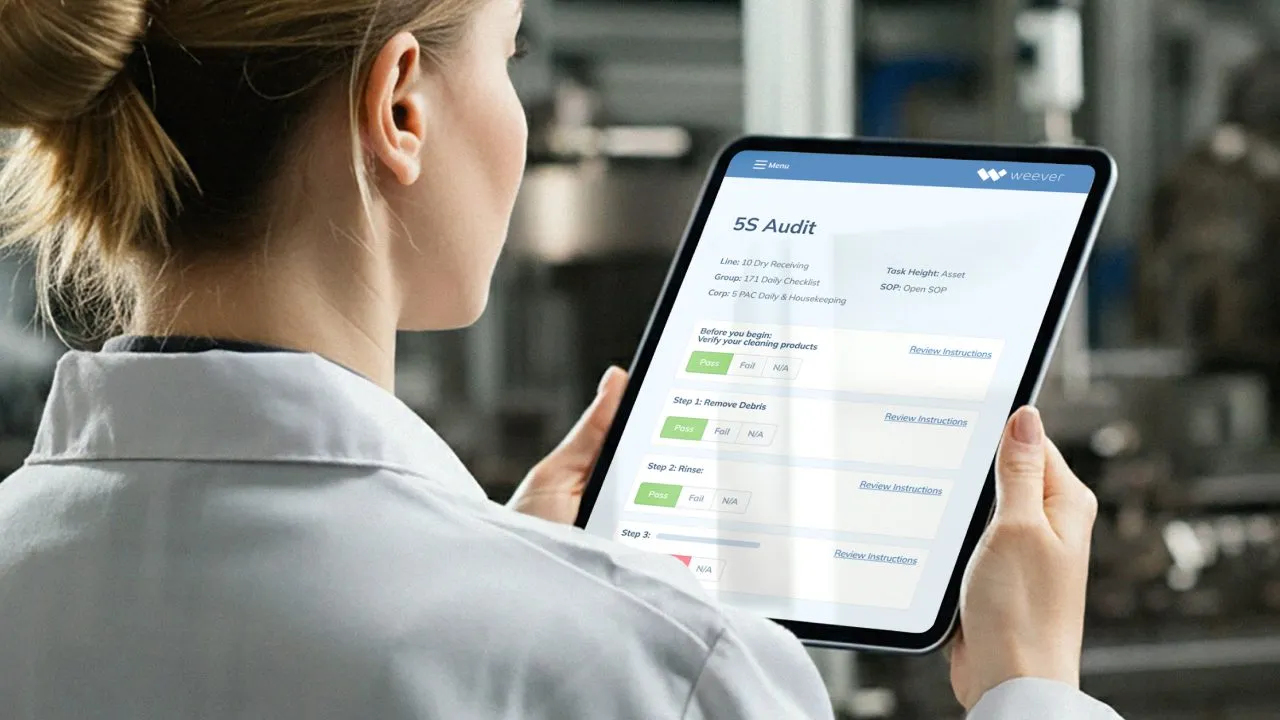
From Compliance Burden to Competitive Advantage: How Audit Software Can Transform your Manufacturing Operations
From Compliance Burden to Competitive Advantage: How Audit Software Can Transform your Manufacturing Operations
Audits. We know they are necessary, but they are one of those activities in manufacturing that few (if any) of us look forward to doing. Audits keep our businesses compliant, improve product quality, and uncover areas for continuous improvement, but ask any plant manager or quality leader, and they'll likely admit that traditional audits can feel like a burden.
So, how do you turn auditing from a reactive headache into a proactive tool for growth? The answer is simple: manufacturing audit management software.
The Challenge of Traditional Audit Processes
Audits, when thorough, require inspections, verification of compliance with regulatory standards, and tracking of corrective actions. Traditionally, this involves manual paperwork, spreadsheets, and gathering information from disconnected systems. This approach often leads to:
- Redundant data entry and lost documents.
- Inconsistent follow-ups on corrective actions.
- Sluggish responses to regulatory changes.
As regulatory expectations grow around the world, manufacturers face more pressure to keep meticulous, up-to-date records about everything from the materials they're bringing into their facilities, to their maintenance logs, to safety outcomes, and even the safeguards they use to protect the privacy and financial data of their customers. A single missed audit deadline or incomplete report can bring costly consequences. In fact, research highlights that the cost of noncompliance averages out to $14.82 million annually per company in penalties, lost productivity, and reputational damage. That's a heavy price to pay for outdated processes.
Level Up with Audit Management Software
Do you use your current audit management system to support reactive problem-solving, or does it assist you in building your strengths and setting you up for success in the future?
Audits should serve as a structured way for companies to check whether their processes, products, and systems meet internal standards and external regulatory requirements. In simple terms, they answer the question: "Are we doing what we said we would and are we delivering the right level of quality?"
Manufacturing audit management software like Weever is designed to cut through inefficiencies. Weever software helps manufacturers plan and execute audits and analyze results with precision and ease. Let's break down what that looks like in practice.
- Simplify complex workflows - One common frustration in traditional auditing is the complexity of audit templates. Departments often have their own versions of audit templates and customizing them requires technical know-how. Weever addresses this challenge by offering intuitive, customizable templates that can be tailored to any type of audit. Whether it's a 5S inspection, autonomous maintenance check, or regulatory compliance review, by giving teams a clear structure and easy-to-use interface, the software helps reduce human error and ensures consistency across every audit.
- Automate what slows you down - Here's a question for you: What happens when your audit reveals a safety hazard? In a manual system, the answer usually involves completing a lot of paperwork, launching email chains, and feverishly hoping that corrective actions don't slip through the cracks, resulting in an injury, shutdown, or worse. With Weever audit management software, automation steps in, generating corrective action plans, assigning tasks to the right people, and setting deadlines. Issues are resolved faster and with greater accountability. Scheduling, task assignments, and reminders are all handled by the system, freeing up your staff for more strategic initiatives.
- Unlock the power of real-time data - Another critical question: How do you know whether your audits are truly driving improvement? If your current audit program does nothing more than uncover existing problems that are already impacting your business, then it is not delivering the value proposition it should. Weever challenges this outdated dynamic by providing real-time reporting. Managers can instantly see the status of audits, track non-compliance issues, and generate detailed reports for internal or external use. These insights allow leaders to move from reacting to problems to preventing them, fueling continuous improvement across operations.
- Integrate new software without disruption - We're not going to sugarcoat it: Disruption can be a concern when introducing new technology. That's why Weever is designed for easy onboarding, with guided implementation, pre-built templates, and comprehensive training. Its flexible configuration means it adapts to existing systems and workflows rather than forcing your business to overhaul how you operate. The result is faster adoption, minimal downtime, and a quicker return on investment.
Audits: From Pain in the Neck to Strategic Advantage
Auditing isn't just about compliance; it's about building trust and protecting your organization from unnecessary risk. Effective audit programs provide assurance your operations are functioning at a high level, and risks are being managed effectively.
By moving to a digital, automated audit system, manufacturers gain more than efficiency. They gain a competitive edge. Consistent, accurate audits mean stronger quality assurance, safer workplaces, and better compliance records. Your investment in manufacturing audit management software helps attract customers and builds your reputation as a reliable partner.
Audit management software like Weever transforms audits from a frustrating necessity into a powerful driver of compliance, efficiency, and improvement. By simplifying workflows, automating corrective actions, and delivering real-time insights, it ensures that audits are not just completed, but that they create meaningful value.
So, the question isn't "Do we need audit management software?" but rather "Can we afford not to have it?" In today's environment of tightening regulations and rising competition, the answer is clear.
Ready to see how streamlined audits can transform your operations? Reach out to Weever today to schedule a demo and take the first step toward making audits a competitive advantage.
Ready to Digitize 5S In Your Operations?
Discover how the Smart Connected Worker Platform can revolutionize your manufacturing operations. Our team of experts is ready to help you implement intelligent solutions that drive safety, efficiency, and operational excellence. Download the 5S Audit Digitization Implementation Guide Demo 5S Today

Beyond Compliance: 5 Steps to a Behavior-Based Safety Culture That Clicks
As a safety or operations manager in manufacturing, you understand that compliance checklists and warning posters only go so far to remind employees about workplace hazards and adopting safe behaviors. True safety performance comes from culture.
Herb Kelleher, the co-founder and former CEO of Southwest Airlines, is famously quoted as saying: "Culture is what people do when nobody is watching." Kelleher adopted an "employee-first" management philosophy, which stressed hiring and managing for attitude as well as skill or credentials, and trusted that employees treated well would, in turn, treat customers well. In other words, empowered employees can ignite your safety program and power your business.
There is no better way to empower employees than to put them in the front row of your safety efforts. That's why more companies are turning to Behavior-Based Safety Observations (BBSO) as a cornerstone of their safety strategy.
The principle is simple: by observing, recording, and constructively addressing workplace behaviors, organizations can shift from reactive compliance toward proactive, engaged safety. The results are tangible. Peer-reviewed research and industry data consistently show that behavior-based safety increases worker engagement, improves communication, and reduces incidents. For example, organizations using BBS to inform safety programs report significantly stronger employee buy-in, because it connects abstract safety policies with visible, everyday actions.
But how do you actually design a BBSO program that works in your manufacturing environment, where variables like production deadlines, shift rotations, and competing priorities can get in the way? The following guide outlines five essential steps you can take to launch a successful BBSO program that provides the results leadership wants to see and and an easy-to-follow strategy that employees will support. Along the way, we'll explore practical tips, common pitfalls, and lessons from organizations that have successfully transformed their cultures through BBS.
Step 1: Set the Stage with Clear, Measurable Goals
Every effective BBSO program begins with intent, so be SMART (specific, measurable, achievable, relevant, and time-bound) about your goals.
"The key challenge to safety is to inspire people to be self-accountable," said noted behavioral psychologist E. Scott Geller. "We need to transition from programs that promote other-directed accountability to ones that promote self-directed accountability."
For example, instead of a vague goal to "improve PPE compliance," set a target to reduce near-miss incidents related to PPE non-compliance by 20% within six months. This level of specificity not only gives the program direction but also helps employees understand what success looks like. They will know when they're meeting program goals.
One thing is certain: Behavior-based safety works best when objectives are visible and trackable. Without a roadmap, observation programs can feel like another administrative task rather than a performance driver. The goal is to guide and inspire your employees to embrace their BBSO program right from the start. To build these objectives, start by asking:
- Which behaviors most influence injury risk in your environment?
- Where do compliance gaps most often occur (e.g., lockout/tagout, tool use, personal protective equipment (PPE), ergonomics)?
- What are your key performance metrics (KPIs) and how will improvement be measured? Are you tracking incident rates, observation counts, training completions, cultural surveys, or some or all of the above?
Clarity here creates momentum later. As your program starts meeting KPIs on a regular basis, you can create new goals to drive even more success.
Step 2: Choose the Right Observers
The effectiveness of a BBSO program hinges on the observers. Some companies restrict observations to trained safety committee members, while others open it up to all employees in a peer-to-peer system.
There are benefits and drawbacks to both approaches. Limiting observations to a select group that already has knowledge about safe work and regulations eliminates the need for training on safety basics and makes scheduling and quality control easier. However, peer-to-peer systems create far more opportunities for learning and collaboration. Employees are more likely to change behavior when feedback comes from colleagues working side-by-side rather than solely from management.
This step is where culture takes root. By enabling frontline workers to participate, you send the message that the responsibility for safety lies with everyone, not just the safety department. Research shows peer-to-peer BBS engagement improves employee ownership of safety processes and fosters proactive behavior.
"Behavior-based safety (BBS) programs promote coworkers observing and correcting each other's at-risk behaviors on site… BBS programs are strategically devised to engage the workforce in the implementation and utilization of their own safety initiatives," wrote the authors of the study "Effects of a behavior-based safety observation program: Promoting safe behaviors and safety climate at work."
Here are some things to consider when selecting your observation approach:
- Manageability: Can the program support broad participation without overwhelming administrators?
- Coaching value: Will more observers translate to more learning opportunities?
- Cultural impact: Does empowering employees align with your long-term safety goals?
Step 3: Design Forms That Make Data Actionable
Management guru and the noted author of In Search of Excellence Tom Peters is widely quoted as saying, "The simple act of paying positive attention to people has a great deal to do with productivity." It makes perfect sense: The more we are acknowledged for our safe and productive work, the more willing we are to continue those behaviors.
Observation isn't just about looking, though. It's about documenting observed behaviors, both good and bad, in a way that drives action. That's why user-friendly forms are the backbone of a successful BBSO program.
The best observation forms are simple, structured, and relevant to the workplace. They should capture three things: antecedents (what led to the behavior), the behavior itself, and consequences (results of the behavior). (Find out more about Weever BBSO templates here.)
At minimum, forms should include categories like body position, PPE, tools and equipment, work environment, and adherence to procedures. Equally important, they should leave room for positive reinforcement, not just incident prevention. Celebrating what went right builds trust and encourages repeat behaviors.
At Weever, digital templates help organizations quickly tailor forms to their workflows. This is crucial to ensuring relevance across different facilities or departments.
Consistency in form design also matters. If employees see the same structure every time, they're more likely to treat observations as part of daily operations rather than a burdensome audit. Over time, aggregated data monitoring the same observed behaviors paints a clear picture of trends, risks, and successes.
Step 4: Train to Observe, Not to Police
For years, safety professionals were tagged as "the safety police." They were not perceived as allies; they were perceived as enemies. That attitude has changed over the years, as employees have realized that safe work protects them from life-threatening injuries and illnesses and safety professionals are their on-site coaches and cheerleaders.
Safety observers also need to be seen as coaches, not tattletales. Even the best forms won't help your BBSP program succeed if observers aren't equipped to use them properly. Training in how to conduct a BBS observation is essential, and it should be comprehensive but practical.
At onboarding, employees should learn what BBS is, why it matters, and how to identify critical behaviors in their specific roles. Training should also focus on how to communicate observations constructively. An effective observer doesn't scold their coworkers. They should engage in respectful, solution-oriented dialogue.
A lot of data can be gleaned from these discussions. For example, if an employee is observed operating a machine without engaging a guard, an observer should ask why the machine is being operated in that manner. The observer might discover the employee proactively reported a malfunctioning guard and was told by a supervisor to operate the machine without the guard. That speaks more about the shop floor culture than it does one employee's behavior. Through the observation process, a much greater threat to safety was uncovered.
A typical training curriculum could include:
- Background about your company's safety culture and corporate values
- Basic safety principles and what constitutes "high-risk" behaviors
- Observation and reporting procedures
- Tips on providing feedback and for honing communication skills
- Positive reinforcement techniques
Follow-up refresher sessions can keep the program fresh and allow for the BBs process to incorporate changes and updates as the system matures. This cycle of training and reinforcement builds confidence, ensuring observers can focus on behaviors without judgment.
Step 5: Observe, Analyze, and Act…On Repeat
Once training and forms are in place, the program comes alive on the shop floor and that's where the fun begins.
The heart of any BBSO program lies in consistent, structured observations. This means scheduling regular sessions, which can be daily, weekly, or monthly, depending on your operations. You must ensure that observations cover different shifts, departments, and conditions.
Not to sound like Miss Manners, but when conducting BBS observations, there are basic etiquette steps that must be followed by observers:
- Ask permission before observing. This is about growth, not punishment.
- Record behaviors objectively, using the form as a guide.
- Stay neutral during the observation. Provide feedback afterward.
- Open the feedback following the observation with positive observations before addressing at-risk actions.
Afterward, the real work begins. Managers should analyze patterns across reports, identify recurring risks, and create action plans. Action plans might include one-on-one follow-ups to review procedures, toolbox talks or refresher training sessions, or updating signage, visual cues, or PPE requirements.
Organizations that regularly review BBSO metrics like observation rates, participation levels, and near-miss reports are better positioned to continuously improve and maintain engagement. Digital systems like those offered by Weever make it so much easier to track, analyze, and visualize behavioral safety observations. The point is not to collect gigabytes of data that will never be used. That is just administrative overload with no payout. When that data is turned into actionable insights, however, the payoff can be huge.
Turning Observations into Ownership
A BBSO program is not a one-off initiative; it's a living system. By repeating observations, analyzing outcomes, and feeding results back into training and communication, companies create a loop of continuous improvement.
Over time, this reinforces the idea that safety isn't imposed from the top down, but owned by everyone. Workers become more engaged because they see the connection between their daily actions and organizational outcomes. As one safety manager described it: "Our people stopped waiting for reminders. They began reminding each other." (Discover how one Weever client achieved over 6 million accident-free work hours by implementing programs like BBSO.)
Launching a BBSO program requires effort and patience, but the payoff is substantial. Clear objectives, empowered observers, smart forms, thoughtful training, and continuous feedback create a culture where safety is both personal and collective.
Behavior-based safety is not just about reducing incidents It's about improving communication, trust, and accountability across the workforce. And when employees see themselves as part of the solution, performance and morale rise together.
Safety has to be everyone's responsibility… everyone needs to know that they are empowered to speak up if there's an issue," said NASA astronaut Captain Scott Kelly. "No problem has ever been solved by people saying 'Hey, let's work apart.' Teamwork is what allows us to accomplish our goals."
Ready to Elevate Your Safety through BBSO?
Discover how the Smart Connected Worker Platform can revolutionize your manufacturing operations. Our team of experts is ready to help you implement intelligent solutions that drive safety, efficiency, and operational excellence. Schedule A Demo Download the BBSO Ultimate Guide

Weever’s Configurable Templates Might Be the Best Tool in Your Toolbox
Every manufacturing operation is its own little universe with unique processes, challenges, and goals.
September 2025

TABLE of contents
Weever's Program Templates Might Be the Best Tool in Your Toolbox
Every manufacturing operation is its own little universe with unique processes, challenges, and goals. How effective is a cookie cutter in your toolbox when you're faced with the need to be flexible and adapt to changing processes and programs?
Wouldn't you prefer a Swiss army knife?
In this case, we're talking about forms that you can configure for just about solution from 5S Audits to BBSO to AM to MSS, or other Connected Work at your manufacturing plant.
That's where Weever comes in, offering templates for your program management that you can tune to fit your exact needs.
Think about the vast range of what manufacturing covers: automotive plants humming with robotic precision, electronics lines soldering microscopic circuits, food and beverage facilities juggling hygiene standards, and pharmaceutical labs operating under strict regulatory scrutiny. The machinery, workflows, compliance checkpoints, and performance metrics are wildly different from one sector to the next. This diversity demands flexibility.
Now imagine you have Weever's Program Templates as part of your toolkit. They can be configured to suit your changing needs, whether you are building cars, crafting circuit boards, bottling soda, packaging food or compounding medicines. Instead of starting from scratch (which can be time-consuming and expensive), you begin with a configurable foundation and customize from there. You decide how simple or complex your templates need to be based on how you will use them.
Here's what makes these templates stand out:
- A user-friendly interface: You don't need to be a tech guru; you can spin up a template in no time. That lowers the learning curve and speeds up adoption on the shop floor.
- Scalability: Your operation today might look nothing like the one you'll be managing two years from now. Whether you're adding new lines, opening a second shift, or branching into a new product category, the same template can evolve alongside you.
- Easy integration with other systems and programs: Seamless integration matters when you've already got ERP, quality systems, or maintenance software in place. Data flows smoothly, nothing falls through the cracks.
- Real-time data and reporting: This is a game-changer! Instead of waiting for end-of-shift debriefs or weekly summaries, you can see what's happening right this minute. Instead of waiting for a report, you will be spotting bottlenecks, tracking compliance, and course-correcting on the fly, in real time.
Let's dig into some examples of how these templates shift gears across sectors:
Food and beverage manufacturing - Safety and hygiene move to the front burner. Templates can include sanitation schedules (remember that nightly deep-clean?), ingredient traceability, and compliance checklists. Real-time monitoring means you see issues immediately and nip them in the bud, not just documenting them after the fact. In all areas of manufacturing, but especially food, reducing the risk of recalls is paramount.
Automotive manufacturing - Precision is king. You can tailor the template with detailed quality-control checklists, ensuring every tiny component hits the right tolerance. Add in maintenance reminders and safety inspection logs, and you're minimizing downtime and keeping lines humming.
Electronics manufacturing - Tiny parts can equal big headaches! Traceability is vital. A template for electronics manufacturing can include workflow steps, component tracking, and quality control. Your templates can be configured to ensure that no defective parts or products slip through and every board can be traced back if something goes sideways.
Pharmaceutical manufacturing - High stakes and lots of regulations. Here, templates can be loaded with comprehensive documentation features, batch tracking, and strict adherence to good manufacturing practices (GMP). When regulators walk in for inspections, all of the information they'll request is organized, up-to-date, and audit-ready, ensuring your facility stays compliant with regulations.
Weever's Impact on Culture Through Engagement
One unexpected side effect of configurable templates is better employee engagement. Turns out your workers prefer Swiss army knives over cookie cutters any day of the week! When your teams use tools that speak directly to their workflows with no extra steps and no confusing generic checklists, they're more likely to take ownership and follow through. Weever's interface delivers real-time feedback, which helps your employees stay on track and actually feel empowered, not burdened, by the tools they're using.
We all know how intimidating it can be to roll out a new program. But with Weever's templates, you can ease into adoption. Start small by picking a basic template and get that running smoothly. Layer in additional features as you go. A soft-launch approach keeps disruption to a minimum and builds confidence on the floor as you build on successes.
At the end of the day, there's no one-size-fits-all solution in manufacturing. But Weever's configurable program templates come pretty close to being the next best thing. They're flexible, scalable, integration-friendly, and real-time: just what you need to keep your operations efficient, compliant, and continuously improving.
So, if you've been wrestling with rigid programs that can't flex when you need them to or been baffled and overwhelmed by expensive custom builds, give configurable templates a try. They'll adapt to your company's needs, helping you tackle today's demands and tomorrow's opportunities with the same solid foundation.
Your manufacturing world is unique. Your program management should be, too. With Weever's configurable templates, you get what you need now, and what you will need in the future.
Ready to Transform Your Operations?
Discover how the Smart Connected Worker Platform can revolutionize your manufacturing operations. Our team of experts is ready to help you implement intelligent solutions that drive safety, efficiency, and operational excellence. Schedule A Demo Read More on the Power of Program Templates
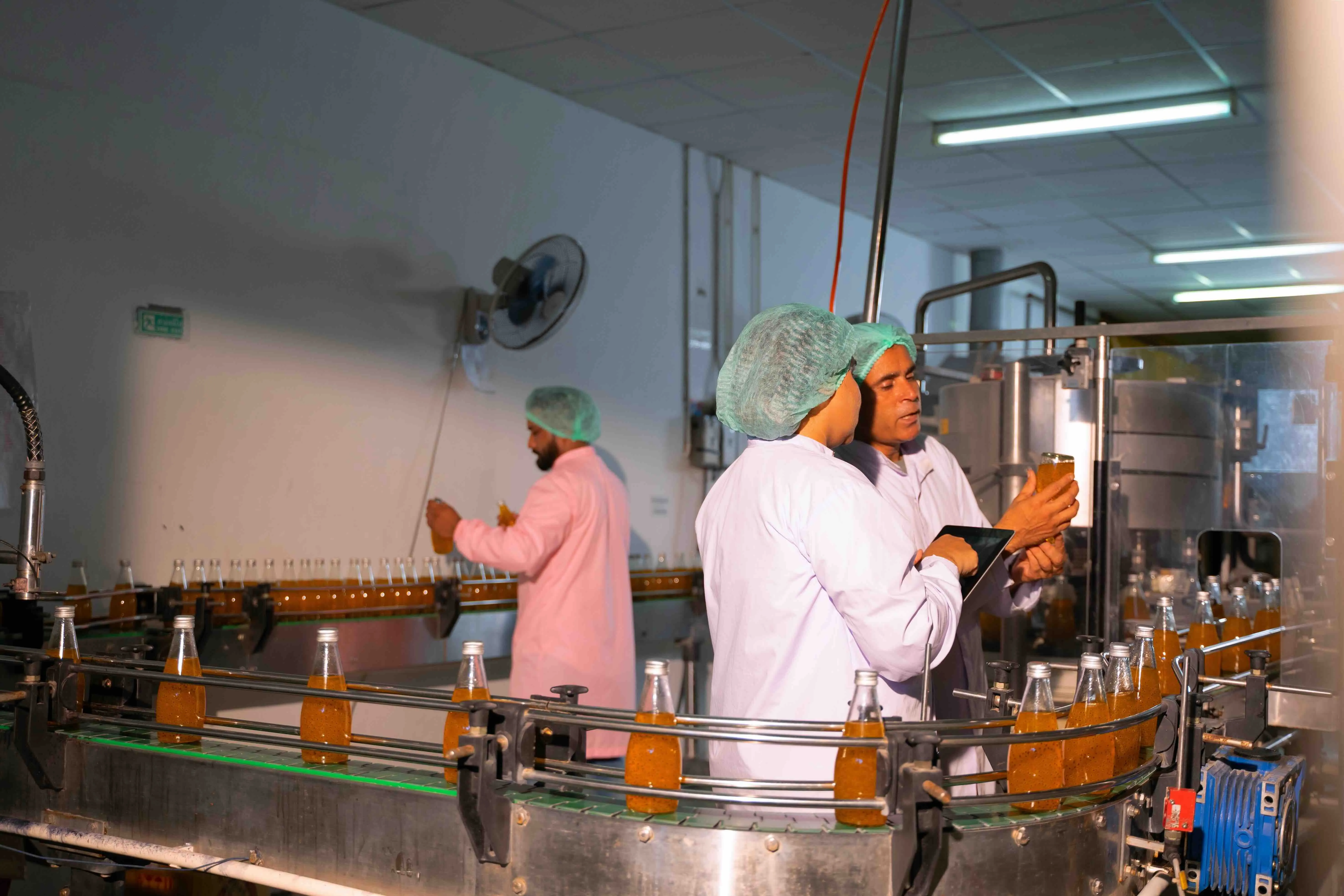
Is Your 5S Program Getting the Job Done?
For manufacturers, early detection and swift management of defects are essential to maintaining quality and minimizing downtime. Left unchecked, even minor abnormalities can escalate, disrupting production lines and increasing costs. That's where Weever software makes a difference. With tools designed to detect defects at the earliest stages, automate the response, and provide real-time insights, Weever empowers manufacturers to maintain the highest operational efficiency.
So, how does Weever help manufacturers detect and manage defects in production? Let's explore how Weever's solutions address this need at every stage of the defect management process.
Simplified Defect Detection: An Intuitive, User-Friendly Platform
Effective defect management starts with quick and accurate detection. Weever's intuitive interface is designed with operators in mind, making it easy for them to identify and report abnormalities or defects without disrupting their work.
Operators on the floor are often the first to notice potential issues, yet traditional reporting systems can be cumbersome, slowing down detection times, and allowing small issues to go unaddressed. Weever solves this by providing a user-friendly platform that minimizes the time needed to log defects. The streamlined interface allows operators to report abnormalities or quality issues with minimal clicks, ensuring that details reach the relevant teams in real time.
This ease of use reduces the risk of defects being overlooked and helps operators feel more comfortable and confident in reporting issues. With Weever, identifying a defect becomes a simple, standardized process that seamlessly fits into the production workflow.
Automated Defect Management: Streamlining Workflows and Action Items
Identifying a defect is only the beginning; the real challenge lies in ensuring that each issue is addressed swiftly and effectively. Weever's solution automates the defect management process, assigning action items and tracking each step's progress, ensuring that no defect slips through the cracks.
Once a defect is reported, Weever automatically triggers a series of actions based on pre-configured workflows. These workflows specify who is responsible for each step in the process, from assessment to resolution, and notify relevant team members as needed. Each action item is tracked within Weever's system, allowing supervisors to monitor progress in real time. This automation eliminates the need for manual task assignments, reducing the likelihood of human error and ensuring consistent responses to each defect.
Weever's automated workflows also help standardize defect management across the organization, so every operator, technician, or manager knows the correct procedures to follow. With Weever, manufacturers can confidently manage abnormalities and defects with speed and consistency, reducing the risk of recurring issues or extended downtime.
Real-Time and Data-Driven Decision-making for Proactive Management
In addition to detecting and addressing individual defects, understanding broader patterns is key to preventing future issues. Weever's real-time reporting and data analysis features empower manufacturers to identify trends in abnormalities and defects, enabling proactive management.
Weever's platform continuously gathers and analyzes data on reported defects, providing insights into the underlying causes of recurring issues. For instance, if a particular machine frequently malfunctions or if specific product lines exhibit higher defect rates, Weever's data-driven insights allow manufacturers to identify these patterns and address them proactively. Armed with this information, teams can make informed decisions on preventive maintenance, equipment upgrades, or process adjustments to eliminate the root causes of defects.
Real-time reporting further enhances Weever's effectiveness, as abnormalities are flagged the moment they're reported, allowing teams to react immediately. This instant reporting minimizes the risk of production delays by ensuring that all personnel are alerted to potential issues as soon as they arise. By combining real-time insights with historical data, Weever enables manufacturers to take both immediate action and long-term preventive measures, enhancing overall quality and efficiency.
Weever's Seamless Implementation for Consistent Abnormality and Defect Management
For manufacturers with multiple facilities or large-scale operations, consistency in defect detection and management processes is critical. Weever's streamlined rollout methodology is designed to ensure that manufacturers can implement defect detection and management systems across facilities with ease and efficiency.
Weever's rollout process is structured to minimize disruption to ongoing operations. Manufacturers receive comprehensive training and resources to support a smooth integration of the platform, allowing teams to start using Weever quickly. The platform is adaptable to various production environments, making it ideal for organizations with complex workflows or multiple locations. By establishing uniform procedures for defect detection and management, Weever helps ensure that every facility or team operates under the same high standards.
With this consistent approach, manufacturers can confidently monitor and manage defects across all areas of their operations, fostering a culture of continuous improvement and quality control.
Weever: A Comprehensive Solution for Effective Abnormality and Defect Management
In manufacturing, the ability to detect and manage abnormalities and defects quickly and accurately is essential for maintaining product quality, minimizing waste, and ensuring operational efficiency. Weever software offers a comprehensive solution that simplifies each stage of the defect management process. From its easy-to-use interface to its automated workflows, real-time insights, and structured rollout methodology, Weever provides manufacturers with the tools they need to detect, manage, and prevent defects effectively.
Weever not only helps manufacturers address individual abnormalities but also supports a proactive approach to quality control, allowing teams to anticipate and mitigate potential disruptions before they impact production. With Weever, manufacturers gain more than just a defect management tool; they gain a partner in quality assurance, enabling them to maintain the highest standards and drive continuous improvement across their operations.
In a sector where precision and reliability are paramount, Weever's defect detection and management capabilities are an asset for any manufacturer committed to excellence. By turning real-time data into actionable insights and automating response workflows, Weever empowers manufacturers to stay ahead of potential issues, optimizing productivity and ensuring consistent quality every step of the way.
Contact Weever for a demo and discover how our software helps you manage defects.
Request more information Preview modal-
Request more information
Please tell us a bit about yourself so we can tailor our response and get you the information you need.
Continue Reading
Boost Your Manufacturing safety with Proactive Measures

How Proactive Measures Can Lead to Cost Savings in Manufacturing

How to be more proactive about safety

How to implement a proactive safety program into your facility
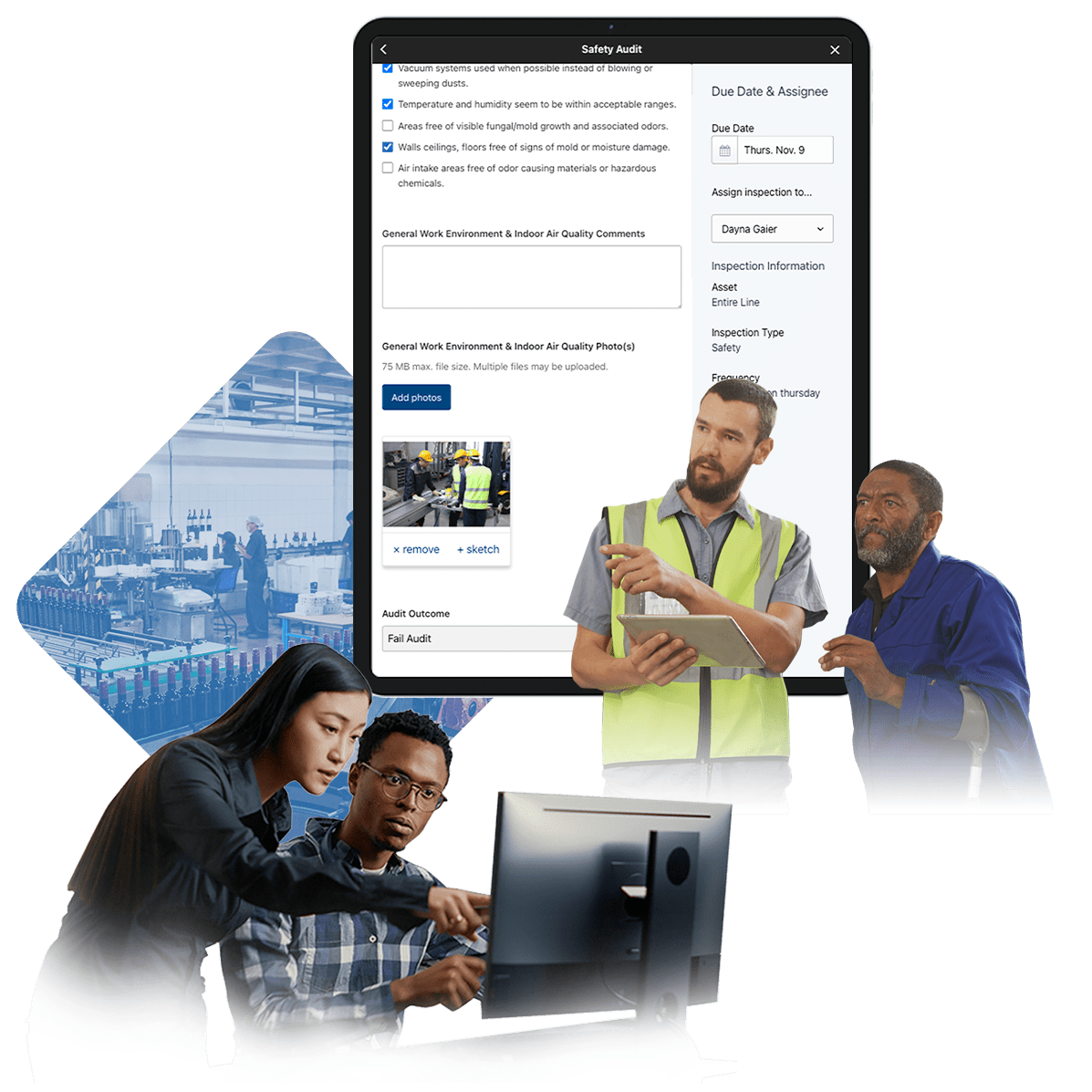
Proactive Measures for Ensuring Compliance in Regulated Industries

Proactive Measures in Manufacturing: Leveraging Weever Software for a Safer Workplace
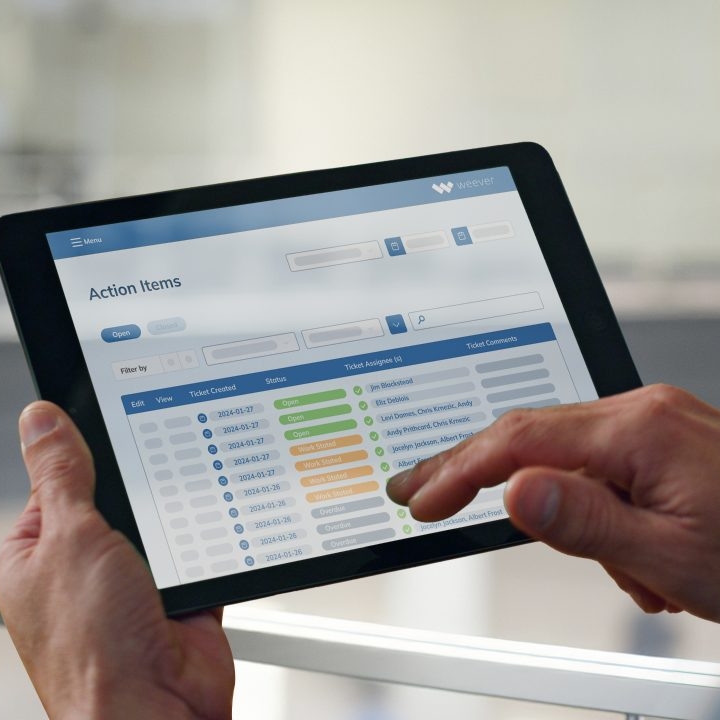
The Importance of Proactive Measures in Manufacturing Operations
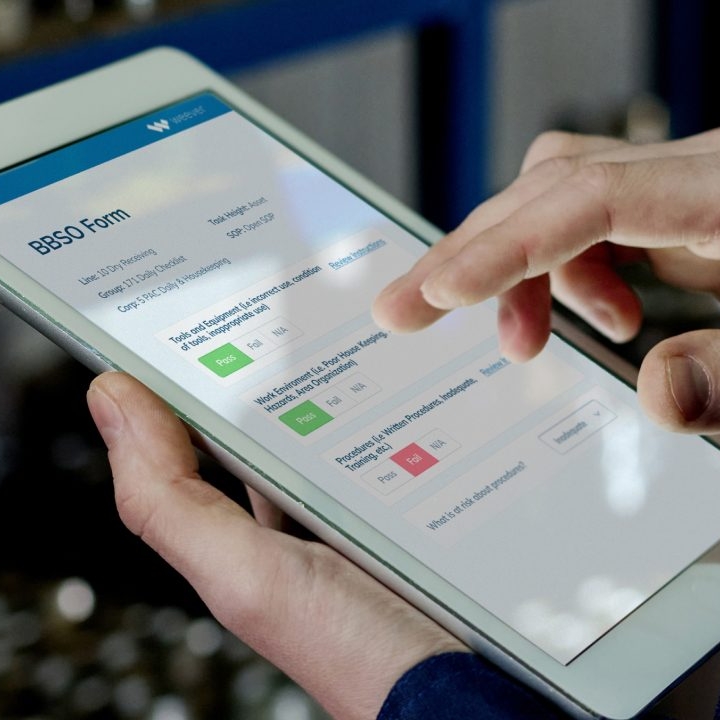
The Power of Proactive Measures in Preventing Equipment Failure

"Having cloud-based forms on devices around the facility makes them so much more accessible, which makes it painless for operators to quickly provide a report."
Johanna Velez, VP Quality Assurance


"Weever is really user friendly and will have a massive positive impact on our operations and training team."
Mel Cadle - Op Ex Lead Process Engineer


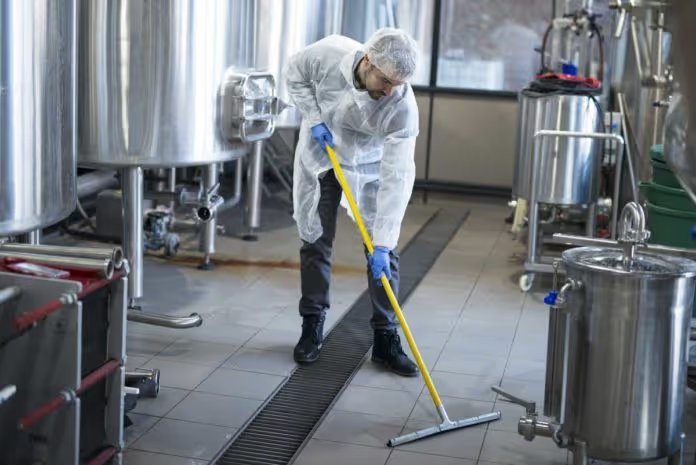
Use Your MSS to Create Data-Driven Strategies to Reduce Contamination and Ensure Compliance
Make MSS Is One of Your Most Powerful Tools
Your master sanitation schedule (MSS) might just be your facility's silent protector. A hidden foundation of operations, the MSS isn't just about cleanliness; it defends your facility against contamination, preserves product integrity, maintains regulatory compliance, and upholds public trust. Behind every sanitized surface lies this simple truth: if you want to provide a safe food product, you must begin with rigorous planning and execution and the best way to do that is through your MSS.
Unfortunately, foodborne illness isn't rare. The U.S. Center for Disease Control and Prevention (CDC) estimates that each year in the United States, some 48 million people fall ill due to contaminated food, resulting in 128,000 hospitalizations and approximately 3,000 deaths. On a global scale, the World Health Organization reports that 600 million people suffer from foodborne diseases annually, resulting in 420,000 deaths from ingesting contaminated food. These staggering numbers reinforce why a robust MSS is vital, not only as a tool to make your plant more efficient, but as a necessary defense against foodborne illness.
An MSS Is More than a Schedule
An MSS must go beyond the scheduling of tasks. It needs to reflect the layout and risk profile of your facility: Do you have a grinding line, a packaging room, or cold storage? Precision matters in this case. Some equipment requires frequent sanitization, while low-risk zones in your facility might follow a different maintenance cadence. Without a detailed and enforced MSS, it is more likely your company could experience an outbreak of foodborne illness that (worst-case scenario) results in deaths, massive recalls, citations and fines from regulatory agencies, and lawsuits. We've all seen those worst-case scenarios in the news.
Neil Marshall, former global Director of Quality & Food Safety at Coca-Cola and now managing director of Guv Consulting International, reflects on this in his industry talks. During his tenure at Coca-Cola, Marshall was responsible for setting the global strategy, policies, and programs for quality and food safety across the company's supply chain. His three decades of experience in food safety attest to the role of a MSS as a foundation of operational integrity, not just administrative window-dressing.
In a Q&A with Quality Assurance & Food Safety, Marshall noted that the important thing to remember about the food industry and food safety is that, "Everything that you're producing could be fed to you. Are you going to be comfortable with what you made being eaten by your kids, friends, family?"
MSS: Streamline Processes, Maintain Quality
By following best practices for a MSS and leveraging technology like Weever software, manufacturers can streamline sanitation processes, reduce risks, and maintain high standards.
Creating an effective MSS means crafting and maintaining a living document that:
- Maps all equipment and areas
- Identifies critical clean zones
- Institutes rigorously clear protocols
- Assigns responsibilities, and
- Builds review checkpoints.
Targeted software can transform your MSS from boxes on a checklist into strategic insights about the effectiveness of your food safety protocols and the quality of your product. Platforms like Weever now allow teams to design facility-specific cleaning routines, adapt on the fly, and monitor task completion in real time. Instead of chasing missing records, supervisors gain real-time visibility and mobile access, which is perfect when you must ensure compliance and consistency across shifts and sites.
Make the MSS Is One of Your Most Powerful Tools
The real power of an MSS lies not just in executing tasks, but in learning from the information (data) it provides. There is tremendous value in having dashboards that point out whether certain zones are chronically behind schedule, and in identifying thresholds where contamination risks resurface.
Kyle Willfahrt, a sanitary process and maintenance specialist at Nelson-Jameson, a leader in sanitary equipment, underscores this mindset in an interview with Food Manufacturing. "Sanitation and hygiene are not merely regulatory checkboxes… A truly effective program … fosters a strong culture of safety throughout the entire facility," he said, adding a warning manufacturers should take to heart: "Plan your maintenance, or it will plan you."
This proactive stance isn't theoretical. Software tools elevate compliance and efficiency. When your MSS is powered by such tools, it becomes transformational. Staff don't just perform tasks; they understand their importance.
Weever software is part of this new era of sanitation management
Dynamic, area-specific scheduling that flexes with regulatory shifts or production changes has replaced static spreadsheets and checklists. Imagine structured task organization that clarifies intent, automated assignments that cut confusion, instant notifications that prevent skipped steps, and real-time progress tracking that keeps operations transparent!
When issues arise, whether it's a spill or equipment damage, Weever sequences corrective follow-ups immediately. Comprehensive digital records ensure readiness at audit time and fuel data that continuously optimizes your MSS.
Weever software makes it easy for you to create, update, and manage a food plant master sanitation schedule utilizing an intuitive and user-friendly design. The platform allows manufacturers to:
- Configure cleaning schedules tailored to facility needs, including area-specific and equipment-specific cleaning requirements.
- Quickly adjust the planned cleaning tasks to accommodate changes in operations or regulatory updates.
- Organize cleaning activities in a structured format, ensuring clarity for staff at all levels.
Your MSS should eliminate the guesswork and empower your teams to focus on execution rather than administrative tasks. Your end goals should be clear: uphold high safety standards, reduce contamination risk, optimize workflow, and create confidence the facility is in compliance with all food safety regulations. Don't treat sanitation as a hurdle; make it your competitive edge.
The most important thing to remember is that the cost of poor sanitation isn't just regulatory, it's human. Tens of thousands of people around the world die each year from foodborne illnesses. And whether voluntary or mandated, recalls can cost millions of dollars and destroy your brand. A thoughtfully built MSS, backed by modern, digital tools like Weever, doesn't just manage sanitation. It turns what many perceive as routine and necessary tasks into your strategic advantage.
Food safety is more than a list of cleaning and sanitation tasks to be checked off. It is the heart of consumer trust, brand resilience, and operational excellence. Most consumers think that it's a given that food is safe. "[They] assume it's safe going out of the supermarket," said Neil Marshall, but that's not always the case.
Connect with Weever to uncover how transforming your sanitation scheduling can elevate safety, efficiency, and compliance, all at the same time.
Best Practices for an Effective Master Sanitation Schedule
- Categorize cleaning tasks clearly:Identify all areas and equipment that require cleaning and categorize them by priority, cleaning frequency, and complexity. This ensures a structured approach and prevents critical tasks from being overlooked.
- Define cleaning frequencies:Specify how often each task needs to be performed: daily, weekly, monthly, or as needed. Align these frequencies with regulatory requirements and operational needs.
- Use detailed cleaning protocols:Develop clear, step-by-step instructions for each cleaning activity, including the tools, chemicals, and techniques to be used. This promotes consistency and ensures tasks are performed correctly, regardless of who is performing them. All workers will know what is expected of them.
- Assign responsibilities:Designate specific personnel or teams for each cleaning task to improve accountability and prevent confusion.
- Regularly review and update the MSS:Your MSS should be evergreen, and should adapt and change as your company needs change. Conduct periodic reviews to ensure the schedule reflects changes in operations, equipment, or compliance standards.
- Document all activities:Maintain detailed records of completed tasks to support audits, identify trends, and ensure compliance readiness.
Ready to Transform Your Operations?
Discover how the Smart Connected Worker Platform can revolutionize your manufacturing operations. Our team of experts is ready to help you implement intelligent solutions that drive safety, efficiency, and operational excellence. Schedule Your MSS Demo Today Download the Food Processing Plant Cleaning & Sanitation Ultimate Guide
Streamline Your Clean, Inspect, Lubricate (CIL) Processes
We've all been there: a busy production line, bustling employees, a long list of orders, and … one critical machine comes to a screeching halt. The cause: a skipped lubrication step that halts production, causing costs to climb at an alarming rate, backs up orders, and generates angry phone calls from leadership and customers. It's a scenario many plant managers know all too well (and don't want to repeat) and a stark reminder of why clean, inspect, lubricate (CIL) routines matter so much.
Here is the ugly truth: unplanned downtime is a revenue killer. Ninety percent of companies report the cost of hourly downtime exceeds $300,000 per hour, and larger operations can face losses of up to $1 million per hour. Forty percent of manufacturers report that downtime is their greatest source of operation cost. Among the Global 2000, the price tag of downtime is a staggering $400 billion annually. CIL isn't just a routine chore; it safeguards the health of your business.
CIL and Your Frontline Workers
Have you noticed that when maintenance steps are buried in binders or obscured by complex systems, operator engagement drops, and so do maintenance standards. Weever's platform tackles this challenge head-on, with a streamlined, intuitive interface designed so that any employee can use it, regardless of their technical background.
The interface allows operators to immediately pull up digital, step-by-step CIL information and instructions on a tablet or phone. In one automotive parts plant, workers now follow CIL workflows right on screen, with no guesswork, no skipped steps, and with minimal training. Production at that facility runs smoothly, and human error rarely occurs, since employees have CIL information at their fingertips, where it is easily accessible.
When production is in full swing, manual tracking is difficult, if not nearly impossible. Weever automates the scheduling and assignment of CIL tasks, sending reminders to operators and offering visual dashboards for quick oversight.
That kind of consistency is especially vital in regulated environments. In one food production facility that utilizes Weever, automated alerts ensure that cleaning and lubrication happen every shift, which keeps operations on track and fully compliant with food safety regulations. It's one less thing managers need to worry about, and another line of defense against downtime and costly recalls.
Using Data to Fuel Smarter Maintenance
Although we're talking about production, it's important to point out that digitizing CIL isn't just about preventing breakdowns. it's about harnessing power from data ... your data! Data is a gold mine of information about your business. Every logged task contributes to a performance timeline across equipment. This allows your teams to spot various trends, like machines that need frequent attention or steps that commonly lag.
One plastic packaging plant, using real-time analytics collected in their Weever platform, discovered that certain high-use machines needed lubrication more often than scheduled. Instead of sticking to rigid intervals, teams began scheduling maintenance based on real-world performance patterns.
Adjusting maintenance routines allows for more frequent lubrication significantly reducing unexpected failures, extending equipment life, reducing downtime, and boosting reliability.
The use of Weever's platform can transform your CIL process, making it smoother and removing a lot of the friction caused by production issues and machine breakdowns. But we all know that rollouts of new CIL processes and programs can be very difficult, which is why Weever's rollout respects the realities of large-scale operations.
Instead of a full-scale launch, companies are encouraged to pilot the Weever platform in one department first: train the users, refine the workflows, and then scale out. Ongoing support ensures teams can adapt and improve as they go.
One global electronics manufacturer took that approach. The smooth rollout of a successful pilot meant that operators quickly embraced the platform, and expansion to other sites became seamless.
Digitizing CIL and Industry 4.0
Digitizing CIL isn't just about maintenance. It's integral to your company's efforts to align with the broader Industry 4.0 revolution. More than 60% of manufacturers now say digital transformation is a defining shift in their sector, and 75% believe they're at a mid-level of digital maturity.
In fact, the vast majority (89%) of manufacturing companies have already embraced digital transformation strategies, and 87% of executives believe that Industry 4.0 will lead to more social and economic equality and stability. In addition, 61% of executives believe that the majority of their workforce can be trained to have the skills they'll require for Industry 4.0. In this light, routine processes like CIL become critical data points feeding into systems of predictive analytics, asset monitoring, and strategic decision-making, all of which are at the heart of smart, resilient factories.
As noted by Simeon Preston, former Managing Director & Group Chief Operating Officer of FWD Insurance: "We don't think of it as just a digital transformation. We're driving an end-to-end business transformation." His comments highlight how technology is reshaping entire operations and underscore how critical both process precision and cultural mindset shifts are to long-term success.
A Smarter, Safer, More Profitable Path Forward
CIL routines might not sound as glamorous as Industry 4.0, but they're foundational to operational excellence and your company's efforts to be a part of the Industry 4.0 revolution. When CIL routines are digital, accessible, automated, and data-driven, they protect uptime, reduce costs, and reinforce compliance.
When you pair that with a phased rollout and data insights, what starts as a checklist becomes a strategic advantage in the era of Industry 4.0.
If you want to elevate efficiency, cut downtime, and stay competitive, Weever represents more than a software upgrade: it's a higher-performing, future-ready approach to maintenance and production.
Ready to Transform Your Operations?
Discover how the Smart Connected Worker Platform can revolutionize your manufacturing operations. Our team of experts is ready to help you implement intelligent solutions that drive safety, efficiency, and operational excellence.

How Behavior Safety Observations Empower Staff
The manufacturing industry stands at a critical juncture where traditional approaches meet cutting-edge technology. Our Smart Connected Worker Platform bridges this gap by providing workers with intelligent, real-time solutions that enhance decision-making, improve safety protocols, and optimize operational efficiency across all manufacturing processes.
In today's rapidly evolving manufacturing landscape, the integration of smart technology with human expertise has become essential for achieving operational excellence. The Smart Connected Worker Platform represents a paradigm shift in how we approach manufacturing operations, safety, and efficiency.
Key Benefits of Connected Worker Technology
Enhanced Safety Protocols
Real-time monitoring and predictive analytics help prevent accidents before they occur, ensuring worker safety through intelligent alert systems and safety compliance tracking.
Operational Efficiency
Streamlined workflows and automated processes reduce downtime, minimize errors, and accelerate production cycles through intelligent task management and resource optimization.
The Four Pillars of Our Platform
- Real-Time Data Integration
Seamlessly connects workers with live production data, equipment status, and performance metrics, enabling informed decision-making at every level of operation. - Intelligent Workflow Management
Automated task assignments, priority management, and resource allocation ensure optimal workflow efficiency while maintaining quality standards. - Predictive Maintenance Solutions
Advanced analytics predict equipment failures before they occur, reducing unplanned downtime and extending asset lifespan through proactive maintenance scheduling. - Comprehensive Safety Monitoring
Continuous safety monitoring with instant alerts, compliance tracking, and emergency response protocols ensure a secure working environment for all personnel.
Measurable Impact on Manufacturing Excellence
35%
Reduction in Safety Incidents
28%
Increase in Operational Efficiency
42%
Reduction in Unplanned Downtime
Implementation Strategy
Successful implementation of the Smart Connected Worker Platform requires a strategic approach that considers both technological integration and human factor optimization. Our proven methodology ensures smooth transition while maximizing return on investment.The platform's modular architecture allows for phased implementation, enabling manufacturers to adapt the system to their specific operational needs while maintaining continuity in production processes. This flexibility ensures that companies can scale their digital transformation efforts according to their capacity and strategic priorities.
Future of Connected Manufacturing
As we look toward the future of manufacturing, the integration of artificial intelligence, machine learning, and IoT technologies will continue to reshape how we approach operational excellence. The Smart Connected Worker Platform serves as a foundation for this evolution, providing the infrastructure necessary to adapt to emerging technologies and changing market demands.
Ready to Transform Your Operations?
Discover how the Smart Connected Worker Platform can revolutionize your manufacturing operations. Our team of experts is ready to help you implement intelligent solutions that drive safety, efficiency, and operational excellence.

Connected Worker Platform for Autonomous Maintenance: The Smart Way to Eliminate Downtime
In industries like food production, logistics, retail, and healthcare manufacturing facilities, keeping equipment in peak condition is as much about survival as it is efficiency. Every minute of downtime can mean lost revenue, compliance risks, or missed customer commitments. But here’s the challenge: frontline maintenance can be chaotic without the right tools.
That’s where connected worker platforms like Weever’s come into play. By combining automation, real-time data, and visual controls, these platforms empower frontline workers to own their maintenance routines, prevent costly breakdowns, and keep operations running like clockwork.
A Connected Worker Platform Is a Game-Changer for Autonomous Maintenance
Traditional maintenance systems often rely on paper checklists, reactive fixes, and over-the-shoulder supervision. This “unconnected” process slows down frontline teams and increases the risk of missed steps. Connected worker platforms will flip the script by putting everything, from tasks to training, in the hands of the workers themselves and in a format that’s easy to follow.
Why connected worker platforms work:
- Automated workflows that schedule and assign tasks before problems arise.
- Real-time reporting, which offers workers clarity, allowing them to spot problems utilizing real-time alerts and clear action items to avoid missed steps.
- Data that helps you track trends, spot recurring issues, and fix problems before they escalate.
- Intuitive navigation and minimal training offer ease of use, which means faster adoption.
Connected worker platforms aren’t about replacing skilled maintenance teams. They are about giving your teams superpowers.
Empower Workers with Intuitive Tools
Frontline workers are the eyes and ears of your operation. Expecting them to navigate clunky systems or memorize complex protocols isn’t realistic, and juggling multiple maintenance tasks can quickly become overwhelming without a clear, consistent process. Weever’s automated workflows take the uncertainty out of frontline maintenance, ensuring every task is completed on time and to your high standards. They provide:
- Automated Task Assignment: Weever schedules and assigns tasks from inspections and lubrication to cleaning protocols automatically, so preventive maintenance happens on schedule, lowering the risk of costly breakdowns.
- Clear Action Items: Each worker receives specific, actionable tasks, such as completing a CIL checklist or SOP, along with alerts for upcoming or overdue work. This keeps priorities in focus and maintenance on track.
- Real-Time Notifications: Instant alerts to workers and managers when a task is due or missed help maintain consistent execution and prevent gaps that can lead to downtime or compliance failures.
By combining automation, clarity, and live updates, Weever allows frontline workers to stay in control of their responsibilities without constant supervision, streamlining the entire maintenance process.
Seamless Integration for Weever’s Connected Worker Platform for Autonomous Maintenance
Now that you know what the platform can do, let’s talk about the elephant in the room.
A common challenge with adopting new technology is ensuring that workers, especially those less familiar with digital tools, can make the transition without disruption. Weever’s rollout methodology is designed to make that shift smooth, intuitive, and stress-free, helping frontline workers quickly incorporate the platform into their daily routines.
The implementation process follows a phased, step-by-step plan. It begins with an introduction to the platform, then gradually incorporates it into everyday maintenance activities. Workers learn how to access their CIL checklists, follow digitized instructions, and manage lubrication schedules at a pace that avoids overwhelm.
Training is tailored to the needs of each industry. In food production, operators are taught how to maintain strict cleaning standards, while in retail, the focus might be on refrigeration systems or point-of-sale equipment. This customization ensures that every worker learns skills relevant to their environment.
To make task management even easier, Weever incorporates visual controls for CIL. Workers can instantly see which tasks are pending, completed, or require immediate attention, enabling them to prioritize effectively even in high-pressure environments like logistics or manufacturing.
By combining a phased rollout, industry-specific training, and visual task cues, Weever ensures that frontline workers adopt the platform confidently and begin reaping its benefits from day one.
What Data-Driven Decision Making Looks Like for Autonomous Maintenance
When maintenance is unstructured, it’s easy for tasks to slip through the cracks. Weever’s automated workflows make sure that doesn’t happen. By building structure into daily routines, connected worker platforms free up supervisors to focus on improvement instead of chasing compliance and offer the data they need to make the right decisions.
By tracking maintenance performance, workers and managers can monitor equipment health, task completion rates, and preventive maintenance coverage, identifying where attention is needed. They can identify recurring issues utilizing the insights dashboard, which flags repeated problems like frequent lubrication needs or failed CIL checks. This allows schedules and inspections to be adjusted before issues escalate and helps supervisors investigate and fix the root causes of issues, rather than just resetting the clock.
Real-time reporting provides instant visibility into task status: are they completed, overdue, or urgent? It ensures that preventive maintenance stays on track, downtime is minimized, and compliance is maintained.
With actionable insights and live reporting, Weever helps teams anticipate issues, make smarter decisions, and keep equipment performing at its best.
Smooth Integration, Zero Disruption, Connected Culture
One of the biggest hurdles with new technology is adoption. A connected worker platform only works if your team actually uses it.
Going beyond tracking CIL checklists and providing real-time data, connected worker platforms create a culture where everyone has ownership of operational health. By meeting workers where they are, adoption becomes natural, and results like higher productivity, better compliance, fewer emergency repairs, and less downtime quickly follow.
Weever’s Connected Worker Platform, and connected worker technology as a whole, isn’t just about keeping equipment running. It’s about building a smarter, more resilient operation where workers are empowered, processes are transparent, and downtime becomes the exception, not the rule.
With the right platform in place, your frontline workforce becomes a highly coordinated maintenance machine. Your frontline teams become proactive problem-solvers, not just task-doers. They stay ahead of breakdowns, improve compliance, and reduce costly emergency repairs, all without disrupting daily operations.
Don’t wait for the next equipment failure. Empower your workers. Streamline your processes. Protect your uptime…and your business.

Keeping Food Production Safe: Key Sanitation Rules and Recent Regulatory Updates
Outbreaks caused by poor production line sanitation can inflict lasting damage. Not only can outbreaks of foodborne illness cost potential millions of dollars in recalls, lawsuits, and penalties, they can destroy the reputation of your business and employee morale.
In 2015, there was an outbreak of the bacterium Listeria monocytogenes that affected 10 states in the U.S. It was caused by contaminated ice cream products manufactured by a popular ice cream company. The outbreak resulted in 10 hospitalizations and three deaths and led to a nationwide recall.
The U.S. Food and Drug Administration (FDA) inspections in March and April 2015 revealed sanitation issues at two of the company's facilities, including problems with the hot water supply needed to properly clean equipment and deteriorating factory conditions that could lead to insanitary water dripping into product mix during the manufacturing process.
Unfortunately, this was not an isolated incident. The U.S. Centers for Disease Control estimates that in the U.S. each year, 48 million people fall ill from foodborne diseases, 128,000 are hospitalized, and around 3,000 people die.
Regulatory landscapes evolve alongside these risks, so staying current is essential. Let's examine the most critical sanitation rules in food production, updated for today's environment, and why they matter more than ever.
Sanitation Is Non-Negotiable
Without proper sanitation, food plants legally cannot operate. Keeping facilities, crucial equipment, and processing lines clean is of paramount importance, not just for compliance, but also to prevent pathogen contamination and protect consumers.
Poor sanitation isn't just a compliance issue; it's a strategic liability that impacts safety, reputation, and profitability, and it goes beyond what happens within the four walls of your facility. Following a 2003 outbreak of hepatitis A attributed to contaminated fresh green onions at Chi Chi's restaurants that infected 650 people and killed four, the company was forced out of business. That outbreak led to significant changes in food-related laws, including the FDA's 2020 produce traceability rule, "Requirements for Additional Traceability Records for Certain Foods."
Recent Regulatory Highlights (as of 2025)
There have been several, relatively recent regulatory updates, among them:
United States
- The FDA final rule on Requirements for Additional Traceability Records for Certain Foods (Food Traceability Final Rule): Establishes traceability recordkeeping requirements, beyond those in existing regulations, for persons who manufacture, process, pack, or hold foods included on the Food Traceability List (FTL). The final rule is a key component of FDA's New Era of Smarter Food Safety Blueprint and implements Section 204(d) of the FDA Food Safety Modernization Act (FSMA). The new requirements identified in the final rule will allow for faster identification and rapid removal of potentially contaminated food from the market, resulting in fewer foodborne illnesses and/or deaths.
The FDA is proposing to extend the compliance date for the Food Traceability Rule by 30 months to July 20, 2028. The comment period for this proposal is open until September 8, 2025. - The Food Safety Modernization Act (FSMA) Preventive Controls (21 CFR Part 117): This cornerstone of food safety remains active, requiring food facilities to implement preventive controls, including sanitation, to minimize risks like pathogens, allergen cross-contact, and contamination. It outlines requirements for cleanliness, allergen management, and maintenance of food contact surfaces. Though FSMA's framework is well-established, enforcement has intensified. In recent years there has been increased FDA facility inspections and stricter requirements for recordkeeping and corrective action timelines.
- FDA Guidance on Environmental Monitoring (2024-2025): The FDA has published new guidance encouraging food plants to adopt more rigorous environmental monitoring protocols, especially in ready-to-eat (RTE) operations. This involves more frequent sampling for Listeria species and quicker response plans when positives are found.
- Electronic Records; Electronic Signatures: FDA inspectors are now placing greater importance on digital recordkeeping. Facilities that use digital sanitation logs, smart sensors, or automated checklists demonstrate stronger compliance and gain audit advantages.
European Union
- Regulation (EC) No 852/2004 (Hygiene of Foodstuffs): A key piece of EU legislation that sets out general hygiene rules for all stages of food production, processing, and distribution. Still in force, it mandates that food business operators maintain a permanent HACCP-based system. Recent updates from 2023, however, emphasize tighter controls on water quality in cleaning processes and guidance for validating cleaning procedures using swab testing data.
- Strengthened Environmental Controls: The European Food Safety Agency (EFSA) plays a crucial role in environmental controls related to food safety by providing scientific advice to EU decision-makers on potential risks to human health and the environment. EFSA assesses risks associated with substances like pesticides, GMOs, and feed additives, ensuring that environmental impacts are considered alongside human health concerns. The agency has urged Member States to implement more frequent microbial testing in high-risk zones (like slicing and packaging), especially for pathogens like Listeria and Salmonella. This is often integrated into HACCP plans and verified during unannounced audits.
- The Sustainable EU Food System Initiative: This soft regulatory push aims to make the EU food system sustainable and to integrate sustainability into all food-related policies. It will lay down general principles and objectives, together with the requirements and responsibilities of all actors in the EU food system. It encourages companies to adopt eco-friendly cleaning agents and to monitor chemical residues, both for product safety and environmental stewardship.
Regulatory Framework: A Refreshed Snapshot
Regulation / GuidelineFocus AreaKey UpdateFSMA, 21 CFR Part 117Preventive sanitation controlsDigital recordkeeping encouraged; FDA audits more intensiveFDA Environmental Monitoring GuidanceTesting for pathogens in RTE zonesMore frequent testing and faster response protocolsEU Regulation 852/2004HACCP-based hygiene systemsHeightened water quality controls; swab validation encouragedEFSA RecommendationsMicrobial testingHigher frequency for high-risk areas and unanticipated auditsSustainability GuidelinesEco-safe sanitationEmphasizes residue monitoring and greener cleaning agents
The Bottom Line
Sanitation in food production is an evolving frontier, not just a cleaning checklist. Preventive requirements under FSMA and EU hygiene rules remain the cornerstones of food safety and hygiene efforts, but contemporary expectations now include:
- Digital-savvy recordkeeping that streamlines audits and compliance.
- Advanced environmental monitoring, especially for ready-to-eat products.
- Stricter microbial testing and validation, tailored for high-risk zones.
- Sustainable cleaning practices, aligned with environmental and health goals.
Staying ahead means implementing sanitation programs that adapt to increased regulatory scrutiny and modern standards.
Modern Best Practices for Sanitation Compliance
Embrace these strategies to ensure your plant meets, or better, exceeds today's regulatory demands:
- Digitize your sanitation logs and integrate smart sensors for real-time visibility and audit readiness.
- Perform swab validation tests post-cleaning to confirm effectiveness, especially in RTE areas.
- Increase environmental monitoring, particularly for Listeria and Salmonella, with rapid corrective response workflows.
- Engage in sustainability-driven cleaning, using low-residue agents and monitoring for chemical buildup.
- Train staff on evolving expectations, including new test procedures, digital tools, and greener cleaning protocols.
By refreshing your sanitation strategy to incorporate modern regulatory requirements and operational innovations, you safeguard not just public health, but also your brand reputation, employee confidence, and ultimately, your bottom line.

Take a Guided Tour.

BBSO and the Bottom Line: What Manufacturing Leaders Need to Know
In today's competitive manufacturing landscape, the greatest threats to your margins aren't always market-driven, they're operational. One workplace injury, compliance failure, or culture breakdown can derail quarterly goals. That's why top-performing manufacturers are no longer treating safety as a compliance issue, but as a strategic asset.
Behavior-Based Safety Observation (BBSO) programs are proving to be a quiet force behind increased productivity, reduced costs, and stronger workforce engagement. If you're in the C-suite, here's what you need to know about how BBSO impacts your business-and why now is the time to invest in it.
1. Unsafe Behavior Is a Silent Margin Killer
According to decades of research, over 90% of workplace incidents are caused by unsafe behaviors not equipment, not hazards, but human decisions. Every incident costs more than just downtime and medical expenses:
- Insurance premiums rise
- Regulatory scrutiny intensifies
- Morale dips and turnover spikes
- Production schedules are thrown off-course
The cost of one serious incident can easily exceed six figures. BBSO helps you get ahead of these risks by preventing them before they surface.
2. BBSO Isn't a Safety Program. It's a Business Strategy
Executives looking at lean ops, Six Sigma, or digital transformation often overlook safety initiatives like BBSO. That's a mistake.
Done right, BBSO:
- Reduces lost workdays by up to 86% (as shown in case studies)
- Improves operational continuity by minimizing unplanned disruptions
- Increases employee retention by building a culture of care and accountability
- Drives compliance with a data-backed audit trail
- Unlocks real-time risk intelligence from the shop floor
This isn't about filling out checklists. It's about building a predictable, high-performing operation that avoids the hidden costs of injuries and poor engagement.
3. Digital BBSO = Scalable, Auditable, and Automated
Traditional BBSO systems rely on pen-and-paper forms, which break down quickly at scale. Modern platforms digitize the entire workflow removing administrative friction and making risk data actionable.
With the right technology, you gain:
- Live dashboards of safety observations and risk categories
- Automated workflows for follow-up actions
- Embedded photos and metadata for richer context
- Participation metrics tied to locations, teams, or individuals
- Incentive tracking to motivate frontline engagement
Digitization isn't just a convenience/ Iit's the only way to make BBSO a true enterprise-level risk management tool.
4. The ROI Is Proven and Often Underestimated
A Weever customer (a Fortune 100 manufacturer) transitioned from a paper-based BBSO program to a fully digitized model. The results were staggering:
- Over 6,000 observations in 16 months (up 500%)
- Significant reduction in time-to-close safety issues
- Identification and elimination of 10 major at-risk behaviors
- Higher adoption across all employee levels
These are measurable returns: fewer incidents, lower costs, more uptime. When you include savings from automation, reduced liability, and better training, the ROI stacks up fast.
5. Leadership Buy-In Is the Difference Between Activity and Impact
Here's the hard truth: without visible C-suite commitment, most BBSO programs stall after six months. But when executives champion safety as a pillar of performance, everything changes.
What that looks like:
- Making BBSO results part of monthly KPI reviews
- Funding software and rewards for participation
- Publicly recognizing safety performance at the top level
- Using BBSO data to inform workforce strategy and capital investments
Your leadership sets the tone. If BBSO matters to the CEO, it matters to the floor.
Final Word: You Can't Afford to Ignore Behavioral Risk
If your operations team is talking about launching or optimizing a BBSO program, don't just sign off - lean in.
In an industry where margins are tight and risks are real, the companies that win are those who lead on safety, digitize smartly, and treat culture as a competitive advantage.
BBSO isn't about catching mistakes, it's about building a more resilient, high-performing organization from the ground up.
Take a Guided Tour.

Shaping the Future of Maintenance: How AM Empowers Smarter, Safer Operations
Manufacturers today face a familiar dilemma: how to increase output and efficiency without cutting corners on safety, quality, or compliance. Labor shortages, rising costs, and complex reporting demands make that balancing act even tougher. Yet one powerful, often underused tool consistently delivers measurable gains across production, quality, and maintenance: workflow automation.
Workflow automation involves using software to digitize and streamline routine, repetitive, or manual processes such as data entry, inspections, and reporting. By removing bottlenecks, reducing errors, and accelerating information flow, automation frees your employees to focus on value-added work instead of administrative busywork.
It's not about replacing workers; it's about amplifying their impact.
Eliminating Repeatable Tasks to Boost Productivity
Every manufacturer has processes that happen the same way every day, including pre-shift checklists, quality inspections, permit signoffs, and maintenance logs. When these are handled manually, often with paper forms, clipboards, and spreadsheets, they drain time and attention from higher-value work.
Before production at one food processing company, operators were required to complete equipment inspections and cleaning and report that these activities were completed. There were delays in filling out the forms and transporting them to the quality team for review, which cost the facility time. Also, each report needed to be manually added to production readiness reports.
Digitizing these workflows accelerated completion times and ensured nothing slips through the cracks. Data is automatically captured and routed to the right person for review, eliminating the handoffs and delays that come with manual processes.
By automating its production readiness reports, that manufacturer saved three to four hours each day previously spent on data entry and report compilation. That time was reinvested into improving product quality and line efficiency. As one of its quality leaders put it, the team had been "drowning in paper" before automation simplified everything.
This kind of time savings isn't unusual. Once forms, approvals, and task assignments become digital, production teams can start their shifts faster, maintenance teams can respond sooner, and managers can make real-time decisions based on live data instead of waiting for end-of-shift summaries.
The result? Faster task completion, better resource utilization, and a more engaged workforce.
Reducing Errors and Strengthening Compliance
Automation doesn't just make things faster. It makes them more reliable. Manual data entry and paper-based systems create opportunities for omissions, transcription errors, and lost documentation. In regulated environments, those mistakes can quickly turn into compliance risks.
By contrast, digital workflows enforce consistency. Required fields ensure that every form is complete before submission. Real-time validation catches irregularities as they occur. Automated notifications remind team members of outstanding tasks or missing approvals.
This structure is especially valuable for areas like safety reporting, root cause analysis, and corrective and preventive actions (CAPAs). With automated systems, incidents are reported immediately, photos and notes can be uploaded from the floor, and supervisors are alerted instantly. Follow-up actions are tracked through completion, creating a transparent and auditable trail for compliance. In the case of the food processing company, the vice president of quality assurance noted, "The safety team loved how photos could be added to reports, which helped save time and ensure accuracy for incident reports."
In short, automation minimizes human error while maximizing accountability, a critical combination for manufacturers that must demonstrate compliance to regulators, auditors, and customers.
Saving Time and Money Across Operations
The benefits of workflow automation ripple across departments. When administrative burden decreases, throughput and uptime tend to increase. Labor hours once spent compiling reports or sending follow-up emails can be redirected toward continuous improvement activities that add value to your operations.
Automation also helps manufacturers reduce rework, eliminate wasted motion, and shorten time-to-market, and who doesn't want that? Reports that once took hours to prepare are now generated automatically, using live data from the floor. Your supervisors gain a clearer picture of performance trends, allowing them to focus on root causes instead of symptoms. These efficiencies translate directly into financial performance through lower labor costs, fewer delays, and reduced material waste. The result? Leaner, more agile operations.
And there's a sustainability angle too. Many organizations, including the same syrup manufacturer that slashed reporting time by four hours a day, have found that automating workflows supports Corporate Social Responsibility (CSR) goals by reducing paper consumption and the overall carbon footprint. Fewer clipboards, printers, and filing cabinets mean a smaller environmental impact and a cleaner, more modern workspace.
Enhancing Collaboration and Continuous Improvement
Another underappreciated advantage of workflow automation is how it strengthens collaboration. When data moves instantly between teams, communication barriers start to fall. Production, quality, maintenance, and safety can all operate from a single source of truth, with real-time dashboards that show progress and highlight issues.
Instead of reactive email chains and siloed reports, teams gain proactive insight. Everyone, from operators to plant managers, can observe performance trends, monitor corrective actions, and pinpoint the areas most in need of improvement. This transparency speeds change.
The new-found visibility builds momentum for continuous improvement. As a manufacturing leader at that food company noted after adopting workflow automation, "Weever makes it easy to see where the issues are and make action plans to address them. Everyone can see how the facility is improving, so we all get excited and want to get more involved."
That sense of shared ownership is what turns isolated process gains into sustained cultural change at your facility.
Building the Future of Manufacturing Productivity
Workflow automation isn't a luxury reserved for large, high-tech factories. It's an accessible, scalable way for any manufacturer to enhance productivity, compliance, and collaboration. Starting small by digitizing a single process like production readiness or safety reporting often delivers immediate results. From there, the benefits compound, and each automated workflow reduces friction, shortens cycle times, and feeds better data you're your decision-making.
Whether your goal is to save hours per shift, accelerate reporting, improve OEE, or meet sustainability targets, workflow automation could be one of the most powerful tools available to you. After all, when routine work runs itself, your teams are free to focus on what really drives success: innovation, quality, and operational excellence.
Ready to go from paper to digital?
Discover how the Smart Connected Worker Platform can revolutionize your manufacturing operations. Our team of experts is ready to help you implement intelligent solutions that drive safety, efficiency, and operational excellence. Schedule A Demo Download the "Bulld a Culture of Excellence" Guide
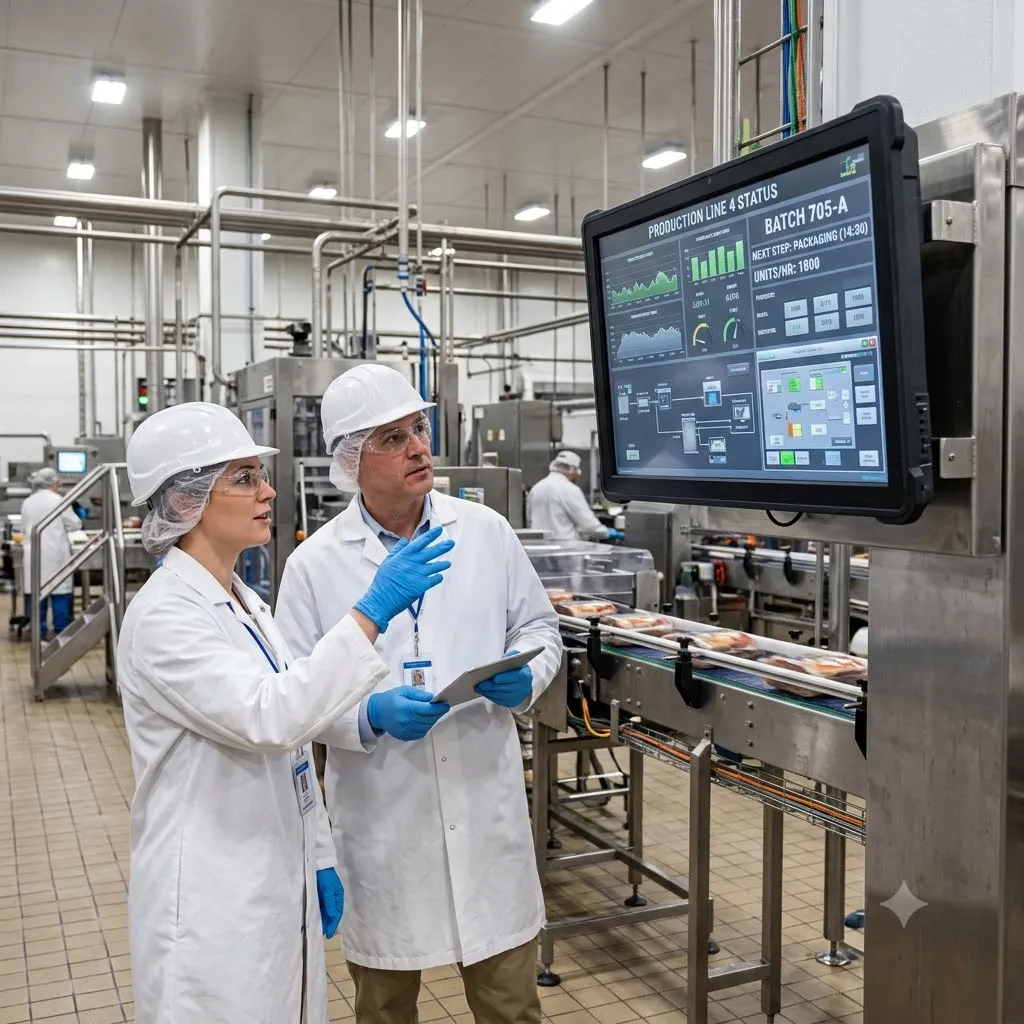
The Smart Connected Worker Platform
The manufacturing industry stands at a critical juncture where traditional approaches meet cutting-edge technology. Weever, the Smart Connected Worker Platform, bridges this gap by providing workers with intelligent, real-time solutions that enhance decision-making, improve safety protocols, and optimize operational efficiency across all manufacturing processes.
In today's rapidly evolving manufacturing landscape, the integration of smart technology with human expertise has become essential for achieving operational excellence. The Smart Connected Worker Platform represents a paradigm shift in how we approach manufacturing operations, safety, and efficiency.
Key Benefits of Connected Worker Technology like Weever
Enhanced Safety Protocols
Real-time monitoring and predictive analytics help prevent accidents before they occur, ensuring worker safety through intelligent alert systems and safety compliance tracking.
Operational Efficiency
Streamlined workflows and automated processes reduce downtime, minimize errors, and accelerate production cycles through intelligent task management and resource optimization.
The Four Pillars of Our Platform
- Real-Time Data Integration
Seamlessly connects workers with live production data, equipment status, and performance metrics, enabling informed decision-making at every level of operation. - Intelligent Workflow Management
Automated task assignments, priority management, and resource allocation ensure optimal workflow efficiency while maintaining quality standards. - Predictive Maintenance Solutions
Advanced analytics predict equipment failures before they occur, reducing unplanned downtime and extending asset lifespan through proactive maintenance scheduling. - Comprehensive Safety Monitoring
Continuous safety monitoring with instant alerts, compliance tracking, and emergency response protocols ensure a secure working environment for all personnel.
Measurable Impact on Manufacturing Excellence
35%
Reduction in Safety Incidents
28%
Increase in Operational Efficiency
42%
Reduction in Unplanned Downtime
Implementation Strategy
Successful implementation of the Smart Connected Worker Platform requires a strategic approach that considers both technological integration and human factor optimization. Our proven methodology ensures smooth transition while maximizing return on investment.The platform's modular architecture allows for phased implementation, enabling manufacturers to adapt the system to their specific operational needs while maintaining continuity in production processes. This flexibility ensures that companies can scale their digital transformation efforts according to their capacity and strategic priorities.
Future of Connected Manufacturing
As we look toward the future of manufacturing, the integration of artificial intelligence, machine learning, and IoT technologies will continue to reshape how we approach operational excellence. The Smart Connected Worker Platform serves as a foundation for this evolution, providing the infrastructure necessary to adapt to emerging technologies and changing market demands.
Ready to Transform Your Operations?
Discover how the Smart Connected Worker Platform can revolutionize your manufacturing operations. Our team of experts is ready to help you implement intelligent solutions that drive safety, efficiency, and operational excellence. Schedule A Demo Download Whitepaper

The Pursuit of Perfection: Why the 4 Principles of Operational Excellence in Manufacturing Matter
The Pursuit of Perfection: Why the 4 Principles of Operational Excellence in Manufacturing Matter
July 31, 2025
In today's challenging manufacturing environment, staying competitive isn't optional, it's existential. Manufacturers are under constant pressure to improve efficiency, reduce costs, and innovate without compromising quality. And that's where operational excellence (OpEx) comes in. It's not just a buzzword; it's the strategic backbone of sustainable success.
Operational excellence is the pursuit of perfection. It happens when processes are streamlined, abnormalities are identified and addressed quickly, and improvements are embedded into the culture. But here's the kicker: it's not a one-time fix or a flashy tool. It's a mindset and a method, built on four core principles. Get these right, and your team won't just survive, they'll thrive.
1. Understand Customer Value and Standardize with SOPs
It all starts with value. Before anything else, your team must deeply understand why your customers choose your product. What problem are you solving? What features matter most? This customer-first clarity isn't just marketing fluff. It's the anchor for every operational decision.
Understanding customer value helps employees prioritize. When something goes wrong, the best corrective action is the one that protects what the customer values most.
That's where standard operating procedures (SOPs) come into play. SOPs aren't just training tools; they are the baseline for consistency. When issues arise, a well-documented SOP lets you spot where things went off track. Without it, you're guessing. With it, you're solving problems faster and more accurately.
"You can't manage what you can't measure," management theory guru Peter Drucker famously said. But just as important: you can't improve what you haven't standardized.
2. Build a System That Fixes and Prevents Defects
Despite what you might think, "perfection" isn't about never having defects. It's about recognizing them fast and responding even faster. To achieve this, factories need a system that catches abnormalities, enables immediate corrective action, and logs information for prevention.
Paper-based processes just don't cut it anymore. If you are using paper and spreadsheets to manage your business, you will have a lag in your workflows and in reporting. Paper forms move like molasses around your factory. They are fertile ground for errors and omissions. Too often, they go missing or hang out on someone's desk for days. By digitizing workflows, teams gain:
- Real-time visibility: Supervisors know what's happening the moment it happens.
- Simplicity & structure: Workflows are guided and repeatable.
- Automation: Routine tasks are handled automatically.
- Compliance: Tasks are tracked and aligned with regulatory standards.
Take the example of Royal Canin's Lebanon, TN facility. Facility management was facing challenges with its abnormality handling because a legacy system consisting of a connected global worker platform and paper-based processes left over 300 issues unresolved. The adoption of Weever's platform allowed Royal Canin to reimagine its abnormality reporting process. Within 90 days, this resulted in:
- Over 100 abnormalities logged by more than 60 active users, representing a massive increase in participation.
- 100% of issues being evaluated and assigned because maintenance teams could efficiently evaluate and assign tasks through the platform.
- Instant clarity on overdue items and action ownership thanks to automated reporting.
3. Create a Culture of Continuous Improvement
"Data is what you need to do analytics. Information is what you need to do business," said John Owen, IBM Analytics.
Operational excellence doesn't stick unless it lives in the culture. And culture starts with your people and their knowledge of their work and your business.
You're asking your team to report issues, provide feedback, suggest improvements, and follow structured workflows. That requires employee engagement to be successful. Engagement doesn't happen by accident.
To build that culture:
- Enable your team: Make the tools easy and intuitive.
- Empower your team: Give them ownership of processes.
- Energize your team: Celebrate wins and reward participation.
When employees see how their input leads to action, they become champions of change.
4. Measure Everything That Matters
Finally, the fuel for continuous improvement: measurement.
"Measurement is the first step that leads to control and eventually to improvement. If you can't measure something, you can't understand it. If you can't understand it, you can't control it. If you can't control it, you can't improve it," said H. James Harrington, past chairman and past president of the prestigious International Academy for Quality and of the American Society for Quality Control.
In other words, good data shows where you stand. Great data shows where you can go. Reporting transforms actions into insights, helping both executives and operators make smarter decisions.
Want to know if your initiatives are working? Measure them. Want to highlight a team's impact? Show the results. Want to motivate more participation? Let your staff see how their efforts made a difference.
Remember, measurement turns data into direction. Weever makes it easy for frontline staff to report anomalies, deviations, suggestions, observations, incidents, and more. Submissions are evaluated and turned into prevention/improvement projects if applicable, and each project is tracked against organizational goals, KPIs and ROI, so you can make more informed strategic business decisions.
Operational excellence isn't a program, it's a philosophy. It's the relentless pursuit of better, smarter, faster ways to serve your customers. And when it's done right, the payoff is more than just efficiency: it's resilience, adaptability, and a workforce that's empowered to make excellence their daily habit.
In a world where disruption is the norm and competition is fierce, one thing is clear: you can't afford not to measure. And you definitely can't afford not to improve.
Frontline Employee Engagement Ultimate Guide

Take a Guided Tour.
.jpeg)
Clean, Compliant, and Confident: Master Sanitation Made Easy with Weever
Unlocking Efficiency in Your Workplace: 8 Tips to Ensure Successful 5S Audits
July 2025
In today's fast-paced manufacturing and industrial environments, clarity and consistency are key to maximizing productivity and reducing waste. That's where 5S, a simple but powerful workplace organization methodology that has helped companies worldwide dramatically improve safety, efficiency, and team morale, comes in.
5S helps teams create clean, efficient, and safe work environments by focusing on five foundational steps:
Sort (Seiri 整理)
Set in Order (Seiton 整頓)
Shine (Seisō 清掃)
Standardize (Seiketsu 清洁)
Sustain (Shitsuke 蹾).
Originating from Japanese manufacturing practices, 5S aims to reduce waste, improve productivity, and enhance consistency by removing unnecessary items, organizing tools and materials, cleaning regularly, setting clear standards, and building daily habits that keep improvements in place. It's often the first step in Lean transformations and serves as a foundation for continuous improvement.
These principles form the foundation of a system that organizes the workplace, eliminates unnecessary items, and standardizes processes to keep things running smoothly.
As Hiroyuki Hirano, the father of the 5S methodology and author of 5 Pillars of the Visual Workplace, famously said: "5S is the foundation of all improvements."
Many large organizations have embedded 5S into their daily routines, logging improvements in quality control, reduced downtime, and even higher employee satisfaction.
But 5S isn't a one-and-done event. Sustaining improvements requires regular auditing to ensure standards are maintained and to spot areas for improvement. Here's how to do it right:
8 Tips to Ensure Successful 5S Audits
TIP 1. Schedule Audits Consistently
The best systems are only as strong as their follow-through. Once a workstation is optimized using 5S, regular audits help ensure it stays that way. A good rule of thumb is to conduct audits at least once per month. These aren't punitive check-ins, they're proactive opportunities to catch slippage early and support continuous improvement.
TIP 2. Choose the Right Auditors
Who conducts your audits matters. While supervisors typically lead the process, some organizations have found success with peer-to-peer evaluations, with oversight from a manager. This approach encourages ownership, strengthens team accountability, and provides a more dynamic view of workplace standards.
TIP 3. Use Structured 5S Audit Forms
A reliable 5S audit form, often referred to as a 5S Scorecard, is essential. These forms usually assess each "S" on a 3-point scale:
1 = Not completed
2 = Partially completed
3 = Fully completed
In addition to scoring, good forms offer space for comments and recommendations. Starting with paper is fine, but many teams quickly outgrow manual methods due to their limitations in consistency, data tracking, and visibility and will turn to digital tools.
TIP 4. Embrace Digital Tools for Better Feedback
Digital 5S forms open the door to smarter audits. Features like photo capture, conditional logic, and mobile accessibility let teams document conditions more clearly and streamline the feedback loop. For example, if an area fails the "Shine" category, the form can prompt users to upload a photo and note the issue, thereby improving both accuracy and actionability.
TIP 5. Always Compare to the Optimal State
Audits should assess not just the current condition, but how closely it aligns with the ideal setup determined at the start of the 5S implementation. Having a reference photo of the optimal state embedded in your audit form can reduce ambiguity and help maintain a clear visual standard and support quality and standardization.
TIP 6. Use the 30-Second Rule as a KPI
Can your operators find the tool they need in under 30 seconds? If not, something's off. This simple metric, called the 30-Second Rule, is a quick way to assess workspace efficiency and identify where reorganization might be needed. It's a practical KPI to gauge real-world functionality across stations.
TIP 7. Analyze Audit Results with Targeted Reporting
A robust 5S audit system doesn't stop at scoring. It analyzes trends. Radar charts and dashboards can highlight patterns across departments, shifts, or individuals. This makes it easier for continuous improvement managers to target retraining, adjust standard operating procedures (SOPs), and boost underperforming areas. Reporting should break down results by workstation, team member, and each of the five S's.
TOP 8. Involve Operators in the Audit Process
One of the most effective ways to embed 5S into your culture is to involve the people who work on the frontlines every day. When operators participate in audits, either by self-assessing or auditing peer workstations, they gain a stronger sense of ownership over the process and outcomes. This approach also uncovers practical insights that top-down audits might miss. To ensure consistency, pair this with simple training and clear scoring guidelines. Empowered operators become champions of 5S, helping shift it from a compliance task to a shared team value.
Using 5S to Transform the Approach to Work
5S is much more than a tidy-up job. It's a philosophy of workplace excellence that, when supported with smart audits and continuous feedback, can transform how your organization operates. By implementing these 8 audit tips and investing in a structured (ideally digital) approach, your team can keep momentum high and chaos low.
Paul Akers is an entrepreneur who founded a multimillion-dollar company in his garage. Years later, he's an internationally renowned lean thinker, educator, and practitioner as well as the author of the influential book, 2-Second Lean. In his book, Akers connects 5S with daily habit-building and celebrates the long-term behavioral change it instills across teams.
"The magic of 5S is in doing it every day. It becomes the muscle memory of improvement," says Akers.
If you're looking to kickstart or level up your 5S efforts, start with your audit process and the 8 tips offered here. Because sustained success isn't just about doing things right once; it's about doing them right every day.
Contact Weever for a demo and discover how our software can help you with your 5S Program.
Request more information Preview modal-
Request more information
Please tell us a bit about yourself so we can tailor our response and get you the information you need.
Continue Reading
Boost Your Manufacturing safety with Proactive Measures
How Proactive Measures Can Lead to Cost Savings in Manufacturing
How to be more proactive about safety
How to implement a proactive safety program into your facility
Proactive Measures for Ensuring Compliance in Regulated Industries
Proactive Measures in Manufacturing: Leveraging Weever Software for a Safer Workplace
The Importance of Proactive Measures in Manufacturing Operations
The Power of Proactive Measures in Preventing Equipment Failure
"Having cloud-based forms on devices around the facility makes them so much more accessible, which makes it painless for operators to quickly provide a report."
Johanna Velez, VP Quality Assurance
"Weever is really user friendly and will have a massive positive impact on our operations and training team."
Mel Cadle - Op Ex Lead Process Engineer

Unlocking Efficiency in Your Workplace: 8 Tips to Ensure Successful 5S Audits
In today's fast-paced manufacturing and industrial environments, clarity and consistency are key to maximizing productivity and reducing waste. That's where 5S, a simple but powerful workplace organization methodology that has helped companies worldwide dramatically improve safety, efficiency, and team morale, comes in.
5S helps teams create clean, efficient, and safe work environments by focusing on five foundational steps:
- Sort (Seiri 整理)
- Set in Order (Seiton 整頓)
- Shine (Seisō 清掃)
- Standardize (Seiketsu 清潔)
- Sustain (Shitsuke 躾)
Originating from Japanese manufacturing practices, 5S aims to reduce waste, improve productivity, and enhance consistency by removing unnecessary items, organizing tools and materials, cleaning regularly, setting clear standards, and building daily habits that keep improvements in place. It's often the first step in Lean transformations and serves as a foundation for continuous improvement.
These principles form the foundation of a system that organizes the workplace, eliminates unnecessary items, and standardizes processes to keep things running smoothly.
As Hiroyuki Hirano, the father of the 5S methodology and author of 5 Pillars of the Visual Workplace, famously said: "5S is the foundation of all improvements." Companies like Toyota, Boeing, and Herman Miller have embedded 5S into their daily routines, logging improvements in quality control, reduced downtime, and even higher employee satisfaction.
But 5S isn't a one-and-done event. Sustaining improvements requires regular auditing to ensure standards are maintained and to spot areas for improvement. Here's how to do it right:
8 Tips to Ensure Successful 5S Audits
1. Schedule Audits Consistently
The best systems are only as strong as their follow-through. Once a workstation is optimized using 5S, regular audits help ensure it stays that way. A good rule of thumb is to conduct audits at least once per month. These aren't punitive check-ins, they're proactive opportunities to catch slippage early and support continuous improvement.
2. Choose the Right Auditors
Who conducts your audits matters. While supervisors typically lead the process, some organizations have found success with peer-to-peer evaluations, with oversight from a manager. This approach encourages ownership, strengthens team accountability, and provides a more dynamic view of workplace standards.
3. Use Structured 5S Audit Forms
A reliable 5S audit form, often referred to as a 5S Scorecard, is essential. These forms usually assess each "S" on a 3-point scale:
- Not completed
- Partially completed
- Fully completed
In addition to scoring, good forms offer space for comments and recommendations. Starting with paper is fine, but many teams quickly outgrow manual methods due to their limitations in consistency, data tracking, and visibility and will turn to digital tools.
4. Embrace Digital Tools for Better Feedback
Digital 5S forms open the door to smarter audits. Features like photo capture, conditional logic, and mobile accessibility let teams document conditions more clearly and streamline the feedback loop. For example, if an area fails the "Shine" category, the form can prompt users to upload a photo and note the issue, thereby improving both accuracy and actionability.
5. Always Compare to the Optimal State
Audits should assess not just the current condition, but how closely it aligns with the ideal setup determined at the start of the 5S implementation. Having a reference photo of the optimal state embedded in your audit form can reduce ambiguity and help maintain a clear visual standard and support quality and standardization.
6. Use the 30-Second Rule as a KPI
Can your operators find the tool they need in under 30 seconds? If not, something's off. This simple metric, called the 30-Second Rule, is a quick way to assess workspace efficiency and identify where reorganization might be needed. It's a practical KPI to gauge real-world functionality across stations.
7. Analyze Audit Results with Targeted Reporting
A robust 5S audit system doesn't stop at scoring. It analyzes trends. Radar charts and dashboards can highlight patterns across departments, shifts, or individuals. This makes it easier for continuous improvement managers to target retraining, adjust standard operating procedures (SOPs), and boost underperforming areas. Reporting should break down results by workstation, team member, and each of the five S's.
8. Involve Operators in the Audit Process
One of the most effective ways to embed 5S into your culture is to involve the people who work on the frontlines every day. When operators participate in audits, either by self-assessing or auditing peer workstations, they gain a stronger sense of ownership over the process and outcomes. This approach also uncovers practical insights that top-down audits might miss. To ensure consistency, pair this with simple training and clear scoring guidelines. Empowered operators become champions of 5S, helping shift it from a compliance task to a shared team value.
Using 5S to Transform the Approach to Work
5S is much more than a tidy-up job. It's a philosophy of workplace excellence that, when supported with smart audits and continuous feedback, can transform how your organization operates. By implementing these 8 audit tips and investing in a structured (ideally digital) approach, your team can keep momentum high and chaos low.
Paul Akers is an entrepreneur who founded a multimillion-dollar company in his garage. Years later, he's an internationally renowned lean thinker, educator, and practitioner as well as the author of the influential book, 2-Second Lean. In his book, Akers connects 5S with daily habit-building and celebrates the long-term behavioral change it instills across teams.
"The magic of 5S is in doing it every day. It becomes the muscle memory of improvement," says Akers.
If you're looking to kickstart or level up your 5S efforts, start with your audit process and the 8 tips offered here. Because sustained success isn't just about doing things right once; it's about doing them right every day.
Contact Weever for a demo and discover how our software can help you with your 5S Program
.webp)
The Top 10 Best Practices for Autonomous Maintenance
Reliable equipment is essential to meeting production goals, ensuring safety, and maintaining quality. Autonomous Maintenance (AM) empowers machine operators to take ownership of basic maintenance tasks like cleaning, inspecting, and lubricating equipment, so issues are identified before they become major problems. It's a key pillar of Total Productive Maintenance (TPM) and one of the most effective ways to reduce unplanned downtime while improving equipment longevity.
But implementing AM effectively takes more than just good intentions. It requires structure, communication, and the right tools to build operator confidence and sustain momentum. Based on over a decade of experience supporting both global brands and local manufacturers, here are 10 best practices to make your Autonomous Maintenance program thrive.

1. Start with Cleaning for Inspection
"Clean to inspect, inspect to detect." Cleaning is the foundation of AM. It's not just about aesthetics. Removing dirt, oil, and debris reveals hidden issues like leaks, loose bolts, or wear. Establish a daily cleaning routine that gives operators time to closely observe machine conditions. This creates awareness and a sense of ownership from day one.
2. Document Everything to Guard Against Turnover
Manufacturing is facing a growing skills gap. When experienced employees leave, they often take years of hard-earned institutional knowledge with them. Combat this by documenting every AM procedure step-by-step. Clear, visual instructions make it easier for new operators to hit the ground running and ensure consistent results across shifts, regardless of tenure.
3. Train Operators to Own Their Equipment
Empowering operators starts with training. Teach them not just how to run the equipment, but how it works, what can go wrong, and how to spot early warning signs.
Autonomous maintenance is not a one-time event; it's a maturity journey. Plan a phased skill-building roadmap for operators, from basic care to preventive tasks like lubrication, tension adjustments, and minor part replacements. Continued development builds confidence and deepens team engagement.
With the right skills and knowledge, operators become the first line of defense against unplanned downtime and mechanical failure.
4. Deliver Real-Time Instructions
Operators shouldn't have to rely on memory to complete detailed maintenance tasks. Providing real-time instructions such as linked documents, videos, or embedded images, can drastically improve execution.
5. Refine Centerlines Through Smart Experimentation and Document
Establishing centerline settings for equipment is part science, part experience. OEM recommendations are a solid starting point, but many manufacturers take a "Run the Target" approach. When a shift performs well, document the setup. Blending both strategies allows you to fine-tune settings that deliver consistent results.
6. Focus on What Matters Most
Too many inspection points can overwhelm your team and reduce compliance. Identify the inspection points that have the biggest impact on performance, whether it's five points or 20. Apply the lean thinking problem-solving four-step process of eliminate, combine, reduce, and simplify (ECRS) to your CIL (Clean, Inspect, Lubricate) process to keep inspections efficient and effective.
7. Share Insights Through One Point Lessons
Learning never stops with AM. When operators or technicians uncover a useful tip or common failure mode, capture it in a One Point Lesson (OPL). These short, visual lessons promote knowledge sharing across teams and reinforce a culture of continuous improvement. It also helps with your efforts to standardize work so that your hard-won institutional knowledge doesn't walk out the door when employees retire or leave.
8. Adopt SOPs and Use Visual Controls to Guide and Alert
Out of sight often means out of mind. Help operators spot issues instantly by using red/green indicators on gauges and color-coded tags for CIL checklists. Visual cues on equipment can show exactly where to inspect, making daily maintenance faster and more foolproof.
Standard operating procedures (SOPs) ensure consistency. Document daily, weekly, and monthly AM tasks in clear, visual formats. Think checklists with photos or color-coded tags.
Labels, gauges, arrows, and color-coding help operators instantly understand what "normal" looks like. Visual controls reduce guesswork, improve safety, and speed up troubleshooting. When done well, they make complex systems easy to monitor and help operators spot issues instantly.
Standardizing work helps maintain quality over time, even with staff turnover or shift changes.
9. Standardize and Enhance Audits
A structured audit process reinforces expectations. Use 5S (Sort, Set in Order, Shine, Standardize, and Sustain) audit forms with scoring and checklists to ensure consistency and visibility. Digital audit tools can capture richer data like photos and timestamps and automatically score results, giving you clearer insight into team performance over time.
10. Strengthen Communication Between Operators and Maintenance
Autonomous Maintenance works best when there's trust and collaboration between operators and technicians. Ensure there's a simple, trackable way for operators to flag issues, whether by using visual tags or digital systems. If problems go unresolved, participation drops. Use software to log, monitor, and resolve reported issues promptly to keep morale and accountability high.
Building an effective Autonomous Maintenance program is a team effort that pays dividends in uptime, safety, and operator engagement. With the right practices and tools in place, your operators become more than machine users. They become key contributors to operational excellence.
Spend Less Time on Admin. Get More Insights by Email.
Subscribe to receive practical tips, updates, and ideas to improve operations without the extra admin work.